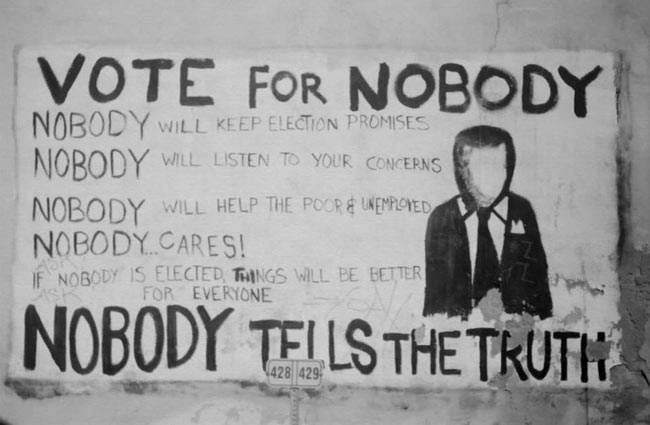
Every election we are told the same story. Democracy is under threat. The stakes have never been higher. This election is the most important of our lifetime. We are urged to enrol, urged to participate, urged to have our say. Politicians, journalists, lobby groups and activists all repeat the message until it becomes background noise. Yet despite this relentless campaign, huge numbers of people continue to stay away from the ballot box.
According to figures drawn from the 2023 General Election, around 1.19 million eligible New Zealanders did not vote. Roughly 829,000 enrolled voters stayed home, while hundreds of thousands of eligible people were not enrolled at all. Together they amounted to one of the largest political groupings in the country. If non-voters were a political party, they would dwarf every party currently represented in Parliament.
Predictably, politicians interpret this as a problem to be solved. They see a vast reservoir of untapped support waiting to be mobilised. Every party imagines that if only the disengaged could be persuaded to participate, they would vote the “right” way. The left imagines that non-voters are frustrated workers waiting to be radicalised into electoral politics. The right imagines that they are ordinary people alienated by political correctness and bureaucracy. Both sides believe the solution is greater participation in the existing system.
What if they are wrong? What if the refusal to vote is not a failure of democracy but a judgement upon it? The political class treats abstention as evidence of apathy. This explanation is convenient because it absolves politicians of responsibility. If people do not vote because they are lazy, ignorant or indifferent, then there is nothing fundamentally wrong with the institutions themselves. The fault lies with the public. Yet the evidence points in another direction. Many people who do not vote are far from disengaged. They complain about housing, wages, healthcare, rents, policing, war, environmental destruction and inequality. They have strong opinions. They simply do not believe that casting a ballot every three years will meaningfully alter any of these conditions. It is difficult to argue with their conclusion.
Election campaigns create the illusion of choice while narrowing the range of possible outcomes. Voters are invited to choose which group of professional politicians will administer capitalism. They are not invited to decide whether capitalism itself should continue. They may choose between competing managers of the state, but they cannot vote away the state’s monopoly on power. They may vote for different tax rates, different spending priorities or different personalities, but they cannot vote to abolish wage labour, landlords, prisons, borders or the structures that generate exploitation in the first place. The ballot paper offers options. It does not offer freedom.
This becomes clearer when we look at the history of political promises. Governments campaign as agents of change and govern as custodians of the existing order. Labour promised transformation and delivered record house prices. National promised prosperity and delivered austerity. Coalition governments are assembled, broken apart and reassembled while the fundamentals remain untouched. Wealth continues to accumulate at the top. Rent continues to rise. Work consumes more of our lives. The machinery of government continues regardless of who occupies the ministerial offices.
Many people recognise this. They may not describe it in anarchist terms, but they understand it instinctively. They have watched governments come and go while their own circumstances remain largely unchanged. They have learned that election rhetoric bears little relationship to political reality. When they refuse to vote, they are often expressing not indifference but disbelief.
The defenders of electoral politics respond that non-participation only strengthens the powerful. If you do not vote, they say, someone else will decide for you. This argument assumes that voting constitutes genuine power. It confuses the ability to choose rulers with the ability to rule ourselves. Anarchists reject this confusion. The question has never been who governs. The question is why anyone should govern at all.
Representative democracy rests on a strange proposition. Millions of people are told that they possess political power, yet that power can only be exercised by transferring it to somebody else. Every few years citizens are invited to surrender their authority to professional politicians, who then act in their name until the next election. This arrangement is presented as self-government. In reality it is government by others. The act of voting does not challenge hierarchy. It legitimises it.
This is why abstention has a long history within revolutionary movements. From the anarchists of nineteenth-century Europe to contemporary anti-authoritarian movements around the world, many radicals have viewed elections not as vehicles of liberation but as mechanisms of incorporation. Voting channels discontent into institutions designed to contain it. Instead of organising workplaces, building communities of resistance or creating alternatives to state authority, people are encouraged to place their hopes in politicians. The result is passivity. Political action becomes something performed on our behalf rather than something we undertake ourselves.
None of this means that all non-voters are conscious anarchists. Far from it. The million-plus New Zealanders who did not vote in 2023 hold a wide variety of beliefs. Some will be socialists. Some will be conservatives. Some will be politically confused. Some will be simply busy. Yet taken together they reveal an important truth. A growing section of society has withdrawn its consent from the electoral spectacle. That withdrawal deserves closer examination.
Political commentators frequently describe low turnout as a crisis of democracy. From an anarchist perspective, it may be a crisis of legitimacy. The state requires more than police, courts and prisons. It requires belief. People must accept that the system represents them. They must believe that participation grants them influence. They must trust that governments derive authority from popular consent. When increasing numbers refuse to participate, that story becomes harder to sustain.
A parliament elected by a shrinking proportion of the population remains legally valid, but its moral authority begins to look questionable. The problem for the political class is not merely that people are staying home. The problem is that people are losing faith in the institutions themselves. This is why governments and political organisations devote enormous resources to increasing voter participation. They need people to believe. They need citizens to see elections as meaningful acts of empowerment. The moment large numbers begin to question that assumption, the ideological foundations of representative government start to crack.
The answer, however, is not cynicism. There is a difference between passive disengagement and active abstention. Passive disengagement says, “Nothing can be done.” Active abstention says, “Something can be done, but not through this.” Anarchists advocate the second position. Refusing to vote is not enough. Staying home on election day while leaving existing power structures untouched achieves little. Abstention only becomes politically significant when connected to collective action outside parliamentary channels. The real question is not whether we vote. The real question is how we organise.
History provides plenty of answers. Workers have won gains through strikes rather than elections. Communities have defended themselves through mutual aid rather than legislation. Social movements have forced change through direct action rather than lobbying. Every meaningful improvement in ordinary people’s lives has depended on pressure from below. Politicians may eventually sign documents and pass laws, but they generally do so after being compelled by organised movements.
Power concedes nothing voluntarily. The obsession with elections obscures this reality. Every three years political energy is funnelled into campaigns, candidates and polling. People are encouraged to view politics as a spectator sport. They become audiences rather than participants. The election cycle consumes attention that could otherwise be devoted to building enduring forms of collective power.
Imagine if even a fraction of the energy spent on electoral campaigning were redirected elsewhere. Imagine neighbourhood assemblies capable of solving local problems without waiting for councils. Imagine tenant unions capable of confronting landlords directly. Imagine workplaces organised enough to challenge employers through collective action. Imagine networks of mutual aid that reduce dependence on state bureaucracy. These are not fantasies. They exist already, albeit on a limited scale. The challenge is expanding them.
This points toward a different understanding of democracy. Not democracy as periodic voting. Not democracy as parliamentary representation. Democracy as direct participation in the decisions that affect our lives. Democracy as collective self-management. Democracy without politicians. The tragedy of modern electoral politics is that it has narrowed our political imagination. We are encouraged to believe that democracy begins and ends at the ballot box. The result is a population that feels powerless because it has been taught to locate power in institutions beyond its control.
The million-plus New Zealanders who did not vote in 2023 should not be viewed as a problem requiring correction. They are evidence that many people already sense something is wrong. The task is not to shepherd them back into the voting booth. The task is to transform scepticism into organisation.
Abstention is often portrayed as silence. In reality it can be a statement. It can express the belief that liberation will not arrive through Parliament, that politicians cannot solve problems rooted in the structures they administer, and that genuine social change requires ordinary people to act for themselves. The largest political force in New Zealand may not be National, Labour, ACT, the Greens or New Zealand First. It may be the millions who no longer believe that any of them speak on their behalf. The political establishment sees this as a reservoir of votes waiting to be captured. Anarchists should see it as something else – a sign that faith in representative politics is weakening.
The question is what comes next. If non-voting remains an individual act of withdrawal, it will change little. If it becomes part of a broader project of self-organisation, mutual aid, workplace struggle and direct action, it points beyond the limits of parliamentary politics altogether. The goal is not a better set of rulers. The goal is a society in which rulers are unnecessary. For those who seek such a society, the choice is clear. Do not vote. Do not place your hopes in parties, candidates or parliamentary majorities. Organise where you live. Organise where you work. Build relationships of solidarity. Create forms of power that do not depend upon the state.
The future will not be delivered through a ballot box. It will be built by our own hands.