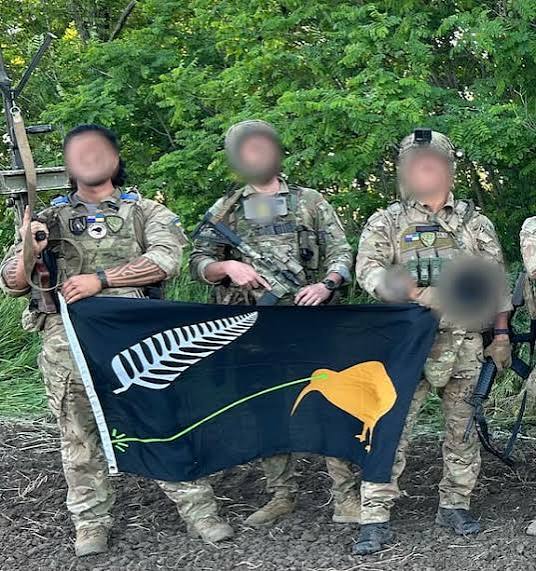
The death of a New Zealand man, Samuel Haines, fighting in Ukraine was reported in the familiar language used whenever ordinary people are consumed by war. He was described through his personal history, his motivations, his family and his decision to travel across the world to take part in a conflict that had nothing to do with the daily lives of most people in Aotearoa. What was not highlighted was the fact that the tragedy of war is that those who suffer most are usually not the people who create wars. Politicians, generals and corporate interests make decisions from offices far away from the front lines, while working-class people are asked to sacrifice their bodies in the name of nations they did not create and systems they do not control.
The death of a Kiwi volunteer in Ukraine raises questions that go beyond one individual. Why are people from countries on the other side of the world being drawn into a conflict between major powers? Why has a war involving Russia, Ukraine, NATO and competing geopolitical interests been presented to millions of people as a simple battle between good and evil? And what does the presence of far-right nationalist forces within Ukraine’s military tell us about the way states use ideology and violence when they prepare societies for war?
For anarchists, the answers do not begin with choosing which flag deserves our loyalty. The history of the twentieth and twenty-first centuries shows that nationalism has repeatedly been used to convince ordinary people that the interests of their rulers are their own. Workers who have more in common with each other than with their own governments are encouraged to see each other as enemies because states require obedience, sacrifice and the willingness to kill. The war in Ukraine is no exception. It is a conflict shaped by Russian imperial ambitions, Ukrainian nationalism, NATO expansion, Western strategic interests and the wider competition between global powers. The people trapped inside this struggle are paying the price for decisions made by governments that claim to represent them.
Sam Haines ended up fighting and dying as a volunteer militia as part of the Azov battalion that emerged in 2014 during the conflict in eastern Ukraine. Its early period was associated with individuals and organisations connected to far-right nationalist politics. Some of its founders had histories linked to ultranationalist movements, and the organisation used symbols and imagery that attracted criticism because of their associations with European fascist traditions. Scholars, journalists and human rights organisations have documented these connections. When Azov was incorporated into Ukraine’s National Guard, it became an official military unit rather than an independent militia. Some argue that integration changed the organisation and that its fighters have since played a significant role in defending Ukrainian territory. Critics sttae that formal incorporation does not erase its ideological origins or the influence that nationalist movements gained through wartime conditions. Denying or minimising the reality of these movements serves the interests of those who want war narratives to remain simple and unquestionable.
The uncomfortable truth is that states have often relied on extremist movements when those movements are useful. Governments that present themselves as defenders of civilisation have repeatedly made alliances with forces they would condemn under different circumstances. During wartime, groups willing to use violence are often granted influence because military effectiveness becomes more important than political principles. This pattern is not unique to Ukraine. It has appeared throughout history wherever states have faced crises and sought to mobilise society around national struggle. The machinery of war creates conditions where authoritarian ideas can grow because war rewards hierarchy, obedience and the belief that violence can solve political problems.
The debate around NATO’s role in Ukraine is another area where discussion is often reduced to slogans. One side argues that NATO is a defensive alliance whose support for Ukraine is a necessary response to Russian aggression. The other argues that NATO expansion after the collapse of the Soviet Union created a security crisis that helped produce the conditions for war. An anarchist analysis should be sceptical of both state narratives because both begin from the assumption that the interests of governments and military institutions should determine the future of ordinary people.
NATO expansion did not happen in a vacuum. After the end of the Cold War, Western governments continued to extend their political and military influence into Eastern Europe. Countries that had once existed within the Soviet sphere joined a Western military alliance that Russia had long viewed as a strategic threat. From Moscow’s perspective, NATO’s movement closer to its borders represented a challenge to its regional power. From the perspective of countries that had experienced domination by the Soviet Union, joining NATO represented a search for security against future Russian aggression.
Great powers have always justified their actions as defensive. The United States has built military bases around the world while claiming to protect global security. NATO presents itself as a shield against authoritarianism while expanding its influence through military alliances. States rarely describe themselves as aggressors. They present their actions as necessary responses to the actions of others. This is how imperial competition operates. Each power claims it is responding. Each claims it is acting reluctantly. Each claims that its violence is necessary because the other side started it. Meanwhile, ordinary people are sent to die.
The idea that a worker from New Zealand, Britain, Poland, Russia or Ukraine should risk their life because of disputes between governments is one of the central illusions of nationalism. Nationalism asks people to identify with a territory, a flag and a ruling structure rather than with the people who share their workplaces, communities and struggles. A Ukrainian worker and a Russian worker may be told they are enemies, even though both face similar problems created by economic systems that concentrate wealth and power among elites.
The same applies to those who travel overseas to fight. Foreign volunteers often believe they are acting according to their values. Some are motivated by genuine opposition to invasion. Some are driven by adventure, ideology or a desire to find meaning through conflict. Some are drawn towards nationalist movements that promise belonging and purpose. War attracts people who are searching for something because war offers a powerful illusion, that that individual struggles can be transformed into a heroic mission. But the reality of war is rarely heroic. It is exhaustion, trauma, injury and death. It is young people being transformed into weapons by governments that will replace them when they are gone.
The arms industry understands this better than anyone. Every modern war creates opportunities for those who profit from weapons production. Governments spend billions on missiles, tanks, aircraft and military technology while claiming that such spending is necessary for security. The companies that manufacture these weapons do not lose when wars continue. Conflict becomes an economic system in itself, with entire industries dependent on permanent preparation for violence.
This is one reason anarchists have always opposed militarism. The problem is not simply that wars are tragic. The problem is that war is built into a political and economic order where power is concentrated in the hands of states and corporations. A society organised around competition, domination and profit will repeatedly produce conflicts because those conflicts serve the interests of powerful institutions.
The ordinary soldier is placed in an impossible position. They may genuinely believe they are defending their community. They may believe they are standing against injustice. They may have personal reasons for being there that outsiders cannot understand. But individual courage does not change the nature of the systems that send people into battle. A worker carrying a rifle does not become powerful because a government gives them a uniform. They become a tool of someone else’s power.
This is why anarchists reject the idea that the answer to imperialism is simply supporting a different imperial power. Opposing Russian aggression does not require celebrating NATO militarism. Criticising NATO expansion does not require supporting Russian nationalism. Rejecting far-right movements in Ukraine does not require accepting the authoritarian politics of the Russian state. A consistent anti-war position must reject the logic that ordinary people should become soldiers in struggles between competing rulers.
The tragedy of Ukraine is that millions of people have been forced into a conflict where their choices are shaped by forces far larger than themselves. Ukrainian civilians face the consequences of invasion and destruction. Russian civilians face the consequences of their government’s decisions and international isolation. Soldiers on both sides experience the reality of industrialised warfare. Refugees are displaced. Families lose loved ones. Meanwhile, political leaders continue to speak the language of victory.
The lesson anarchists draw from wars like Ukraine is not that people should ignore oppression or accept domination. The opposite is true. People have every right to resist invasion, exploitation and authoritarianism. But resistance does not have to mean replacing one hierarchy with another. The liberation of ordinary people will not come from stronger states, bigger armies or more powerful alliances. It will come from solidarity across borders.
The working class has no interest in endless competition between national elites. A Russian factory worker and a Ukrainian factory worker do not benefit from each other’s deaths. A New Zealand worker travelling thousands of kilometres to fight in someone else’s war is not advancing the interests of ordinary people here or anywhere else. The interests of workers are not found in the success of governments, military alliances or corporations. They are found in the possibility of a world where people no longer have to choose between obedience and destruction.
The death of a Kiwi in Ukraine should not simply be used as another piece of evidence in a debate between rival states. He was a person, not a symbol. His life mattered beyond the politics that surrounded his death. The question we should ask is why a world organised around borders, armies and competing powers continues to create situations where people believe that a meaningful path available to them is to travel across the world and risk dying in another country’s war.
The answer is not more nationalism. It is the opposite. The future belongs not to the flags that divide us, but to the solidarity that connects us.