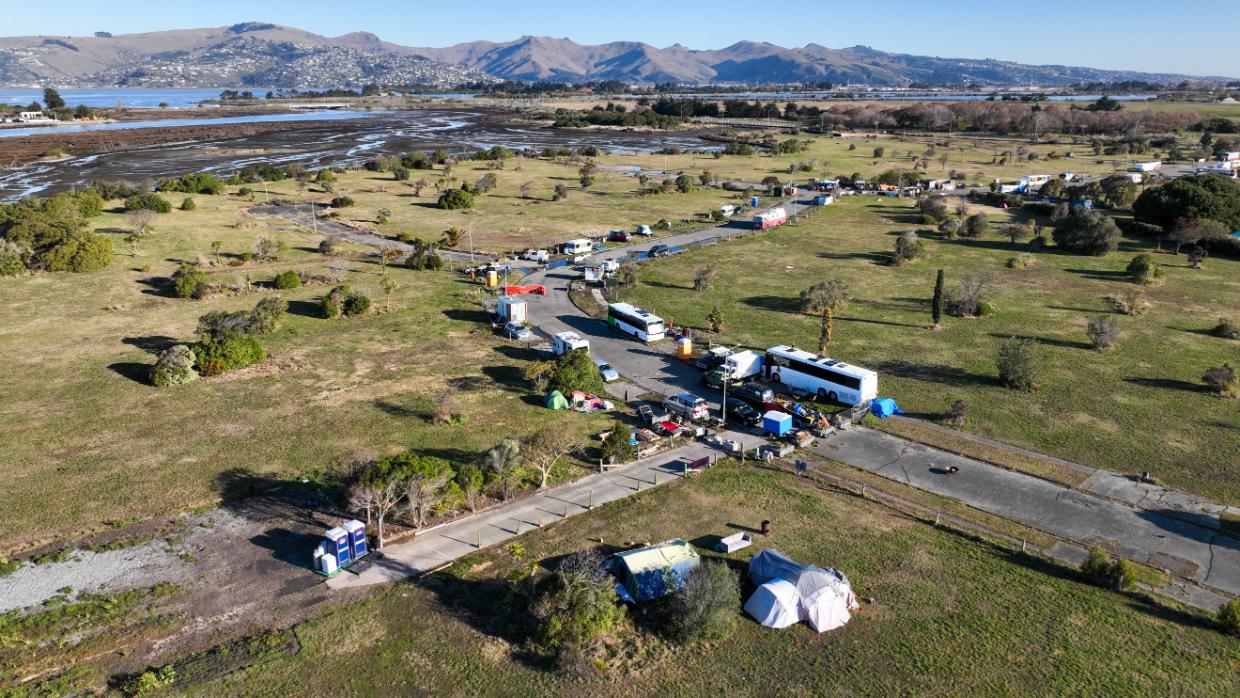
A piece of Christchurch that the property market abandoned after the earthquakes has become home to people abandoned by the property market. The old Bexley neighbourhood was largely cleared after liquefaction made conventional residential development impossible. Houses disappeared, streets remained and the land sat waiting for whatever official purpose would eventually be found for it. Into that gap came people who needed somewhere to live. They arrived in cars, vans, buses and tents. Some were working. Some were retired. Some had children. They did what people have always done when the institutions around them fail, they improvised. A community grew. Earlier this year about 40 people were living around Wetlands Grove; reports now put the number at more than 100. Christchurch City Council has told them they must leave by 28 February 2027 because the area is intended for wetland development. There is an obvious temptation to treat this as a story about homelessness, council planning or the difficulties of finding somewhere suitable for a group of people living in vehicles. It is all of those things, but underneath them sits a much simpler question. What is land for? The answer given by our economic system is that land belongs to whoever has legal title to it, and its legitimate use is determined by owners, planners and institutions. The people actually living on it remain secondary. They may sleep there, look after one another there and make the place usable through their own effort, but none of that gives them any meaningful claim to it. Their relationship to the place exists only for as long as the legal owner tolerates it. That distinction between ownership and use lies close to the heart of the anarchist criticism of private property.
The people living at Wetlands Grove have already demonstrated something that governments spend enormous amounts of money trying unsuccessfully to manufacture through policy documents – people can organise social life themselves. Earlier reporting described an informal community growing around buses, vans and cars, with neighbours helping one another through winter and a communal tent being established as shared space. One man who had been sleeping in a small tent was helped into an old car when the cold became severe. Council rubbish collection and portable toilets made conditions more bearable, but the social organisation of the place came largely from the people living there. Moko, one of the informal figures in the community, was working full-time on an on-call road crew. Others were pensioners. Ngawai Timu described abandoning a $470-a-week rental because she felt she was spending her life paying somebody else’s mortgage. Polly Stewart was surviving on the pension in a bus. Families were living there too, including a woman with several children living from a bus. These details matter because homelessness is constantly spoken about as though it were primarily a pathology of homeless people. Addiction, mental illness, poor budgeting, antisocial behaviour and bad choices are summoned as explanations because those explanations leave the social order intact. They allow us to imagine that housed people possess some quality that homeless people lack. Wetlands Grove makes that story harder to sustain. When people with jobs cannot obtain housing, when pensioners decide rent leaves too little for ordinary life, and when families find themselves competing with dozens of others for a private rental, the problem is no longer plausibly located inside the individual. There are certainly people living rough who struggle with addiction or serious psychological distress. There are also people who get up and go to work from a tent. A housing system that cannot reliably house either has failed at the most elementary level.
New Zealand has become remarkably skilled at describing this failure without challenging the institution producing it. We talk about housing supply, affordability pressures and housing need. We devise eligibility categories and waiting lists. We construct administrative pathways through emergency housing, transitional housing, community housing and social housing. Every stage acquires its own assessments and rules. The language becomes more sophisticated while people remain without homes. At the 2023 Census, Statistics New Zealand estimated that at least 112,496 people were experiencing severe housing deprivation, around 2.3 percent of the usually resident population. The estimate itself is likely conservative because hundreds of thousands of people could not be conclusively classified. As of 30 June 2026 there were still 19,002 applicants on the Housing Register, meaning people already assessed as eligible for social housing and waiting to be matched with somewhere suitable. Behind every administrative term is the same physical requirement humans have had for as long as there have been humans – somewhere safe to sleep. Capitalism has managed to turn that requirement into an investment class. A house can simultaneously be a place necessary for human survival and an asset expected to generate rent, capital gain or both. When those purposes conflict, ownership wins. Ngawai Timu’s remark about paying somebody else’s mortgage is therefore more politically perceptive than most discussion of the housing crisis. Rent appears to be payment for accommodation, but economically it transfers part of a tenant’s income to somebody who controls access to land and housing. The tenant works. The landlord owns. Money moves from the former to the latter because the legal structure of property permits one person to charge another for access to something they need in order to live.
Anarcho-communists have always distinguished personal possession from property used to extract income or control the lives of others. Nobody is proposing that a person should lose the bed they sleep in or the home they actually occupy. The argument concerns the social power created when houses and land can be accumulated and withheld by people who do not use them, then rented back to those who do. Wetlands Grove shows the opposite principle operating almost accidentally. The residents occupy land because they need it. Their claim arises from use. They have created relationships there and made forms of mutual aid possible there. Under capitalist property law none of this ultimately counts for much. Christchurch City Council owns the land and has another use planned for it, so the residents must go. There is an environmental complication here that should not be ducked. The council intends to restore tidal wetlands in an area profoundly altered by earthquake damage, and wetland restoration is worthwhile. The answer cannot be to demand that ecological restoration be sacrificed so people can remain indefinitely on land without proper sanitation or infrastructure. The revealing part is that we are being offered a choice between the wetland and the people living there. A wealthy society ought to be capable of restoring an ecosystem while guaranteeing every person displaced by that work somewhere secure to live. If it cannot do both, the problem is political. The ecological project becomes another deadline imposed upon people who already have almost no control over the circumstances of their lives.
This is where the word “choice” begins doing dubious work. Some Wetlands Grove residents have said they prefer living there. Ngawai Timu spoke about the freedom of the place. Polly Stewart compared the prospect of living in a Kāinga Ora apartment unfavourably with her life in the bus. Those views should be taken seriously. People should be allowed far greater freedom over how they live than either the private housing market or the bureaucratic state usually permits. Cooperative settlements, tiny homes, communal land, papakāinga, vehicle-based living and other arrangements should not automatically be treated as deviant because they fail to resemble a suburban house with a mortgage. Yet freedom requires genuine alternatives. Choosing a bus because conventional rent would consume most of your pension is a peculiar form of freedom. Choosing a tent because every rental viewing has another 30 applicants is not the same as freely deciding to camp. Capitalism routinely transforms constrained decisions into evidence of personal preference. A worker is “free” to accept an employer’s conditions because technically nobody forces them to take that particular job. A tenant is “free” to accept the rent because another landlord might charge the same amount down the road. A homeless person is “free” to reject temporary accommodation that is unsuitable for their life. Formal choice conceals the distribution of power underneath it.
The state cannot easily solve this because the state is one of the institutions maintaining the property relations that produced the problem. Governments can build public housing, and they should. They can regulate landlords, fund Housing First, provide emergency accommodation and prevent evictions. Those measures can keep people alive and they matter enormously to anyone who needs them. An anarchist criticism of the state does not require indifference to whether somebody has a warm house tonight. We should support measures that materially improve people’s lives while refusing to mistake them for the resolution of the underlying conflict. The current Kāinga Ora programme illustrates the contradiction. The Government says around 900 state houses a year may be sold as part of stock renewal while new construction and redevelopment will prevent the total national stock from declining. From an administrative viewpoint this is portfolio management. From the viewpoint of someone sleeping in a vehicle while houses are treated as units in a managed asset base, the language feels rather different. Housing remains something allocated through institutions according to scarcity. The scarcity itself becomes normal.
Wetlands Grove also unsettles another comfortable assumption that order flows downward from authority. The community appeared before the council had a plan for it. People found the place, negotiated relationships with one another and established ways of getting by. That does not mean it is an anarchist commune, nor should people living in poverty be turned into political mascots. There will be arguments there, difficult personalities and all the problems found anywhere humans live together. Anarchism does not depend on romanticising people. What matters is that social organisation emerged without a landlord designing it or an agency assigning everyone a place. The residents discovered one another through a shared material predicament and began constructing a community around it. Their circumstances are harsh, but the impulse underneath what they have made is recognisable. Mutual aid begins with the discovery that another person’s survival is connected with your own.
The bitter part is that once people create something workable in the gaps left by capitalism, authority often arrives to remind them that the gap was never theirs. Squatted buildings are emptied while people sleep outside. Informal settlements are cleared because they breach regulations written for a world in which everyone supposedly has conventional housing. People living in vehicles are moved from one parking area to another. Public space is made hostile to anyone attempting to remain there too long. None of this creates housing. It manages visibility. The homeless person disappears from one street and appears in another, allowing the first location to be recorded as a successful intervention. Wetlands Grove could easily follow the same pattern. On 1 March 2027 the council may possess an empty road ready for ecological work while the people who lived there are scattered across cars, spare rooms, emergency accommodation and some other piece of land where they will eventually be noticed again. If that happens, nothing will have been solved. Geography will have changed.
The anarcho-communist response begins somewhere else. Housing should be organised around use rather than profit. Land should cease to function primarily as a commodity. Housing that people need should not be held from them because somebody else possesses a stronger legal claim backed by money. Communities should have the power and resources to shape the places where they live, with decisions made by those affected rather than handed down through property ownership or distant administration. That does not supply a magic blueprint for Wetlands Grove. It does tell us what a decent outcome would look like. Nobody currently living there should be made homeless by its closure. People who want conventional housing should receive secure, permanent homes before they are required to leave. Those who prefer communal or vehicle-based living should be involved in establishing another legal, serviced site rather than being forced back into a model of housing they have rejected. Families should not have to demonstrate months or years of escalating desperation before they become sufficiently urgent for assistance. A pensioner should be able to rent without sacrificing the income needed to live. A full-time worker should not finish a shift and return to a tent.
Perhaps the most revealing sentence spoken at Wetlands Grove came from a resident who rejected the description of the people there as homeless. “We’re refugees in our own country,” he said. The phrase is uncomfortable, but it captures something important about dispossession. These are people surrounded by houses, roads, supermarkets and all the accumulated wealth of a developed society, yet somehow unable to secure a small portion of it in which to live. Nothing has physically disappeared. New Zealand has timber, builders and land. We have engineers and electricians. We know how to construct houses. What stands between the person and the home is a network of ownership, prices, debt and permissions that we have been taught to regard as natural.
There is nothing natural about it. Property is a social arrangement. Rent is a social arrangement. The rule that one person may own several houses while another sleeps in a car is a social arrangement. These things continue because institutions enforce them and because we have lived with them long enough to mistake familiarity for inevitability. Wetlands Grove briefly exposes the arrangement by turning it upside down. People found unused land and used it. They made homes where there were no houses. They built a community in the remains of one destroyed by an earthquake. Now the official city has returned with plans for the land and the authority to move them on. The question facing Christchurch is therefore larger than what should happen to a hundred people beside an old road in Bexley. It is whether the right to exclude people from land should continue to carry more weight than the human need for somewhere to live. Until we are prepared to answer that question, New Zealand will keep treating homelessness downstream. We will fund programmes, adjust waiting lists and move people from one temporary arrangement to another while leaving the machinery producing housing insecurity largely untouched. Then we will act surprised when another Wetlands Grove appears.
It will appear. It has to. People need somewhere to go.