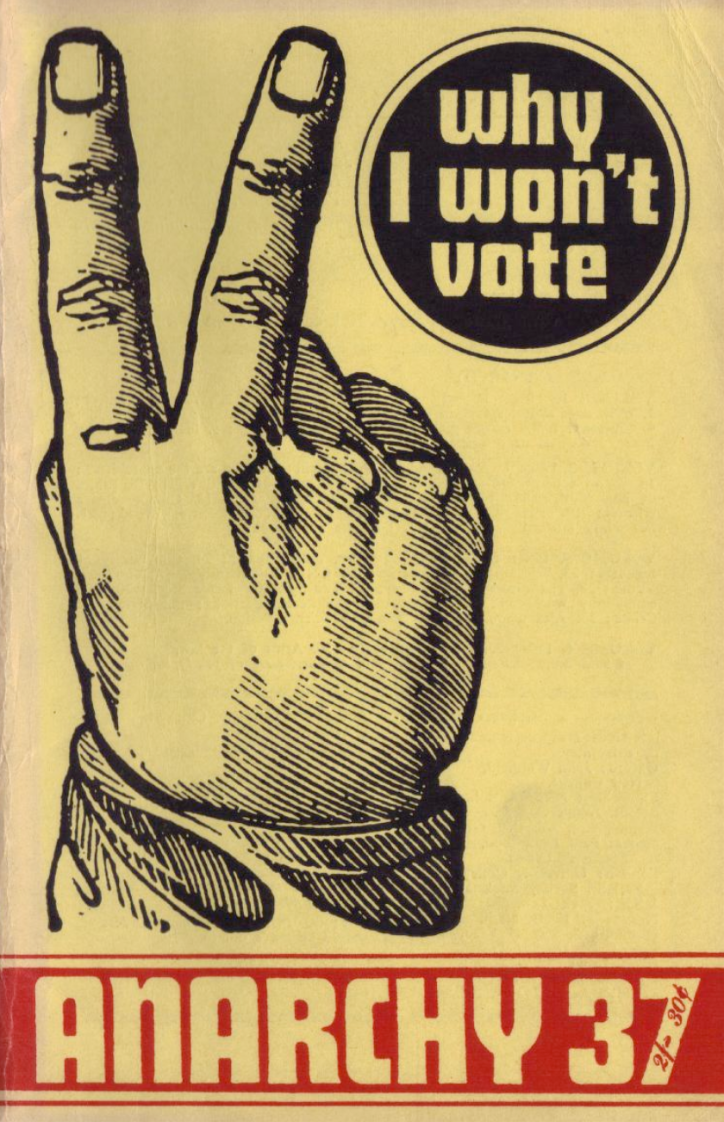
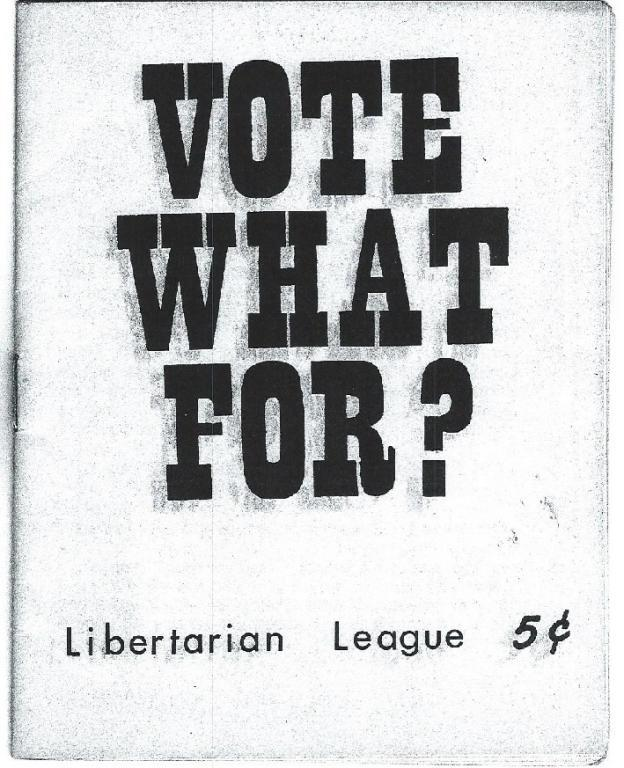
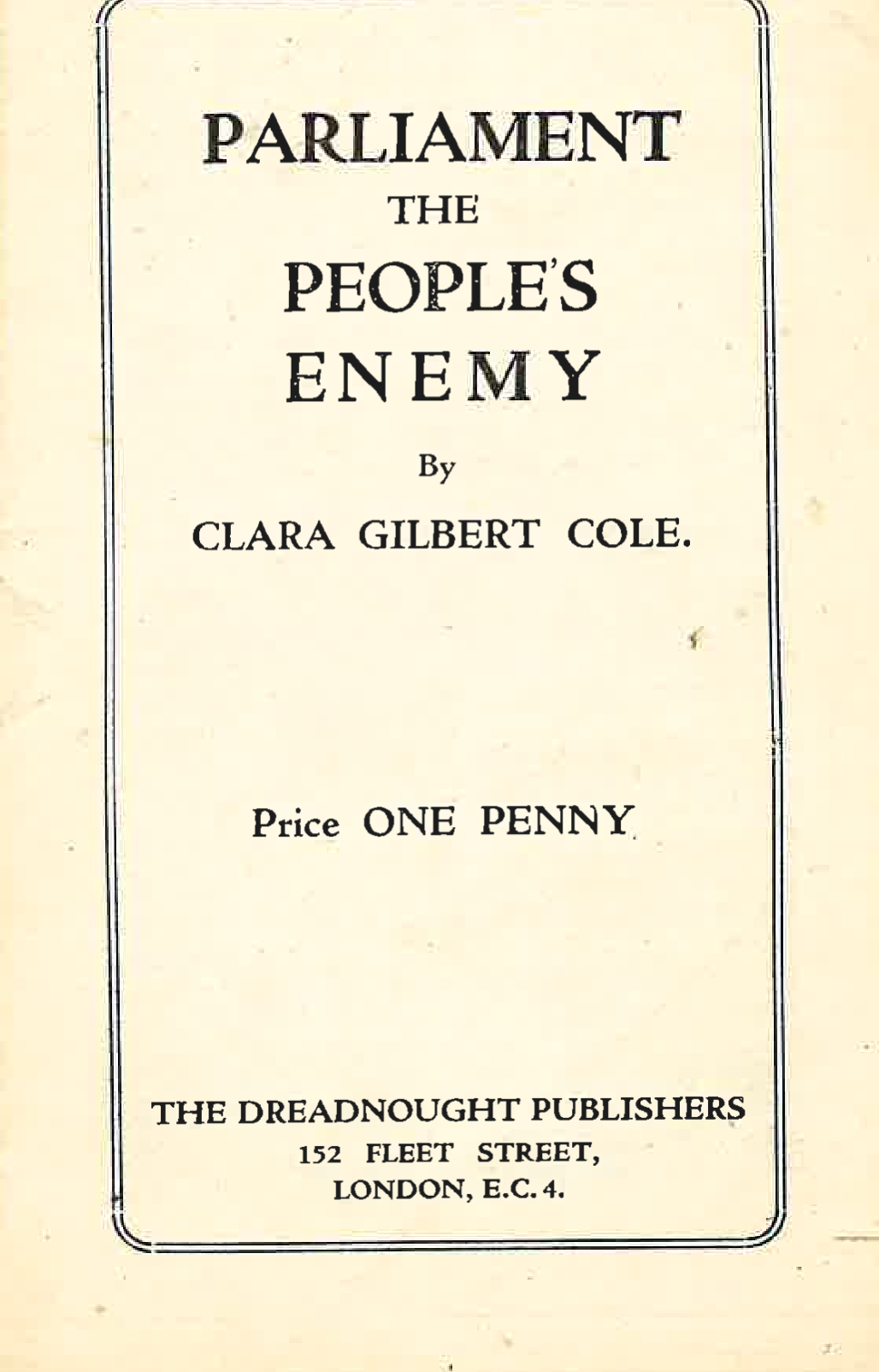
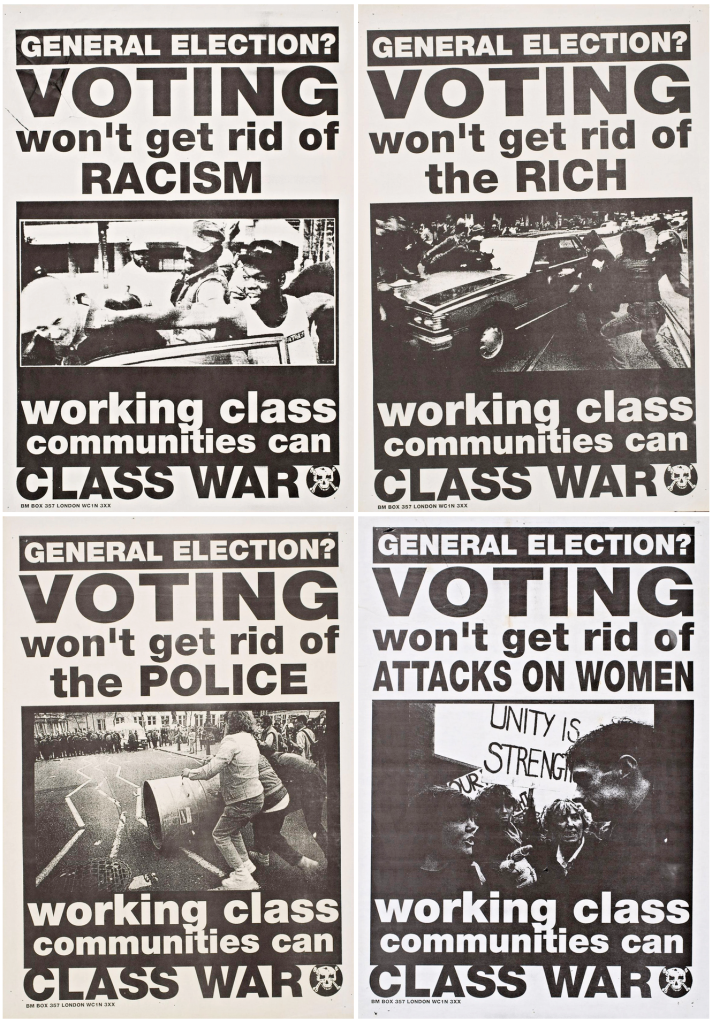
The right to vote is seen by most as a necessary prerequisite for freedom across the world. People have fought and died for the right to vote in elections. Women across the world fought bitter battles for the right to vote. So why should anarchists question this as a right worth having?
The entire electoral show is designed to encourage us to believe that not only does our vote matter, but that it is the most important decision we could possibly make. Indeed, voting is held so sacred by many that the mere mention of not voting is enough to cause outrage. Pointing out that our vote makes no difference anyway, will see you accused of being apathetic, privileged, immature, and even being part of the alt-right!
But as noted anarchist Vernon Richards wrote,
“So long as we have capitalism and government, the job of anarchists is to fight both, and at the same time encourage people to take what steps they can to run their own lives.” [“Anarchists and Voting,” pp. 176–87, The Raven, No. 14, p. 179].
Electoralism ensures that a statist perspective becomes dominant. Everything is seen in terms of state intervention and following the decisions of the leaders, which has always proved deadly to encouraging a spirit of revolt, self-management, and self-help – the very keys to creating change in a society. Rather than being something other people discuss on behalf of working-class people, anarchists argue that politics should not be a specialised activity in the hands of the so-called experts (i.e., politicians) but instead lie in the hands of those directly affected by it in the process of participation, direct action, and self-management. Those that channel any “political” conclusions into electoral politics distort discussions into only what is possible within the current system. Given this, is it surprising that anarchists argue that the people “must organise their powers apart from and against the State?” [Bakunin, The Political Philosophy of Bakunin, p. 376].
Abstentionists get told, “If you don’t vote, you have no right to complain about the outcome,” but we consider the opposite to be true. It is those who have voted, who have agreed to the rules, and agreed to be governed by the winners who cannot complain. It is those who do not participate who have the right to complain about the outcome more than anyone else.
We get told that the reality is that voting does change things, but we can, and do, deny that. Voting attempts to provide the population with the illusion of change while in reality it reinforces the current system. A policy here and there may change, the faces may change, but the system of a wealthy minority ruling a poorer majority remains. People will continually be telling us that abstaining from voting will help the right-wing win the election, that it is better if the lesser evil wins. This may possibly be the case (although the argument is far from convincing), but why should we base our society on a compromise with evil? In fact, the “progressive” left wing party you vote for will often be ready to take the same actions as a right-wing government when it comes to imposing anti-working-class action upon us, (as we shall show later in this essay the state has a corrupting effect on those who enter politics with high principles). There should be a better way, and we say the dismantling of government, in all its existing and potential forms is that way.
Most of the left wing in Aotearoa, and quite a few people who claim to identify as anarchists, will support reformist parties in the upcoming election. You will hear them saying things like “vote Labour (or Green) without illusions,” or “vote Labour/Green but build a socialist alternative.” The slogans that these others may shout only reflect the idea that change can and should be brought about by a small number of elite politicians. Abstentionists do not say things like this. There are many problems with our electoral system of democracy, which we shall run through, but we must state that first and foremost, as anarchists, we see voting as against running contrary to our anti-statist and anti-hierarchy principles, and we see electoralism as contrary to our goals and practice. It reinforces the idea that society is divided into order-givers and order-takers. Famed French anarchist, Elisee Reclus, put it well when he said,
“Everything that can be said about the suffrage may be summed up in a sentence. To vote is to give up your own power. To elect a master or many, for a long or short time, is to resign one’s liberty… Instead of entrusting the defense of your interests to others, see to the matter by yourselves. Instead of trying to choose advisers that will guide you in future actions, do the thing yourselves, and do it now!…. Do not vote!”
We are against is a system that allows for us to tick a box every few years for candidates that are selected for us, and policies that are chosen for us, which gives whoever received the most X’s to make decisions that affect our lives in all ways. Much of our so-called “democracy” is bogus and undemocratic, as many of the hundreds of thousands of kiwis who do not vote understand. Politicians, once elected, have no compunction to keep their promises they made while campaigning, they can, and do, pretty much what they like because we have no power to recall them until the next election comes along, when again we will be given a barrage of promises that don’t have to be kept, and mostly won’t be kept. To call this democracy and representative of our demands is a blatant falsehood.
So, to continue, voting in government elections is an inherently authoritarian activity, and authoritarian means can never yield libertarian results. In the words of Emma Goldman, “participation in elections means the transfer of one’s will and decisions to another, which is contrary to the fundamental principles of anarchism.” [Emma Goldman, Vision on Fire, p. 89]. The very act of voting is an attempt on the part of the voters to delegate control over their own life to another person. While states of various sorts provide some services and benefits to their citizens, the institution of government also maintains and makes use of the police, the courts, the prison, the military, etc, to coercively interfere in the lives of its subjects. For anarchists, it is a basic belief that individuals should not have the authority to coerce others, and therefore they should not put themselves in a position to delegate such authority to anyone else, which, after all, is the essence of voting. Noone, whether in or out of government, should have such power. Anarchists who oppose political power and coercion of any sort cannot advocate voting in national elections and stay true to the principles of anarchism. This is a system that divides us into a massive majority ruled by a tiny minority, and which allows for power, wealth, and privilege to be ever more concentrated into the hands of that minority. The state is not a neutral body which can be used by all classes in society to protect their interests, rather it is an instrument of class rule that exists to protect the wealth and power of the ruling class and enforce their property rights and authority.
What we are offered as democracy is a farce, a dictatorship of capital devoid of any real choice. Even worse is that this form of democracy gives the illusion that we, the people, have the power to change it, while simultaneously reinforcing it. No wonder all politicians agree on one point – that we should vote. They want you to sanction the process by which they acquire their position, because without that sanction they have no legitimacy, and it is that claim to legitimacy they use to dismiss any actions taken by oppressed or marginalised groups outside of parliament as illegitimate. Before going to cast your vote remember that there is a real limit to what governments can do anyway – winning an election is not taking power. The real decision-making takes place in the boardrooms of corporations, not in parliament. Political parties, even in a majority government, can only do what capitalism allows them to. The politicians’ only argument is to organise capitalism in a “kinder way,” but anarchists want to smash capitalism, not waste our time trying to make it kinder.
MPs are little more than the committee for managing the affairs of capitalism. We cannot elect the revolution, or even a radical government, because capitalism will use its economic power, in the form of things such as sanctions and the flight of capital, to punish anyone who wishes to radically reform society, regardless if the majority voted for it or not. Even worse, in some situations the elected government may well see itself undermined by outside influences, even facing invasion and war. Realistically though the nature of the state means that capitalists rarely have to use these tactics.
While many radicals may be tempted to agree with this analysis of the limitations of electioneering and voting, very few will automatically agree with the anarchist arguments of not voting. Instead, they argue that we should combine direct action with electioneering, and they will suggest that the state is too powerful to leave in the hands of right-wingers. Those that say this though ultimately fail to take into account the nature of the state and the corrupting effect it has on politicians. If history is anything to go by, the net effect of radicals using elections is that by the time they are elected to office the radicals will happily do what they once would have condemned the right-wing for doing.
Given that we have had many decades of universal suffrage, not only in Aotearoa but worldwide, and we have seen the rise of Labour and other so-called progressive parties aiming to use that system to effect change, it is sad to say that we are probably further away from socialism than ever. The simple fact is that these parties have spent so much time trying to win elections that they have stopped even thinking about creating socialist alternatives in our communities and workplaces.
The state shapes people. As Noam Chomsky argues, “within the constraints of existing state institutions, policies will be determined by people representing centres of concentrated power in the private economy, people who, in their institutional roles, will not be swayed by moral appeals but by the costs consequent upon the decisions they make — not because they are ‘bad people,’ but because that is what the institutional roles demands.”
It was Bakunin who predicted in 1869 (three years before Marx hoisted his parliamentarianism onto the First International) that when “the workers … send common workers … to Legislative Assemblies … The worker-deputies, transplanted into a bourgeois environment, into an atmosphere of purely bourgeois ideas, will in fact cease to be workers and, becoming Statesmen, they will become bourgeois … For men do not make their situations; on the contrary, men are made by them.” [The Basic Bakunin, p. 108] Similarly, Krotpotkin argued that “in proportion as the socialists become a power in the present bourgeois society and State, their socialism must die out.” [Kropotkin’s Revolutionary Pamphlets, p. 189]. History has undoubtedly proven the anarchists correct.
We cannot repeat this often enough, electioneering results in the party using it to become more moderate and reformist — indeed the party often becomes the victim of its own success. In order to gain votes, the party must appear “moderate,” “responsible” and “sensible” and that means working within the system. This has meant that (to use Rudolf Rocker’s words),
“Participation in the politics of the bourgeois States has not brought the labour movement a hair’s-breadth nearer to Socialism, but thanks to this method, Socialism has almost been completely crushed and condemned to insignificance… Participation in parliamentary politics has affected the Socialist Labour movement like an insidious poison.” [Anarcho-Syndicalism, p. 49]
Every time a so-called or Labour party has come to power, they have acted in a way that makes them almost indistinguishable from their more right-wing opponents. Despite their promises to act for the working class, once in government they always seem to be more concerned with being ‘respectable’ and ‘reasonable,’ and not doing anything that would offend the rich, the real rulers of our society. Nowadays we have ‘progressed’ to the stage where parties do not even pretend to campaign on the basis of representing the working class, limiting themselves to saying they are more “trustworthy,” or are a “safe pair of hands” to control the economy. Socialism is an embarrassment from the past.
The Labour Party in Aotearoa has been one of a history of compromise with capitalism and anti-working class action. Three quotes from Peter Fraser, early once a self-proclaimed revolutionary socialist and Labour prime minister 1940–49 demonstrates this. In 1913 Fraser was writing: “Industrial Unionism plus revolutionary political action, in my opinion, provide the most effective and expeditious means of reaching [socialism].” By 1918, Fraser had moderated his views. Instead of revolution he called for “the peaceful and legal transformation of society from private to public ownership and the increasing of democratic control over land and industry.” By the early 1930s Fraser saw Labour’s main objective as a simple one: jobs for the unemployed.
Janet Biehl sums up the effects on the German Green Party of trying to combine radical electioneering with direct action:
“The German Greens, once a flagship for the green movement worldwide, should now be considered stink normal, as their de facto boss himself declares. Now a repository of careerists, the Greens stand out only for the rapidity with which the old cadre of careerism, party politics, and business-as-usual once again played itself out in their saga of compromise and betrayal of principle. Under the superficial veil of their old values – a very thin veil indeed, now – they can seek positions and make compromises to their heart’s content… They have become ‘practical,’ ‘realistic’ and ‘power orientated.’ This former New Left ages badly, not only in Germany but everywhere else. But then, it happened with the S.P.D. in August 1914, then why not with Die Grunen in 1991? So it did.” [“Party or Movement?,” Greenline, no. 89, p. 14]
Here in Aotearoa the effect has been the same on our own Green Party, whose evolution has seen it tie itself firmly to sensible budgeting and relying on market forces to solve our problems and moved from something of an activist party to one of “professional politicians.”
It is not enough to blame the individuals elected to office for these betrayals, arguing that we need to elect better politicians, or select better leaders. For anarchists nothing could be more wrong as it is the means used, not the individuals involved, which is the problem. Writing of his personal experience as a member of Parliament, Proudhon recounted that,
“[a]s soon as I set foot in the parliamentary Sinai, I ceased to be in touch with the masses; because I was absorbed by my legislative work, I entirely lost sight of the current events … One must have lived in that isolator which is called a National Assembly to realise how the men who are most completely ignorant of the state of the country are almost always those who represent it. “There was “ignorance of daily facts” and “fear of the people” (“the sickness of all those who belong to authority”) for “the people, for those in power, are the enemy.” [Property is Theft!, p. 19]
Ultimately, as syndicalist Emile Pouget argued, this fate was inevitable as any socialist politician “could not break the mould; he is only a cog in the machine of oppression and whether he wishes it or not he must, as minister, participate in the job of crushing the proletariat.” [quoted by Jeremy Jennings, Syndicalism in France, p. 36]
Ultimately, supporters of using political action can only appeal to the good intentions and character of their candidates, and hope for the best. Anarchists, however, in contrast to Marxists and other radicals, continually give an analysis of the structures of government and the other influences that will determine how the character of the successful candidates and political parties will change. Only anarchists continually present an analysis of the effects of electoralism and its effects on radicals. History is our proof, electoralism, as Bakunin put it, “inevitably draws and enmeshes its partisans, under the pretext of political tactics, into ceaseless compromises with governments and political parties; that is, it pushes them toward downright reaction.” [The Basic Bakunin p. 288].
Not only is making use of the ballot box as a tactic harmful to politicians and their parties, but it also has a negative effect on the rest of the population too. Support for electioneering is at odds with us being in favour of collective mass action. It hinders the arguments for collective organisation and action as the voters expect their representative to act and fight for them. Political actions become solely considered to be parliamentary activities, made for the people by their representatives. There is no other role for the people than that of passive support and spectators. So, instead of working-class self-activity and self-determination, there results in a non-working-class leadership acting for the people. The real causes and solutions to the problems we face are not understood and ignored by those at the top of the party and rarely discussed in the open, less they damage their chance of re-election.
There is nothing more isolated and individualistic than voting. It is the act of one person in a booth by themselves. It is the total opposite of collective struggle. The individual is alone before, during and after the act of voting. Indeed, unlike direct action, which, by its very nature, throws up new forms of organisation in order to manage and coordinate the struggle, voting creates no alternative forms of working-class self-management. Nor can it. It simply empowers an individual (the politician) to act on behalf of a collection of other individuals (the voters). Political parties forsake direct action in favour of success in elections (indeed, winning elections will soon enough become the be-all and end-all of their activity). Also, if radicals are elected the whole focal point of struggle changes. Rather than direct struggle against the state and the boss, this is seen as being no longer needed as the elected representatives will act, or people will think they will act, and so do not act themselves. They have elected someone to fight for them and so do not see, or realise, the need to fight themselves.
In a lot of ways, direct action is a more effective means for people to have a say in society than voting is. Voting is a lottery, your preferred candidate may not get elected, and all the time and energy put into supporting them is wasted. With direct action, you can be sure that your work will offer some kind of results, and the experience you gain, the lessons learnt, and networks and connections built up in the process, cannot be taken away from you.
Also voting is only possible when election time comes around, direct action can be applied whenever the need rises. Relying on electoralism means you can only address whatever topics are current in the political agendas of candidates, while direct action can be applied to deal with the issues in every aspect of your life.
In other words, our support for direct action is linked with our rejection of voting, and our call to not vote stresses the importance of direct action, as well as having an important educational effect in highlighting that the state is not neutral, but serves to protect class rule, and that meaningful change only comes from below. So just not voting is not enough, we need to organise and fight. In the words of an anarchist member of the Jura Federation writing in 1875,
“Instead of begging the State for a law compelling employers to make them work only so many hours, the trade associations directly impose this reform on the employers; in this way, instead of a legal text which remains a dead letter, a real economic change is effected by the direct initiative of the workers … if the workers devoted all their activity and energy to the organisation of their trades into societies of resistance, trade federations, local and regional, if, by meetings, lectures, study circles, papers and pamphlets, they kept up a permanent socialist and revolutionary agitation; if by linking practice to theory, they realised directly, without any bourgeois and governmental intervention, all immediately possible reforms, reforms advantageous not to a few workers but to the labouring mass — certainly then the cause of labour would be better served than … legal agitation.” [quoted by Caroline Cahm, Kropotkin and the Rise of Revolutionary Anarchism, p. 226]
So, we urge people to not vote in order to encourage activity, not apathy. Instead of spending our time urging people to vote for one set or another of groups offering slightly different ways to manage capitalism, we raise the option of choosing to rule yourself, to organise with others in your workplace, in your community, everywhere. We offer the option of something you cannot vote for, a new society. Instead of waiting for others to make some changes for you, along with all anarchists we urge people to do it themselves. In this way, we can build an alternative to the state, which can reduce its power now and, in the long run, replace it. This is the core of our anarchist principles and why anarchists say do not vote.
By making the principled choice not to participate in the election, we open an opportunity to question the acceptance of the status quo. We consider it is important to stand up and remind people what is wrong with voting. Maybe by consciously not voting, and explaining to others why we are not voting, we can change people’s beliefs about government. We use this opportunity to say that there are better, more meaningful ways to achieve a fairer, freer, more meaningful life; that we do not need to resort to the state to solve problems.
As anarchists we simply think that our policy should be the destruction of the State rather than looking to work with it. We believe this stance is essential if we are to be able to promote anarchism, and if we are going to mark a divide between others and ourselves and place ourselves firmly outside the activity and the political games of all the other parties. We believe this is essential so as not to be seen as another bunch of leftists after votes, and to avoid being tainted by the inevitable failure of any government to meet our needs. We believe in revolution and have a revolutionary ideology and we want to win people over to anarchism. If people started associating Anarchism with the political parties, then it would be difficult for people to understand what Anarchism actually is.
By arguing for our anti-electoral position, we can get our ideas across about the nature of the current system, how elected politicians are controlled and shaped by the state, and how the state acts to protect capitalism. In addition, it allows us to present our ideas of direct action and encourage those disillusioned with political parties and the current system to become anarchists by presenting a viable alternative to the sham of party politics. For, after all, a sizeable percentage of not just non-voters but voters too are disillusioned with the current set-up. Many who do not vote do so for essentially political reasons, such as being fed up with the political system, failing to see any major differences between the parties, or recognition that the candidates do not represent their interests. Many who do vote do so simply against the other candidate, seeing them as the least-worst option. This is an opportunity when people are talking a little more about politics to challenge the notion that important decisions can only be made by a few and put across our anarchist ideas.
This essay started with a quote from Vernon Richards, and will finish with one,
“If the anarchist movement has a role to play in practical politics it is surely that of suggesting to, and persuading, as many people as possible that their freedom from the Hitlers, Francos and the rest, depends not on the right to vote or securing a majority of votes ‘for the candidate of one’s choice,’ but on evolving new forms of political and social organisation which aim at the direct participation of the people, with the consequent weakening of the power, as well of the social role, of government in the life of the community.” [“Anarchists and Voting,” pp. 176–87, The Raven, no. 14, pp. 177–8]
So… Do not vote and let us start making a real difference.
the anarchist case for abstentionism in elections _ now available as downloadable pdf