Pay to Belong: Why Membership Dues Have No Place in Anarchist Organisation

AWSM has long been a dues paying organisation.  There has been some internal debate about changing this and it was decided to do away with this model. Unfortunately it led to the loss of a member (who was also our treasurer), but this is our thinking behind the stance.

 There is something quietly contradictory about an anarchist organisation that charges admission. Membership dues feel administrative, mundane, almost reasonable. That is precisely why they deserve scrutiny.

This is not an argument against funding political work. Printing costs money. Travel costs money. Maintaining infrastructure costs money. The question is not whether anarchist organisations need resources, they do, but whether a subscription model is a legitimate way to secure them. The argument here is that it is not and that dues-based membership is philosophically incoherent with anarchist principles, and historically at odds with the organisational forms that have actually advanced working-class struggle.

Anarchism, at its core, is a politics of prefiguration. The argument has never simply been that a stateless, classless society would be desirable at some future point, it is that the means of getting there must embody the end. Kropotkin was clear on this. So was Malatesta. The organisational forms we build now are not neutral vessels for transporting us to a better world, but they are themselves expressions of the world we are trying to create. A dues model treats membership as a commodity. You pay a fee and you receive membership status in return. The transaction might be dressed up in the language of contribution and solidarity, but its underlying logic is exchange, and exchange logic is market logic. It draws a boundary between those who have paid and those who have not, and it makes that boundary structurally significant. Whether you intend it or not, you have introduced a price of entry into a space that ought to be defined by shared commitment rather than financial transaction.

This matters because anarchism is not simply anti-state, it is anti-capitalist in a sense that includes the market relations capitalism naturalises. When we replicate those relations inside our organisations, we are not just being inconsistent, we are actively training ourselves and others to understand political participation as something that is purchased. That is a lesson capitalism is already teaching very effectively. Anarchist organisations should not be reinforcing it. There is also a more subtle philosophical problem, dues-based membership tends to produce a bounded conception of the organisation itself. Membership becomes a defined status with defined boundaries, and the organisation comes to understand itself as the aggregate of its paying members. The organisation stops being a tool for struggle and starts being a club, one with good politics, perhaps, but a club nonetheless.

Move from principle to practice and the problems multiply. The most obvious is exclusion. Any fixed monetary threshold will price out people living in poverty, people with unstable or informal income, people in debt, people supporting dependants on a single wage, people who are undocumented and wary of paper trails. In Aotearoa New Zealand, as elsewhere, these are disproportionately Māori and Pasifika communities, recent migrants, people with disabilities, young people, and those caught in the housing crisis that has made even basic financial stability a precarious achievement for a significant portion of the working class. An anarchist organisation that structurally excludes the most marginalised sectors of the class it claims to organise is not just failing at inclusion as a value, it is failing at its own political project. Working-class struggle requires working-class participation, and not just the participation of the relatively secure fraction of the working class that can absorb a monthly subscription without noticing.

The standard response to this problem is the sliding scale or the hardship waiver,  pay what you can, pay nothing if you can’t. This is well-intentioned, but it does not resolve the contradiction – it manages it. It still requires people to identify themselves as unable to pay, to navigate an administrative process, to ask. For many people, particularly those who have experienced bureaucratic humiliation in welfare systems, this is not a neutral act. It is a barrier, even when it is meant to be a door. There is also the question of what dues actually produce inside the organisation. Money tied to membership status creates a constituency of paying members who have, in some sense, a stake in the organisation as an institution. This is not the same as having a stake in the struggle. Organisations funded through dues can develop a conservatism, an interest in organisational self-preservation, that sits uneasily with the kind of risk-taking, confrontational politics that anarchism requires. The budget becomes something to protect. The membership rolls become something to maintain. The organisation starts making decisions not just about what is strategically correct but about what is financially sustainable, and these are not always the same thing.

Anarchist and anarchist-adjacent organisations have been funding themselves without subscription models for as long as they have existed, and the historical record suggests that the alternatives are not just viable but actively superior for building movements with genuine depth. The Spanish anarchist movement, the most significant mass anarchist movement in history, was not funded through individual membership dues in the subscription sense. The Confederación Nacional del Trabajo operated through solidarity structures embedded in workplace organisation, where contributions were tied to collective action and mutual aid rather than individual subscription to an organisation. The distinction matters, money flowed from shared struggle rather than purchasing access to a group. The organisation was not something you paid to join, it was something you were already part of by virtue of participating in the struggle.

The broader tradition of mutual aid, operates on a different logic again. Mutual aid is not subscription. It is not transactional. It is the practice of meeting needs because needs exist, funded collectively because the collective has an interest in the wellbeing of all its members. This is the financial logic anarchist organisations should be drawing on, not the logic of the gym membership or the streaming service, but the logic of the whānau, the community hui, the koha,  contributions calibrated to capacity and given freely because the community is understood as something you belong to, not something you pay for. More recent examples reinforce this. The IWW, which has historically used dues, has also been honest about the ways dues structures create barriers and has experimented with alternatives. Food Not Bombs has operated for decades without any membership model at all, funding its work through donations and in-kind contributions, and has arguably achieved broader reach precisely because it has no formal membership boundary to maintain. The historical lesson is not that funding is unnecessary, it is that the funding model shapes the organisation. Dues tend to produce membership organisations. Solidarity-based, need-based, contribution-based funding tends to produce movements.

If not dues, then what? The question is fair, and the answer is not that anarchist organisations should simply operate without money and hope for the best. It is that the alternatives to dues are numerous, and most of them are better. Voluntary contribution models, where members and supporters contribute what they can, when they can, to specific projects or ongoing needs, distribute financial participation without making it a condition of belonging. This requires more organisational trust and more transparency about what money is needed for, but these are both things anarchist organisations should be cultivating anyway. A culture of openness about collective finances is healthier than a bureaucratic dues structure precisely because it keeps the question of money tied to the question of purpose. Fundraising through events, and publishing, for example, serves multiple functions simultaneously.  It raises money, it builds community, and it does political work in public and is an expression of the movement’s vitality and its embeddedness in a broader social world. An organisation that only counts financial contributions is already operating with a framework that privileges those with money over those with other things to offer. And where money genuinely needs to be raised from members, the model should be needs-based and transparent – here is what we need, here is why, contribute if you can. Not a subscription, not a transaction, but a collective response to a collective need.

The argument for dues often comes from a legitimate place, organisations need stability, financial commitment signals genuine membership. These are real concerns, but the solutions dues offer come with structural costs that anarchist organisations cannot afford, the commodification of belonging, the exclusion of the most marginalised, the creeping institutionalism. Anarchism is a politics that refuses to separate means from ends. It insists that how we organise now is not merely instrumental, rather it is itself the practice of the world we are trying to build. An organisation that charges for membership is already, in its deepest structure, practising the wrong world. The alternative is not chaos or underfunding. It is the harder, more honest work of building genuine solidarity, funding our politics the way we want to fund our lives, through collective care, shared commitment, and free contribution rather than purchased access. That is worth more than any subscription.
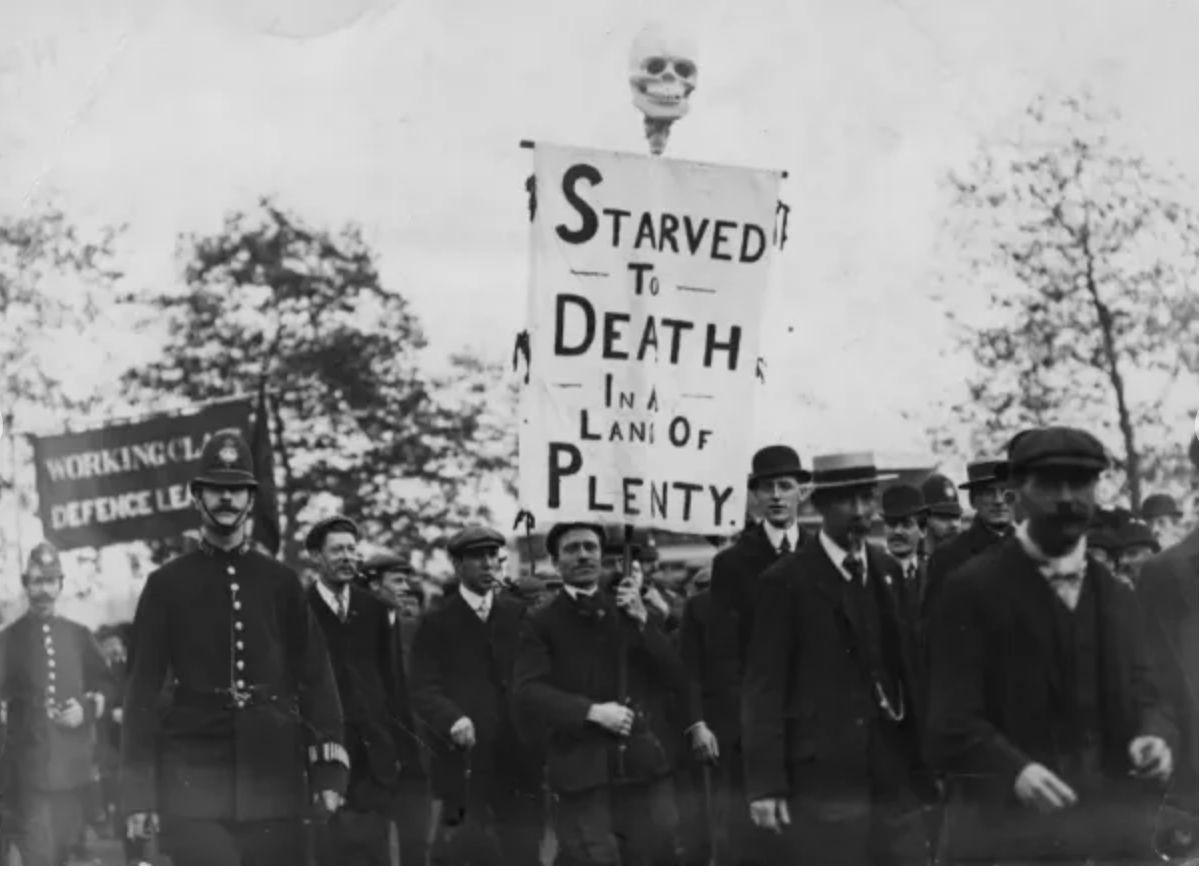
Going Hungry In A Land Of Plenty: food Insecurity in Aotearoa New Zealand

There is a number sitting in a new report that deserves to stop you in your tracks. One in three New Zealand households struggled to access affordable, nutritious food in the past year. Not one in a hundred. Not a marginal statistical blip that policy wonks can argue over in committee rooms. One in three. In a country that exports enough food to feed tens of millions of people beyond its own borders, roughly a third of households here could not reliably put adequate meals on the table. If that does not clarify something fundamental about the society we live in, it is hard to know what would.
The Hunger Monitor, described as the country’s first comprehensive tally of food insecurity, surveyed three thousand people late last year and was commissioned by the New Zealand Food Network. The numbers it produced surprised even the people working on the frontlines of food poverty. Gavin Findlay, chief executive of the Food Network, described it as confronting. Ian Foster, who has run the South Auckland Christian Foodbank for eighteen years and distributed forty thousand food parcels last year alone, said he was taken aback to learn how wide the problem had spread. These are people who deal with hunger every single day. And they were surprised. That tells you something about the scale of what we are actually dealing with.
Nearly one in five households (eighteen percent) had experienced what the report calls severe food insecurity. Two thirds of households that struggled to afford food had experienced it for the first time last year. And among those going hungry for the first time, many were reluctant to seek help, held back by shame and embarrassment. They had not expected to find themselves in this position. They had played by the rules, done everything they were supposed to do, and still found themselves unable to feed their families.
That shame is not accidental. It is a feature, not a bug. The ideology of individual responsibility, the idea that poverty is fundamentally a personal failure rather than a structural condition, serves capital extremely well. When people blame themselves for their hunger, they do not organise. They do not agitate. They queue quietly at the foodbank, grateful for the charity of strangers, and internalise the lesson that the system has dispensed to them – that their suffering is their own fault.
The Hunger Monitor blows a hole through this fiction, even if it does not quite name it as such. Nearly half of low-income households faced food insecurity, yes but so did just under a third of full-time workers. Read that again. People who are employed. People who are going to work every day, fulfilling their end of a bargain that was never fair to begin with, and still coming home to empty cupboards. The report even found that twelve percent of households earning over $156,000 a year had experienced some form of food insecurity when burdened by debt. The hunger problem in New Zealand is not a story about laziness or poor choices. It is a story about a system that extracts labour and wealth from working people while delivering less and less in return.
Tracey Phillips, chief executive of the Henderson Budget Service, put it plainly. In the five years she has been working with families in financial hardship, the population seeking help has shifted. It used to be primarily people out of work going through a rough patch. Now it is working whānau. Families with children who, after paying rent, power, and fuel to get to work, have under a hundred dollars left at the end of the week. A hundred dollars. For food, for clothing, for anything unexpected, for the small dignities of ordinary life. The arithmetic of survival under contemporary capitalism has become this brutal, and still the dominant political conversation treats it as a problem of individual budgeting rather than one of structural exploitation.
Phillips names the core contradiction clearly – the cost of living has driven food prices up, but wages and benefits have not kept pace. There is a disconnect, she says, between money coming in and what is needed to put food on the table. This is not a mystery. It is capitalism functioning exactly as it is designed to. Wages are a cost to be minimised. Profit is a value to be maximised. The distance between the two is where shareholders get rich and workers go hungry. Every supermarket duopoly price rise, every landlord rent increase, every energy company quarterly profit report represents a transfer of resources away from working people and towards capital. The hungry households in this report are not the victims of a system gone wrong. They are the product of a system working exactly as intended.
From his warehouse in Manukau, Ian Foster described a transformation that has accelerated dramatically in recent years. During the Covid pandemic, the South Auckland Christian Foodbank was distributing a hundred parcels a day, and staff were staggered by the demand. They are now averaging a hundred and seventy-seven a day. The pandemic-era spike turned out not to be a spike at all. It was a new floor. And the floor keeps rising.
Foster identifies something important in how he talks about the people coming through the doors. Budgeters, he says, have done everything they can. The people seeking food parcels are not people who have failed to manage their money. They are people who have managed their money meticulously, found that there still is not enough, and are now at the door of a charity as a last resort. “Until we turn that around,” he says, “we’ve got a major problem.” The politeness of that framing is understandable for someone in his position, dependent on goodwill and donations. But the blunter version is this – until we fundamentally restructure who owns what and who gets what, we will keep having this problem. And it will keep getting worse.
Brook Turner from Vision West has seen a fifty percent jump in households seeking food help since this time last year. Fifty percent, in a single year. He articulates something that cuts to the heart of the matter, he does not understand why food is not seen as a legitimate need. He is right to be bewildered, though the explanation is not difficult to find. Food is not treated as a right under capitalism because treating it as a right would mean guaranteeing it regardless of a person’s capacity to pay, which would mean decommodifying it, which would mean undermining the logic of the market itself. Food is a commodity. Hunger is leverage. If you are hungry enough, you will take whatever wage is offered. You will accept whatever conditions your employer imposes. You will be grateful. The food bank exists not to challenge this logic but to maintain it, to keep the hungry functional enough to return to work on Monday morning without the desperation becoming so acute that it tips into open revolt.
None of this is to disparage the people running food banks. They are doing necessary work under impossible conditions, driven by genuine care for their communities. But it is worth naming clearly what they are doing and what they are not doing. They are providing emergency relief within a system that generates the emergency. They cannot, by their nature, address the causes of hunger. And increasingly, they know this. Turner says food banks are needed for people who fall through the system, and he hopes the government can hear that. This is the language of appeal to power, which is the only language available to charities dependent on state funding. But the subtext is evident, the system has holes in it large enough for a third of the population to fall through.
The food charities asking the government to extend their funding beyond June this year face a grim irony. They are organisations created to manage the fallout of policy decisions, wage suppression, benefit inadequacy, housing costs left to the market, now dependent on the political goodwill of the same class of people whose decisions created the crisis in the first place. If the government does not extend funding, Vision West and others face reducing services or closing entirely, precisely at the moment when demand has never been higher. This is the bind that charity always finds itself in under capitalism – it fills gaps that should not exist while remaining structurally unable to close them.
What would it actually mean to solve the problem of food insecurity in Aotearoa? It would mean wages that genuinely reflect the cost of living, set not by what the market will bear but by what people actually need to live well. It would mean benefits sufficient to eat on, housed in an adequate and affordable home, without choosing between rent and food. It would mean a housing system that serves people rather than investors, because housing costs are eating the money that families need for food. It would mean confronting the supermarket duopoly that has consistently prioritised shareholder returns while squeezing suppliers and charging working people ever more for basic groceries. It would mean, ultimately, an economy organised around meeting human needs rather than accumulating private wealth.
The Hunger Monitor is described as a benchmark, a baseline against which future years can be measured. There is something quietly devastating about that framing. We are now at the stage of formally documenting and tracking mass hunger in one of the wealthiest countries on earth, and treating this documentation as progress. In a way, it is progress of a kind. You cannot solve a problem you refuse to see. But measurement is not a solution. A spreadsheet tracking the depth of the crisis each year is not a substitute for dismantling the conditions that created it.
One in three households. In a country that grows and exports food in extraordinary abundance. The land is not the problem. The farmers are not the problem. The workers who pack and transport and stock and sell food are not the problem. The problem is who owns the land, who controls the supply chains, who sets the wages, who collects the rents, who pockets the difference between what things cost to produce and what they are sold for. The problem has a name, and the Hunger Monitor, for all its value, is not permitted to say it.
We can say it. The problem is capitalism. The solution begins with understanding that food, like shelter, like healthcare, like all the things human beings need to survive and flourish, belongs to everyone. Not as a charity. Not as a conditional gift from the state. Not as a commodity dispensed to those with the means to pay. As a right, inseparable from the fact of being human, and guaranteed by a society that has organised itself around meeting the needs of all its members rather than the profits of a few.
Until then, the warehouses in Manukau will keep running. The numbers will keep climbing. And a country with enough food for everyone will keep watching a third of its people go without.

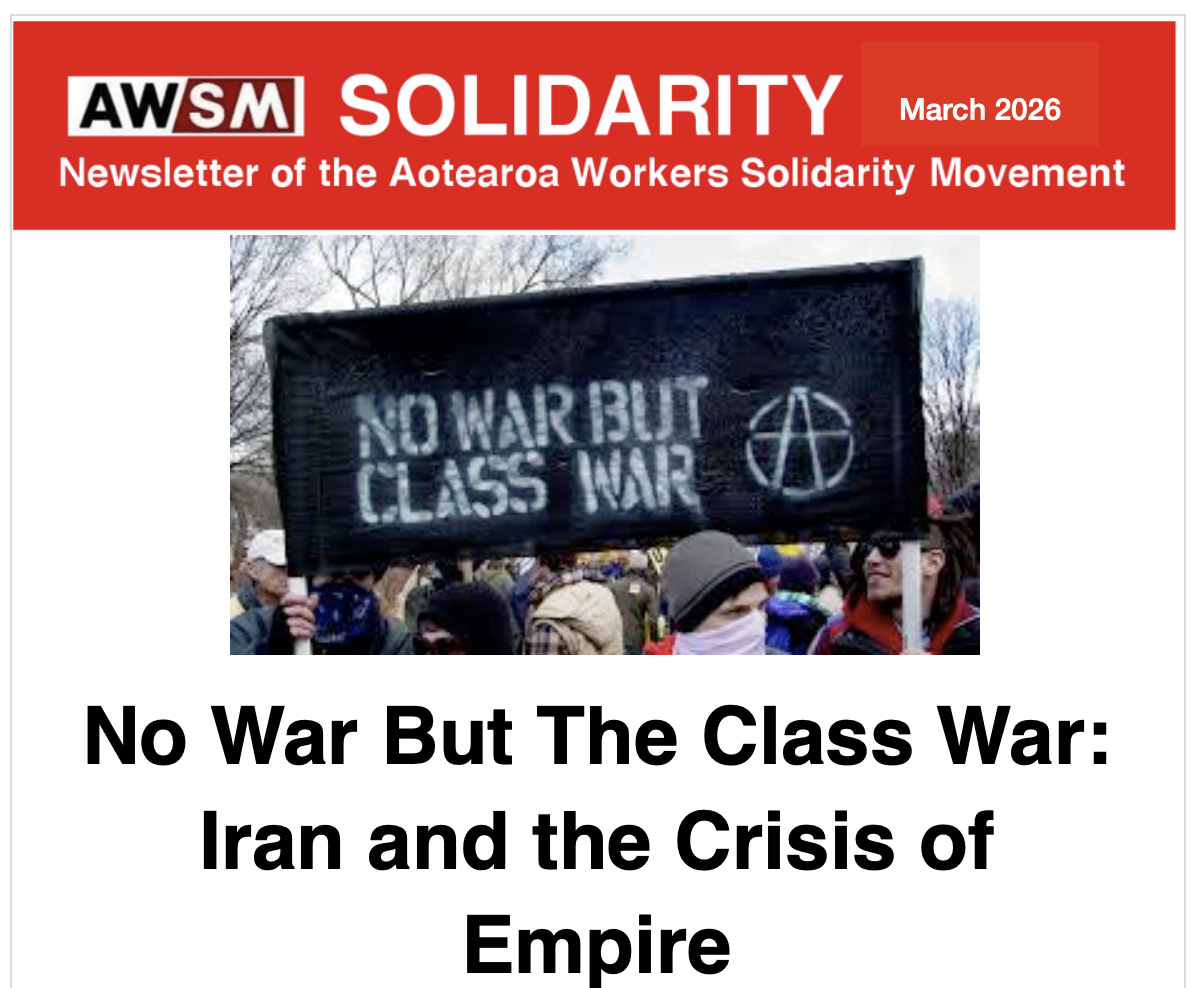
No War but the Class War: Iran and the Crisis of Empire

There is a persistent arrogance embedded in the worldview of Western power that overwhelming violence can break the political will of entire societies. Again and again the same assumption appears. Israeli strategists believe that flattening Gaza will sever Palestinians from their land. Washington spent more than sixty years trying to strangle Cuba economically in the hope that its people would abandon their revolution. Now the same logic is driving the escalating war against Iran. The belief remains that bombs, assassinations and economic siege will eventually force a nation to submit.

These actions are usually described in the language of policy errors or strategic miscalculations. But that framing misses the deeper issue. What we are witnessing is not simply poor strategy. It is the continuation of a worldview shaped by centuries of colonial domination, one that still imagines Europe and its settler extensions as the natural centres of civilisation. That worldview continues to shape the political imagination of Western elites, producing a kind of ideological blindness whenever societies outside the Western sphere refuse to comply.

The current war against Iran illustrates this dynamic with disturbing clarity. The conflict erupted when the United States and Israel launched coordinated strikes on Iranian military and strategic sites, triggering retaliatory missile and drone attacks across the region and raising fears of a wider war. The ripple effects have already spread far beyond the Middle East, shaking global energy markets and disrupting shipping routes through the Strait of Hormuz, one of the most important oil transit chokepoints in the world.

Yet even as the war intensifies, the underlying logic driving it remains remarkably familiar. Western policymakers appear convinced that military force will compel Iran to abandon its political trajectory. This assumption persists despite decades of evidence showing that sanctions, assassinations and military threats have failed to achieve that outcome.

To understand why this pattern repeats itself, it is necessary to look beyond individual decisions and examine the ideological structure that underpins Western power. For centuries European empires justified their expansion through a belief in civilisational superiority. Colonised peoples were portrayed as irrational, backward or incapable of governing themselves. This narrative provided the moral cover for conquest, slavery and economic exploitation.

Although the formal colonial empires of Europe have largely disappeared, the assumptions that sustained them remain embedded in the political culture of the West. They shape how conflicts are interpreted and how resistance from non-Western societies is understood. When nations like Iran refuse to submit to Western dominance, their actions are often framed not as political resistance but as irrational fanaticism or extremism.

This mindset has profound consequences. It produces policies that consistently underestimate the resilience of the societies they target. The result is a cycle of escalation in which each failure leads to more coercion rather than reflection.

Iran occupies a particularly central place within this history of imperial confrontation. The modern conflict between Iran and the United States cannot be understood without remembering the 1953 coup that overthrew Iran’s democratically elected Prime Minister Mohammad Mossadegh after he attempted to nationalise the country’s oil industry. The coup, orchestrated by the CIA and British intelligence, restored the authoritarian rule of the Shah and laid the foundations for the 1979 revolution that created the Islamic Republic.

In other words, the very political system that Western governments now describe as a threat was itself shaped by earlier Western intervention. The present war is therefore not simply a confrontation between two states. It is part of a much longer historical struggle over sovereignty, resources and geopolitical power.

Energy lies at the heart of this struggle. Iran sits atop some of the world’s largest oil and gas reserves, making it a crucial player in global energy markets. Control over those resources, and over the financial systems that govern them, has long been central to US foreign policy. The dominance of the US dollar in international trade allows Washington to wield enormous economic power through sanctions and financial restrictions.

But that system is increasingly under strain. Countries targeted by sanctions are developing alternative financial arrangements designed to bypass Western control. Iran has strengthened economic ties with China and Russia while participating in broader discussions within the BRICS framework about alternative trade and currency systems. The more Washington attempts to isolate these states economically, the more incentive they have to construct parallel systems outside the reach of Western financial institutions.

From the perspective of American strategists, this represents an existential threat to the existing global order. The privileged position of the US dollar has allowed the United States to sustain massive deficits while maintaining global influence. Preserving that position requires control over energy flows and the prevention of rival economic blocs capable of challenging dollar dominance.

Seen in this light, the war against Iran appears less like a defensive response to security threats and more like an attempt to enforce the geopolitical architecture that has underpinned Western power since the end of the Second World War.

For people in Aotearoa New Zealand, these dynamics might appear distant. Yet our country is far from neutral in this global system. The New Zealand government has publicly supported the US-Israeli strikes as part of efforts to prevent Iran from threatening international security, while simultaneously calling for negotiations and restraint.

This response reflects a long-standing pattern in New Zealand foreign policy. Successive governments have cultivated the image of an independent, rules-based international actor while remaining firmly embedded within Western strategic alliances. Wellington may not deploy troops in every conflict, but it rarely challenges the fundamental assumptions of the imperial system that structures global politics.

The reaction to the current Iran war illustrates this balancing act. Official statements have avoided openly endorsing regime change while still framing the strikes as a response to Iranian behaviour. Critics, including former Prime Minister Helen Clark, have argued that the attacks constitute a clear violation of international law, drawing parallels with earlier Western interventions such as the invasion of Iraq.

This debate reveals the contradictions at the heart of New Zealand’s international identity. On the one hand, the country likes to present itself as a defender of international law and multilateral diplomacy. On the other hand, it remains politically and economically integrated into the Western alliance system that repeatedly violates those same principles.

These contradictions are not merely diplomatic curiosities. They reflect the material realities of a settler-colonial society embedded within the structures of global capitalism. New Zealand’s prosperity has long depended on participation in an international economic order dominated by Western powers. Our security relationships, intelligence partnerships and trade networks are deeply intertwined with that system.

From an anarcho-communist perspective, this raises uncomfortable questions. Can a state built on the colonisation of Māori land genuinely claim moral authority in global debates about sovereignty and self-determination? Can a society integrated into imperial economic networks meaningfully oppose the wars that sustain those networks?

The war against Iran forces us to confront these questions more directly. It exposes the reality that even small states like New Zealand are implicated in the geopolitical structures that produce global conflict.

This does not mean that the Iranian state itself should be romanticised. The Islamic Republic is a deeply authoritarian regime that suppresses dissent and enforces rigid social controls. Acknowledging that reality, however, does not justify foreign aggression. Opposition to imperial war does not require political support for the governments targeted by that war.

The real issue is the broader system that continually produces such conflicts. The same structures of global capitalism that generate inequality and ecological destruction also generate war. Competition over resources, trade routes and strategic influence drives states toward confrontation.

As that system enters a period of increasing instability, the political responses within Western societies are becoming more authoritarian. Governments expand surveillance powers, criminalise protest and tighten borders. The language of security becomes the justification for repression.

Empire and authoritarianism develop together. The violence inflicted abroad inevitably reshapes politics at home.

For people living in Aotearoa, this reality should not be abstract. Our own history is shaped by colonial conquest and the suppression of Indigenous sovereignty. The same ideological frameworks that justified the seizure of Māori land also underpinned the expansion of European empires across the world.

Recognising this connection does not mean collapsing all struggles into a single narrative. But it does require acknowledging that colonialism, capitalism and imperial war are historically intertwined.

The war against Iran is therefore more than a distant geopolitical event. It is part of a broader crisis within the global system that shapes our lives here as well.

As the conflict escalates, its economic consequences are already being felt around the world. Disruptions to oil supplies threaten to push up fuel prices and destabilise supply chains. Small economies like New Zealand’s are particularly vulnerable to such shocks.

Yet the deeper significance of the war lies not in its immediate economic effects but in what it reveals about the trajectory of global power. The post-Cold War era of uncontested American dominance is fading. New geopolitical blocs are emerging. Old alliances are shifting.

In this uncertain landscape, imperial powers are attempting to preserve their dominance through increasingly aggressive means. Military force, economic sanctions and political destabilisation remain the tools of choice.

But history suggests that such strategies rarely achieve the outcomes their architects intend. Attempts to crush resistance often strengthen it. Societies subjected to external pressure frequently become more determined to defend their sovereignty.

This is why decades of sanctions have not broken Cuba. It is why Venezuela has survived repeated attempts at regime change. And it is why Iran, despite relentless pressure, continues to resist submission.

The lesson is not that states are invincible. It is that the political will of entire populations cannot easily be destroyed through violence and coercion.

For radical movements around the world, including here in Aotearoa, the challenge is to confront the structures that make such wars possible. That means questioning the alliances, institutions and economic systems that bind our society to imperial power.

It also means building forms of solidarity that extend beyond national borders. The struggle against exploitation and domination is inherently international.

The war against Iran is a stark reminder of the stakes involved. It reveals the enduring arrogance of imperial power and the catastrophic consequences that arrogance can produce.

The question facing us is whether we continue to accept the structures that make such wars inevitable, or whether we begin to imagine and organise for a world beyond them.

The age of illusions is ending. The only meaningful response is clarity, solidarity, and resistance.

This article appears in the latest issue of our newsletter which can be found here: https://awsm.nz/awsm-newsletter-solidarity-march-2026/

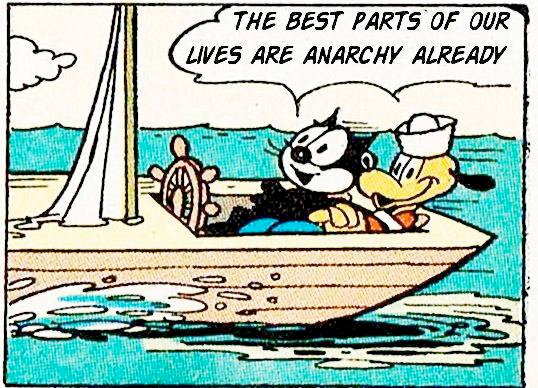
Anarchy Is Not What You Think It Is


For most people, the word anarchy conjures chaos. Burning cars, smashed windows, shouting crowds, the collapse of all restraint. It is a word carefully trained to frighten. Politicians invoke it as a threat, newspapers as a warning, and police as a justification. Anarchy, we are told, is what happens when order disappears.


But we are making a simpler and more unsettling claim: anarchy is not the absence of order, but the absence of rulers. And far from being rare, it is woven through everyday life in Aotearoa New Zealand.
This is not about anarchism as an ideology, a movement, or a future revolution. We are not arguing that everyone should call themselves an anarchist, nor do we offer a blueprint for how society ought to be reorganised. Instead, we offer something quieter and more subversive. We look closely at how people already live, care, work, raise children, resolve conflict, and survive, often without asking permission, without formal authority, and without the state playing a central role at all. In other words, we argue that anarchism is a lived practice, not a doctrine.


The inspiration for this approach comes from the British writer and thinker Colin Ward, whose work Anarchy in Action refused the dramatic gestures of revolutionary politics and instead turned attention to the mundane. Ward was interested in housing co-operatives, playgrounds, allotment gardens, informal education, and the ways ordinary people organise their lives when institutions fail or intrude too heavily. His argument was disarmingly simple – if you want to understand anarchism, do not look to manifestos or barricades, look at everyday life.


Aotearoa offers a particularly clear view of this everyday anarchism. Not because it is uniquely radical or harmonious, but because the failures and violences of the state are so visible, and because people have had to rely on one another in spite of it. Mutual aid after floods, whānau stepping in where welfare systems fall short, informal housing arrangements that keep people off the streets, cash work and favours that bypass wage discipline, conflict resolved quietly without police or courts, these are not marginal or exceptional activities. They are normal. They are how life continues and yet they are rarely named as political.


One of the most powerful myths of modern society is that order comes from above. We are taught that without rules imposed by the state, without police, bureaucrats, managers, and experts, society would descend into violence and disorder. Cooperation is treated as fragile, conditional, and in need of constant supervision. When people help one another, it is framed as charity or kindness, never as a form of social organisation in its own right.


This myth serves a purpose. It legitimises authority while obscuring the fact that most of what keeps society functioning happens below the level of law and policy. The state depends heavily on unpaid care, informal cooperation, and community resilience, even as it claims credit for stability and threatens punishment for deviation. It is quick to intervene when people step outside permitted channels, but slow, or absent, when real support is needed.


Nowhere is this contradiction clearer than in moments of crisis. After earthquakes, floods, and fires in Aotearoa, it is neighbours, whānau, and community groups who act first. Food is shared, shelter organised, children looked after, elders checked on. These responses are not centrally planned. They emerge from relationships, trust, and local knowledge. The state arrives later, often to regulate, document, or withdraw support once the immediate danger has passed.


This is not an argument that the state does nothing, or that it is always irrelevant. It is an argument that social life is not produced by authority, even when authority claims ownership over it. The order we rely on most is informal, relational, and largely invisible to official accounts.


In Aotearoa, these dynamics are inseparable from colonisation. The settler state did not arrive to create order from chaos. It arrived to impose its own forms of order on societies that were already organised, often in ways that conflicted with European notions of property, hierarchy, and law. Māori social organisation, grounded in whānau, hapū, tikanga, and collective responsibility, represented a profound challenge to the authority of the colonial state. Land tenure without individual ownership, justice without prisons, governance without a sovereign rule, these were not abstract alternatives, but lived realities.
Colonisation sought to dismantle these systems, replacing them with wage labour, private property, policing, and bureaucratic control. Yet despite generations of violence, dispossession, and assimilation, non-state forms of social organisation persist. They persist not as relics of a pre-colonial past, but as adaptive, living practices shaped by ongoing resistance and survival.


It is important to be clear here. We are not claiming that Māori society is “anarchist” in any simple or ideological sense. Such a claim would be both inaccurate and disrespectful. What it does argue is that Māori social life exposes the limits and contradictions of the state by demonstrating that authority is not the only way to organise society, and that relational, non-statist forms of order are not only possible but enduring.


These practices are not confined to Māori communities. Working-class life across Aotearoa is full of informal systems that make survival possible in the face of rising rents, precarious work, and shrinking public services. People share childcare, tools, transport, and knowledge. They look after one another’s kids, cover shifts, lend money without contracts, and find ways around rules that would otherwise leave them stuck. Much of this activity exists in a legal grey area, tolerated when it is convenient and criminalised when it becomes too visible.


What links these practices is not ideology, but necessity. People do not organise this way because they have read anarchist theory. They do it because they have to, and because cooperation works better than competition when resources are scarce and institutions are hostile.


Anarchism, in this sense, is not a destination but a description. It describes what happens when people take responsibility for their own lives and for one another, rather than deferring to distant authorities. It describes social order that emerges from below, shaped by context, relationships, and mutual obligation. It is messy, imperfect, and often fragile, but so is life itself.


This perspective challenges both defenders and critics of the state. Against those who insist that authority is the source of all order, it offers abundant evidence to the contrary. Against those who imagine anarchism only as a future rupture or total collapse, it insists that much of what they desire already exists, quietly, in the present.


We are not trying to romanticise these practices. Informal systems can reproduce inequality, exclusion, and harm. They can fail, break down, or be overwhelmed. Nor do we deny the reality of violence, abuse, or exploitation within communities. What we do though is refuse the assumption that the state is the natural or necessary solution to these problems.


Instead, we ask a different set of questions. How do people actually manage harm when they do not call the police? How do families and communities regulate behaviour without formal authority? What happens when responsibility is collective rather than delegated upward? And why are these forms of organisation so often ignored, dismissed, or actively undermined?


These questions matter now more than ever. As faith in political institutions erodes, as economic inequality deepens, and as crises multiply, the gap between official systems and lived reality grows wider. Governments promise security while delivering precarity. Bureaucracies expand even as their capacity to care diminishes. In this context, the everyday anarchism of mutual aid and informal cooperation is not a fringe phenomenon, it is a lifeline.


We invite you to look differently at your own life and the lives around you. To notice the ways order is created without orders being given. To recognise that much of what feels natural or inevitable is in fact the result of collective effort without command. And to consider what might change if we took these practices seriously, not as temporary stopgaps, but as the foundations of social life.


We are not demanding agreement, but we do ask for attention. Because once you start to see anarchism in action, it becomes difficult to unsee it.

image c/o theslowburningfuse.wordpress.com