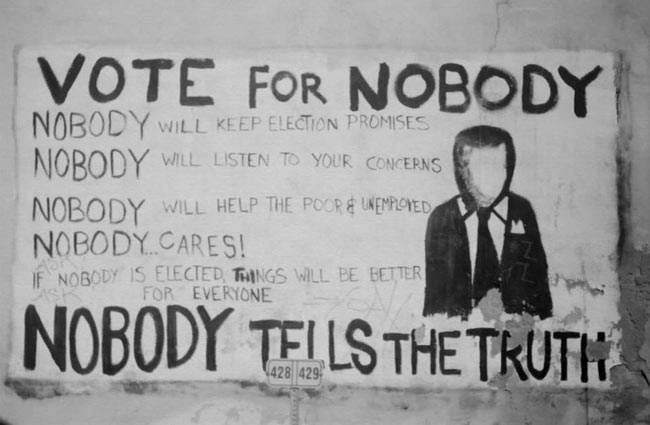
Against the Ritual: Why Anarchists in Aotearoa Refuse the Ballot Box

It’s a strange thing to be told, over and over again, that you’re the unreasonable one for refusing to participate in something that, historically and globally, anarchists have treated with deep suspicion at best and outright hostility at worst. In Aotearoa New Zealand, saying anarchists should abstain from elections is still treated as fringe, sectarian, even irresponsible. You’ll be told you’re letting the Right win, that you’re abandoning vulnerable people, that you’re indulging in ideological purity while others suffer. Yet if you zoom out, even slightly, this position is neither new nor particularly extreme. It is, in fact, one of the oldest and most consistent threads in anarchist thought.

So why does it feel so controversial here? Part of it is that New Zealand has cultivated a very particular political culture, one that leans heavily on the myth of fairness, moderation, and incremental progress. Electoral politics here is framed less as a site of domination and more as a kind of collective moral project. Voting is not just a tactic, it is a ritual of belonging. To abstain is not simply to opt out of a strategy, but to step outside what is imagined as the shared ethical life of the nation.

Anarchism, at its core, has never been about belonging to the nation. It has always been about refusing the structures that demand obedience in the first place. Historically, anarchists have been remarkably consistent on this point. From the late nineteenth century through to the present, anarchist movements across Europe, the Americas, and beyond have argued that participation in parliamentary systems does not challenge power but legitimises it. The state, from this perspective, is not a neutral tool that can be wielded for good or ill depending on who holds office. It is a structure built to organise domination, class domination above all, and elections function as a way of renewing consent to that structure.

This isn’t an abstract argument. It emerges from lived experience. Again and again, movements that have placed their hopes in electoral change have found those hopes blunted, redirected, or outright betrayed. Radical parties moderate once they enter parliament. Transformative demands get watered down into policy tweaks. The machinery of the state absorbs opposition and spits it back out as something far less threatening.

Anarchists noticed this early. That’s why abstentionism, refusing to participate in elections, became a defining feature of many anarchist traditions. It isn’t about apathy. It is about clarity. If you believe that the state is fundamentally structured to maintain hierarchy and exploitation, then participating in its rituals starts to look less like pragmatism and more like complicity.

Globally, this position has never really gone away. It has shifted, adapted, been debated internally, but it remains widely understood. In some contexts, anarchists engage tactically with elections, supporting specific reforms, for instance, but often while maintaining a critical distance. In others, abstention remains the default. Which brings us back to Aotearoa. Here, abstention feels different. Not because the arguments against electoralism are weaker, but because the social and political context reshapes how those arguments are heard. New Zealand’s relative stability, its small size, and its carefully managed image as a progressive democracy all contribute to a sense that the system more or less works. Not perfectly, of course, but well enough that participation feels meaningful.

This is where the controversy really sits. When anarchists in New Zealand call for abstention, they are not just critiquing the state in the abstract. They are challenging a widely held belief that the system is capable of delivering justice if only the right people are elected, and that belief runs deep. You can see it in the way political debate is framed. Elections are treated as moments of possibility, of hope, of collective agency. Campaigns are saturated with language about change, about making a difference, about shaping the future. Even when people are disillusioned, the solution offered is usually more engagement, vote harder, get the right party in.

Against this backdrop, abstention looks like withdrawal. It can be read as giving up, as refusing to fight on the terrain where outcomes are decided. And in a context where harm is real and immediate, where people are struggling with housing, healthcare, and poverty, it’s not surprising that this interpretation carries weight. However it rests on a particular assumption, the assumption that elections are the primary or most effective site of change.

Anarchists challenge that assumption. Not by denying that elections can have effects, of course they can, but by questioning their limits. What kinds of change are possible within the framework of the state? What kinds are foreclosed? And what does it mean to focus our energy on a terrain that is structurally tilted towards preserving existing relations of power?

From an anarchist perspective, the problem isn’t just that elections often fail to deliver meaningful change. It’s that they actively shape how we think about change. They channel political imagination into a narrow set of options – vote for this party or that one, support this policy or that one – while sidelining more fundamental questions about power, ownership, and control.

In this sense, participation in elections doesn’t just reflect the system; it reproduces it. This is where the global history becomes important again. Anarchists have long argued that real transformation comes not from capturing the state but from building power outside it. Through unions, through mutual aid networks, through community organising, through direct action. These are not just tactics, but they are forms of social organisation that prefigure the kind of world anarchists want to create, one based on cooperation, autonomy, and collective decision-making rather than hierarchy and coercion. Abstention, in this context, is not an end in itself. It is part of a broader orientation towards building alternative forms of power.

So why does this still feel so marginal in New Zealand? Partly because the infrastructure of extra-parliamentary struggle is relatively weak here. There are exceptions, of course, but compared to other parts of the world, there is less of a tradition of mass movements operating independently of electoral politics. Trade unions are weaker. Community organisations are often tied, directly or indirectly, to state funding. Even protest movements frequently orient themselves towards influencing policy rather than building autonomous power. In this context, elections loom larger. They become the default site of politics because other sites feel less viable.

There’s also the question of scale. In a small country, where political actors are relatively accessible and the distance between voters and representatives feels shorter, it’s easier to maintain the illusion of influence. You might not be able to change the system, but you can imagine nudging it in a better direction. You can meet your MP, submit on legislation, see small wins. These experiences matter. They make participation feel tangible. However, they can also obscure the bigger picture. The structural constraints on what any government can do within a global capitalist economy, within existing property relations, within the logic of state power, remain in place regardless of who is elected. This is where the anarchist critique cuts through the optimism. It asks not just what governments say they will do, but what they are actually able to do without fundamentally challenging the system they operate within.

It’s much easier to believe that change can be delivered through elections than to confront the possibility that it requires building entirely different forms of social organisation. The former fits within existing rhythms of life, vote every few years, follow the news, maybe attend a rally. The latter demands a deeper shift. It asks people to invest time, energy, and imagination into something that is not guaranteed to succeed and may not deliver immediate results. Layered over all of this, and often under-acknowledged, is the liberal co-option of anarchism itself. In New Zealand, as elsewhere, “anarchism” has been softened, aestheticised, and folded back into the very political culture it was meant to disrupt. You see it in the casual way the term is used to mean little more than decentralisation, lifestyle individualism, or a vague distrust of authority, positions that can sit quite comfortably alongside continued participation in electoral politics.

In this diluted form, anarchism becomes less a critique of the state and more a flavour of liberalism. It is reduced to personal expression, ethical consumption, or community-mindedness, all of which can be easily accommodated within the existing system. The harder edge, the rejection of state power, the insistence on dismantling hierarchy, the commitment to building entirely different social relations, gets blunted or ignored. This co-option has consequences. It reshapes expectations about what anarchists should do. If anarchism is understood primarily as a set of values, fairness, equality, anti-authoritarianism, rather than a structural critique, then participating in elections can seem not only compatible with anarchism but required by it. Voting becomes framed as the responsible thing to do, the way to minimise harm, the practical expression of one’s ethics.

Refusing to vote, in that context, looks like a betrayal, not just of society, but of anarchism itself. This is a reversal of the historical position. It takes a tradition that has consistently questioned the legitimacy of the state and recasts it as a moral supplement to that state. It turns anarchism from a challenge into a conscience, from a threat into a corrective. Once that shift happens, abstention becomes much harder to defend. It is no longer seen as a principled refusal grounded in a critique of power, but as an abdication of responsibility within a system that is assumed to be fundamentally legitimate. This helps explain why the argument that abstention helps the Right carries so much weight here. If you accept the premise that elections are the primary means of achieving social good, and if anarchism has been reframed as a set of progressive values within that system, then not voting can only appear as harmful. However, this argument rests on a very short time horizon. It focuses on the immediate outcome of a particular election while bracketing off the longer-term dynamics of the system itself. It assumes that the best we can do is choose the lesser evil, again and again, without asking what that cycle does to our capacity to imagine and build something better.

From an anarchist perspective, this is precisely the trap. Lesser-evilism doesn’t just accept the limits of the system, it entrenches them. It trains us to lower our expectations, to settle for marginal improvements, to see politics as a series of constrained choices rather than an open field of possibility. Over time, this can become self-fulfilling. If all our energy goes into electoral cycles, there is less left for building alternative forms of power. And without those alternatives, elections really do become the only game in town. Abstention is a refusal of that cycle. Not because anarchists are indifferent to harm, far from it, but because they are trying to shift the terrain on which harm is addressed. Instead of asking how to manage exploitation more humanely, the question becomes how to dismantle the structures that produce it in the first place. This is where the position starts to make more sense, even if it remains controversial to some. It’s not about purity. It’s about strategy. It’s about where to invest energy, what kinds of power to build, and how to move beyond a system that, by design, limits what is possible.

So when anarchists here argue for abstention, they are pushing against a deeply entrenched common sense. They are saying that the thing most people take for granted, the idea that voting is the primary way to effect change, is not just insufficient but part of the problem. Even to some who identify as anarchists that is controversial, but controversy isn’t the same as being wrong. Sometimes it’s a sign that a position is touching something real, something that unsettles established ways of thinking. The challenge is to move beyond the surface-level arguments, the accusations of irresponsibility, the defensive appeals to pragmatism, and engage with the underlying questions.

What is the state for? What are elections actually capable of delivering? And what would it mean to build power in ways that don’t rely on either? Those are not easy questions. They don’t come with ready-made answers. But they are the questions anarchists have been asking, consistently, for well over a century. That tension between anarchism as a disruptive force and anarchism as a co-opted aesthetic is where the controversy lives.

Against the State, Against Electoral Illusions


For much of the socialist movement’s history, the question of the state has acted like a fault line running beneath every strategy, every party, every programme. Again and again, the Left has been pulled back towards the idea that emancipation can be delivered through the machinery of government, that the capitalist state can be captured, redirected, and made to serve the interests of labour. However there is a growing recognition of the hollowness of that belief. It reflects an unease that has been quietly accumulating for decades – that parliamentary socialism, however well intentioned, remains structurally trapped within institutions designed to preserve capitalism rather than abolish it. For anarcho-communists, this is not a new insight but a confirmation of something long understood. The state is not a neutral arena waiting to be occupied by the Left; it is a form of social power built to discipline labour, defend property, and stabilise exploitation.

The capitalist state is not simply a set of elected officials or a collection of policies. It is a dense network of bureaucracies, legal systems, police forces, financial institutions, and ideological norms that together reproduce class domination. Even when staffed by socialists, it remains bound to the imperatives of capital accumulation, economic growth, and social order. This is why left governments, from post-war social democracy to more recent reformist projects, so often find themselves retreating, compromising, or outright capitulating. They inherit a machine whose purpose is to manage capitalism, not dismantle it. To imagine that such a machine can be repurposed for socialism is to misunderstand its very function.

The appeal of the state has always been understandable. It offers immediacy, visibility, and the illusion of control. Winning an election feels tangible in a way that slowly building collective power does not. Legislation can be passed, budgets allocated, nationalisations announced. Yet these victories remain fragile precisely because they leave the underlying relations of power intact. Capital retains its mobility, its ownership of production, its ability to withhold investment, relocate, sabotage, and discipline. The state, even under left leadership, is forced to respond to these pressures or face economic crisis, capital flight, and political destabilisation. What is presented as political realism is in fact structural blackmail.
AWSM gestures towards this reality by insisting that socialism cannot be reduced to electoral success. We point to the necessity of building power outside the state, in workplaces, unions, and communities, to support and sustain any meaningful transformation. This is an important recognition, but it remains incomplete. From an anarcho-communist perspective, the problem is not merely that the state is insufficient on its own, but that it actively undermines the development of genuine collective power. The more movements orient themselves towards parliamentary outcomes, the more their energies are channelled into leadership contests, messaging discipline, and electoral cycles. Popular participation is narrowed to voting, while decision-making is centralised and professionalised. The result is demobilisation, not empowerment.

Social democracy offers a clear historical lesson. Its great post-war achievements in welfare provision and public ownership were real, but they were also shallow. Workers were not given control over production, they were given managed security within capitalism. Industries were nationalised but remained hierarchical and bureaucratic, run by state managers rather than workers themselves. When neoliberalism arrived, these arrangements were easily dismantled because the working class had never been organised as a ruling power in its own right. The state could give, and the state could take away.

This dynamic was not just confined to Europe. In Aotearoa New Zealand, the legacy of Labour governments tells a similar story. The welfare state, built on colonial foundations and exclusion, provided limited security while entrenching bureaucratic control over Māori and working-class communities. The neoliberal counter-revolution of the 1980s did not emerge from nowhere, but it was enabled by a state apparatus already accustomed to managing society from above. The lesson is not that reforms are meaningless, but that reforms delivered by the state are always contingent, reversible, and ultimately subordinate to capital.

Anarcho-communism begins from a different premise. It understands socialism not as a policy programme but as a transformation of social relations. The abolition of capitalism requires the abolition of the state because both rest on hierarchy, coercion, and alienation. The state concentrates decision-making in the hands of a few, separates people from control over their own lives, and enforces obedience through law and violence. Capitalism does the same in the economic sphere. To dismantle one while preserving the other is impossible.

This does not mean waiting for a mythical moment of total collapse. It means recognising that socialism must be built through practices that prefigure the world we want. Workers controlling their workplaces, communities organising their own resources, people collectively meeting their needs without mediation by state or market. These practices are not supplementary to political struggle, they are its substance. They create the material basis for a society without bosses or bureaucrats.

The parliamentary left need to draw on the idea of extending democracy into the economy, an argument that resonates strongly with anarcho-communist thought. But democracy, if it is to mean anything, cannot be confined to representative structures. Real democracy is direct, participatory, and rooted in everyday life. It is exercised in assemblies, councils, and federations where people have immediate control over decisions that affect them. It is incompatible with institutions that monopolise authority and enforce compliance from above.

Historically, moments of revolutionary rupture have demonstrated this possibility. Workers’ councils, neighbourhood committees, and communal structures have repeatedly emerged in periods of intense struggle, from Russia in 1905 and 1917 to Spain in 1936. These were not spontaneous miracles but the product of long-term organising and collective confidence. They showed that ordinary people are capable of managing society without bosses or states, when given the opportunity and necessity to do so.

The tragedy of much of the twentieth-century Left is that these moments were either crushed by reaction or absorbed into new state structures that replicated old hierarchies under socialist rhetoric. The promise of the state withering away became a justification for its expansion. Anarcho-communists reject this logic entirely. The state does not wither; it entrenches itself. Power, once centralised, resists dissolution.

This is why the strategy of dual power remains crucial. Rather than aiming to take over the state and transform society from above, anarcho-communism seeks to build alternative forms of power that make the state increasingly irrelevant. Mutual aid networks that meet material needs without bureaucratic mediation. Workplace organisations that challenge managerial authority directly. Community assemblies that coordinate housing, food, and care. These structures do not wait for permission, they assert collective autonomy in the here and now.

In the context of Aotearoa, this approach must be inseparable from decolonisation. The colonial state was imposed through violence, land theft, and the destruction of Māori social structures. Any socialist project that centres the state risks reproducing these colonial dynamics, even when wrapped in progressive language. Anarcho-communism aligns with tino rangatiratanga not as a symbolic gesture, but as a practical commitment to autonomy, self-determination, and the dismantling of imposed authority. Supporting iwi and hapū control over land and resources is not a concession within the state framework, but it is a challenge to the legitimacy of the colonial state itself.

The fixation on elections often obscures these deeper questions. Some argue that voting can be a tactic, but it cannot be a strategy. When movements orient themselves primarily towards winning office, they internalise the priorities of the system they seek to oppose. Radical demands are softened to appeal to swing voters, direct action is discouraged to maintain respectability, and organisational energy is funnelled into campaigns that dissipate once the ballot boxes are packed away. Disappointment follows, then cynicism, then retreat.

Direct action, by contrast, builds confidence and capacity. Strikes, occupations, blockades, and collective refusal confront power where it actually operates. They force concessions not through persuasion but through disruption. More importantly, they teach participants that change comes from their own collective strength, not from benevolent leaders. This is the pedagogical function of struggle, one that no parliamentary process can replicate.

Socialism must be rooted in mass participation rather than elite management. Where anarcho-communism diverges is in its refusal to subordinate that participation to the state at all. The goal is not to pressure governments into doing the right thing, but to render them increasingly obsolete. Every time people organise to meet their needs directly, they weaken the ideological and material foundations of state power.

This does not mean ignoring the reality of repression. The state will defend itself, often brutally. Police, courts, and prisons exist precisely to contain challenges from below. Anarcho-communist strategy therefore emphasises solidarity, decentralisation, and resilience. Movements that are horizontal and federated are harder to decapitate. Networks of mutual support reduce vulnerability to repression. Collective defence becomes a shared responsibility rather than the domain of specialists.

Capitalism is entering a period of deep instability, marked by ecological collapse, widening inequality, and permanent crisis. States respond not by resolving these contradictions but by managing them through austerity, surveillance, and repression. In this context, the fantasy that the state can be the vehicle for emancipation becomes increasingly untenable. The machinery is being retooled not for redistribution but for control.

Socialism against the state is therefore not a slogan but a necessity. It means recognising that freedom cannot be legislated into existence. It must be constructed through collective struggle that dismantles hierarchy in all its forms. Anarcho-communism offers not a blueprint but a direction towards a society organised around mutual aid, collective ownership, and direct democracy, without rulers and without classes.

The task before us is not to perfect the art of governance but to abolish the conditions that make governance necessary. To replace domination with cooperation, coercion with solidarity, and representation with participation. In doing so, we move beyond the narrow horizons of state-centred socialism and reclaim the revolutionary heart of the communist project.