A World of Plenty, Organised for Poverty

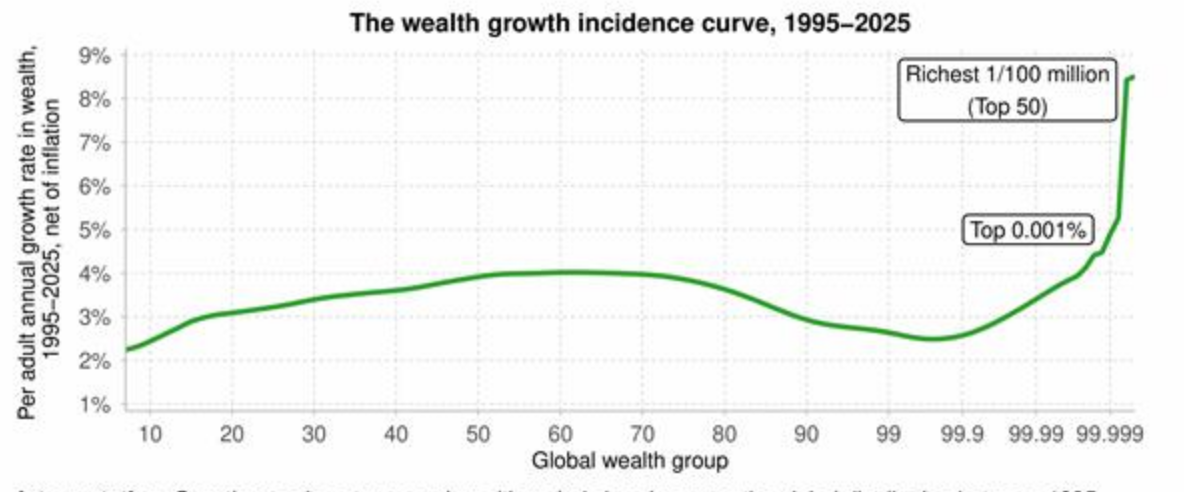
Extreme inequality is no longer a trend that economists cautiously warn about or a distant moral concern for charity campaigns. It is now the defining feature of global capitalism. The latest World Inequality Report, discussed by Michael Roberts in “Extreme Inequality – and what to do about it”, confirms what working people have long known from lived experience: wealth is being hoarded at the top at a scale unprecedented in human history, while the majority are expected to accept stagnation, precarity and ecological collapse as the normal price of “economic growth”.

Today, the richest ten percent of the world’s population take more income than the remaining ninety percent combined. A tiny elite of roughly sixty thousand people controls more wealth than half of humanity. These numbers are so grotesque that they almost lose meaning through repetition, yet they describe a reality that structures everyday life from housing unaffordability and crumbling health systems to climate breakdown and permanent insecurity for workers. Inequality is not an abstract statistic; it is the background condition shaping how we live, work and survive.

What is striking about the current moment is not just how extreme inequality has become, but how openly it is now defended. We are told that billionaires are “job creators”, that obscene wealth is the reward for “innovation”, and that any attempt to limit accumulation will harm everyone else. This ideological cover has become thinner over time, precisely because the material outcomes are impossible to hide. Productivity rises, profits soar, and yet wages flatline. Wealth multiplies at the top, while public services are stripped back and people are blamed for failing to thrive in an economy rigged against them.

The World Inequality Report makes clear that this concentration of wealth is not accidental. Since the 1980s, the deliberate dismantling of labour protections, the privatisation of public assets, and the globalisation of capital have allowed wealth to flow upwards with remarkable efficiency. Tax systems have been re-engineered to favour capital over labour. Financial markets have been deregulated, enabling speculative profits divorced from any social use. States have become managers of inequality rather than restraints on it, ensuring that the conditions for accumulation remain intact even during crises.

This global picture has local resonance in Aotearoa New Zealand. While politicians still trade on myths of fairness and opportunity, wealth inequality here has steadily deepened since the neoliberal restructuring of the 1980s and 1990s. Housing has become a primary vehicle for accumulation, locking entire generations out of secure shelter while landlords extract rent as a form of unearned income. Māori and Pasifika communities continue to experience disproportionately worse outcomes across health, housing and income, a direct legacy of colonial dispossession compounded by capitalist exploitation. None of this is a policy failure, rather it is the logical outcome of a system designed to concentrate ownership.

One of the most politically useful insights from the inequality data is the way it exposes the connection between wealth concentration and climate destruction. The richest layers of society are not only the primary beneficiaries of capitalist growth, they are also its most destructive agents. The top ten percent are responsible for the vast majority of emissions linked to private consumption and investment, while the poorest half of the world contributes almost nothing to the climate crisis. Yet it is the poor who face the harshest consequences, from rising food prices to displacement and environmental collapse.

This alone should demolish the moral blackmail that frames climate action as a sacrifice demanded of ordinary people. The problem is not that “we all consume too much”, it is that capital demands endless expansion, and the wealthy profit from it. Any serious response to climate change must therefore confront inequality at its root. Green capitalism, carbon trading schemes, and market incentives merely repackage the same logic of accumulation under a different aesthetic. They do nothing to challenge who owns, controls and benefits from production.

Michael Roberts is clear that mainstream responses to inequality, while often well-intentioned, fail to address these structural realities. Proposals for wealth taxes, improved public services, and international cooperation on tax avoidance are important, but they remain defensive measures within a system that constantly regenerates inequality. Even where such reforms are implemented, they are fragile and reversible. Capital is mobile, organised and politically powerful; gains made through reform can be undone the moment they threaten profitability.

From an anarcho-communist perspective, this limitation is fundamental. Redistribution after the fact does not change the underlying relations of power. As long as a small minority owns the means of production – land, housing, infrastructure, factories, finance – inequality will reassert itself. The state, no matter how progressive its rhetoric, exists to manage these relations, not abolish them. This is why decades of social democratic compromise have failed to halt the upward transfer of wealth.

The deeper question, then, is not how to make capitalism fairer, but why we continue to accept a system that requires inequality to function. Capital accumulation depends on exploitation. Profit is extracted from labour by paying workers less than the value they create. This surplus is then reinvested to generate more profit, concentrating wealth and power in fewer hands over time. No amount of moral appeal or technocratic adjustment can change this basic mechanism.

Anarcho-communism begins from a different premise: that the resources and productive capacity of society should be held in common and democratically controlled by those who use them. This is not an abstract utopia but a practical alternative rooted in cooperation, mutual aid and collective self-management. Rather than redistributing wealth after it has been hoarded, anarcho-communism aims to prevent hoarding altogether by abolishing private ownership of productive assets.

Under such a system, production would be organised around human need rather than profit. Housing would exist to shelter people, not to generate rent. Food would be grown to feed communities, not to maximise export returns. Energy systems would be designed for sustainability and collective benefit, not shareholder dividends. The obscene accumulation of wealth that defines our current reality would simply be impossible.

Critics often respond that this vision is unrealistic, yet what could be more unrealistic than a system that concentrates vast wealth in the hands of a few while pushing the planet toward ecological collapse? Capitalism presents itself as inevitable only because alternatives have been systematically marginalised or violently suppressed. History is full of examples of cooperative production, commons-based resource management and non-hierarchical organisation. These practices persist today, often invisibly, wherever people organise to meet their needs outside the market.

The challenge, of course, is scale and power. Capitalism is not merely an economic system but a social order enforced by law, police and military force. Dismantling it requires organised collective resistance. This is where the struggle against inequality becomes inseparable from class struggle. Workers withholding labour, tenants organising against landlords, communities defending land and water from extraction – these are not isolated issues but interconnected fronts in the same conflict.

In Aotearoa, this also means confronting the ongoing reality of colonial capitalism. The theft of Māori land was not a historical aberration but a foundational act of accumulation. Any genuine movement against inequality must therefore be anti-colonial, supporting tino rangatiratanga and recognising that capitalism and settler colonialism are deeply intertwined. Re-indigenisation is not an optional add-on to class struggle; it is central to dismantling the structures that produce inequality here.

What, then, is to be done? Not in the sense of policy recommendations, but in terms of building power. The answer is not to wait for better leaders or kinder governments, but to organise where we are. Strengthening unions, supporting strikes, building tenant and community organisations, creating networks of mutual aid. These are not symbolic gestures but concrete steps toward a different social order. They challenge capital directly by asserting collective control over labour and resources.

Internationally, solidarity matters more than ever. Capital moves freely across borders, exploiting differences in wages, regulation and political stability. Resistance must be equally internationalist, rejecting nationalist narratives that pit workers against each other. Global inequality is not caused by migrants or foreign workers, but by a system that extracts wealth from the Global South and concentrates it in imperial centres. An anarcho-communist politics insists on solidarity across borders, recognising shared interests against a common enemy.

The data on extreme inequality should not lead us to despair, but to clarity. The problem is not that we lack wealth or productive capacity; it is that wealth is controlled by a class whose interests are fundamentally opposed to human flourishing. Ending extreme inequality is not a matter of better distribution within capitalism, but of abolishing the system that creates it.

The choice before us is stark. Either we accept a future of deepening inequality, ecological collapse and permanent insecurity, or we organise to build something different. Capitalism will not collapse on its own, nor will it reform itself into justice. It must be confronted, resisted and replaced.

There is no technocratic fix for a system built on exploitation. There is only struggle, solidarity and the collective creation of a world where no one hoards while others go without. Extreme inequality is not an unfortunate outcome, it is capitalism working exactly as intended. Our task is to make it unworkable.


Food insecurity in Aotearoa: rising demand in a broken system

According to RNZ (2.8.25), roughly 30 percent of people seeking food aid through the New Zealand Food Network (NZFN) were doing so for the first time. This alarming proportion reveals that hardship is extending into households that have never before needed emergency food support. According to NZFN CEO Gavin Findlay, even dual‑income families, people who would previously have been considered economically secure, are now struggling to feed their whānau. Many have exhausted all private fallback options, such as savings or family assistance, before reluctantly turning to external support.

The scale of the need is staggering. NZFN now supports approximately 500,000 people per month, and the organisation estimates it only meets about 65 percent of demand. With household costs rising 6.2 percent in the past year, many are pushed into precarity despite working, saving, or tapping family networks.

This spike in demand cannot be separated from policy failures and the broader capitalist economic system. The 2024–25 period saw dramatic increases in living costs, energy, rent, transport, groceries, without commensurate real wage growth or meaningful expansion of social welfare. The result is rising poverty.

Consumer NZ surveys and governmental Grocery Market studies highlight ongoing uncompetitive markets, that undermine affordability. Meanwhile, targeted responses, such as the Commerce Commission’s prosecution of Woolworths and Pak’n Save for misleading pricing—are slow-moving and lack teeth given weak enforcement tied to the Fair Trading Act.

In this environment, many working families cross the line into food insecurity, not thanks to laziness or mismanagement, but because market logics actively shape a system where profit takes priority over feeding people.

Food insecurity is not a failure of individuals, but a structural symptom of capitalist distribution. The collapse of reliable access for working households reveals how safety nets are brittle and inadequate. Public systems, MSD, housing, health, are stretched and underfunded. Charitable responses step in, but are also under‑resourced and increasingly unable to scale.

In effect, we see a privatised patchwork response. Food banks, rescue networks and community hubs address immediate needs but cannot resolve the underlying causes of wage stagnation, insecure housing, exploitative labour, and neoliberal market structures in food distribution.

The figure that 30 percent of seekers are first‑time users is politically potent. It shows major sectors of the population pushed to the wall, and unwillingly aware of their vulnerability. This is fertile ground for organising and people figuring out collectively that what affects one household may soon affect others.

NZFN: solidarity in action, but limited capacity

Founded in July 2020 during the initial COVID response, the New Zealand Food Network rapidly built a distributed system, collecting surplus and donated food from producers, retailers, and businesses and redistributing it to 64 partner “Food Hubs” across the country; and supporting food banks, social supermarkets, community services, schools, and emergency relief providers. Over five years, NZFN has redistributed some 35 million kilograms, enough for 79 million meals, while preventing millions of kilograms of food waste and greenhouse emissions.

These achievements are remarkable, organised mostly by volunteer labour, donations, and corporate surplus. On NZFN’s fifth anniversary, they launched a “5th Birthday Wishlist” to solicit protein, dairy, produce, hygiene supplies, and household staples, and received a five-tonne beef donation from ANZCO Foods, equivalent to 40,000 meals.

Yet NZFN remains chronically under‑funded, with its distributed hubs only meeting around 65 percent of observed need. Many hubs, such as Fair Food in Auckland, report record volumes of rescued kai, 2.3 tonnes daily, 680 tonnes annually, but also report rising marginalisation of elderly and first-time seekers. Other grassroots efforts, such as BBM Foodshare in South Auckland, continue to struggle with budget cuts and uncertainty over sustainable funding.

Grassroots networks as bases for resistance

What does this say for anarcho‑communist praxis in Aotearoa? Organisations like NZFN, Fair Food, Food Rescue groups, BBM, social supermarkets, and community kitchens embody the mutual aid ethic, redistributing resources horizontally, empowering recipients, and resisting commodification. These are crucial prefigurative spaces, not only alleviating suffering, but demonstrating what solidarity looks like.

However, when demand rises beyond capacity, and especially when newcomers enter the struggle, networks can become overwhelmed. Without expanded support from government, or pressure to redistribute wealth more equitably, volunteer-run circuits can only absorb so much.

The key, then, is to bridge the mutual aid infrastructure with wider political struggle – pressing for living wages, rent control, robust welfare, decommodified health and housing, and democratic control over food systems. Pressure could take the form of coordinated mass advocacy, alliances with sympathetic unions, city councils, Māori collectives, and environmental organisations.

The story that 30 percent of food‑aid seekers are first‑timers is a wake-up call. Aotearoa’s precarious middle is crossing the line, and it reflects systemic injustice, not inadequate character.

Charities like NZFN, Fair Food, and BBM do critical solidarity work, but they are under‑resourced and facing escalating need. As anarcho‑communists, we must support mutual aid while refusing to normalise this as the solution. Instead we demand—and organise for systemic transformation – reclaiming food production and distribution for communities, not profits; empowering collective survival; highlighting the political nature of hunger; and fighting for a society where no one is forced to ask for food.

Let this 30 percent statistic be the spark that ignites broader resistance. Let us amplify the voices of first‑time seekers, honour the labour of mutual aid networks, and build toward a future where food is a shared resource and a social right.

The Nerd Reich: Tech Billionaires and Authoritarianism

In the current stage of late capitalism, the figure of the tech billionaire has taken on an almost theological dimension. They are portrayed as visionaries, geniuses, men (almost always men) whose innovations will rescue us from ecological collapse, social fragmentation, and the limits of human biology itself. They promise immortality through AI, peace through crypto, and utopia through deregulated digital governance. But behind the thin veneer of progress and innovation lies a disturbing reality: these men are not building a better world, they are preparing to rule over its ruins.

In a recent episode of Decoder, journalist Gil Duran lays bare what he terms “The Nerd Reich” – a loosely connected but ideologically coherent group of tech billionaires and venture capitalists who are quietly waging war on democratic institutions, collective decision-making, and the very idea of egalitarianism. The interview, rich in insight and dripping with alarm, deserves to be read not merely as a critique of individual arrogance but as a glimpse into the structural death drive of capital. A system that, in its desperation to preserve elite control, is birthing a new form of digital feudalism.

For those of us who stand within the anarcho-communist tradition, this emerging constellation of authoritarian tech-libertarianism is neither surprising nor novel. It is the logical conclusion of a society where wealth is treated as wisdom, ownership as virtue, and control over digital infrastructure as a divine right. What Duran calls “The Nerd Reich,” we might more precisely name techno-neofascism, a ruling class project to resurrect hierarchical domination in sleek black turtlenecks and smart contracts.

From Libertarianism to Autocracy – The Dark Enlightenment Arrives

At the intellectual centre of this movement is a web of reactionary thought cloaked in technological jargon. Duran highlights the influence of Curtis Yarvin (also known by his blog pseudonym “Mencius Moldbug”), a former software engineer turned political philosopher of the so-called “Dark Enlightenment”. Yarvin openly advocates for the dismantling of democracy and its replacement with a kind of “CEO monarchy,” in which a single, unaccountable ruler efficiently governs a polity as if it were a startup.

It is difficult to overstate how grotesque this vision is. Yarvin’s contempt for the “unproductive, which often maps onto the disabled, the racialised, the poor, recalls the most violent projects of eugenics and colonial domination. He has casually proposed turning these people into biodiesel or locking them into VR environments to be managed as livestock. This is not satire. It is class war waged as fantasy, and it is no accident that such ideas find resonance among the likes of Peter Thiel, Marc Andreessen, Elon Musk, and Sam Altman.

These men are not merely building apps and platforms. They are attempting to build states, or more accurately, to replace states with corporate governance models. Whether it is Thiel bankrolling far-right political candidates, Musk using Twitter (now X) to shape political discourse, or Andreessen pouring millions into projects that aim to “exit” from democratic society entirely, the trajectory is clear. This is not an eccentric ideological fringe. It is the direction of capitalist power itself in an era where traditional mechanisms of state legitimacy are in crisis.

The Rise of the Network State – Capital’s Final Utopia

One of the most chilling developments in this landscape is the increasing popularity of the “network state” concept—a kind of digital micronation built on blockchain governance, bypassing traditional regulatory frameworks. Popularised by Balaji Srinivasan, the network state is presented as a liberatory alternative to the inefficiencies of the nation-state. In reality, it is the digital equivalent of a walled estate, where capital rules without interference and where citizenship is reduced to a subscription model.

In Honduras, Prospera – a private charter city backed by U.S. tech investors – has already begun implementing this model. In Greenland, a startup called Praxis aims to build a city for “like-minded people” (read rich libertarians) with its own governance, currency, and laws. Closer to home, Duran recounts how a major Silicon Valley firm attempted to declare a “national security emergency” to bypass local environmental laws and construct a private city on an old military base in California.

This is the logical endpoint of a capitalist system that no longer needs mass participation. Having outsourced production, financialised labour, and automated much of its value extraction, capital now seeks to secede from humanity itself. The network state is not a fantasy of freedom. It is a blueprint for a neo-feudal dystopia, in which the population is divided into those who own code and those who are owned by it.

The Alliance with Fascism: MAGA, Musk, and Emergency Powers

In case this seems abstract, Duran draws attention to the very real and immediate political alliances forming between the tech elite and authoritarian political movements. Musk’s open alignment with MAGA discourse, Thiel’s financing of Trumpist candidates, and the broader silence of Silicon Valley in the face of growing far-right movements signal a dangerous convergence.

Duran warns that should Trump or another autocratic figure seize power again in the United States, many tech leaders would not resist. They would likely collaborate, seeing in the rollback of democratic norms an opportunity to fast-track their vision of corporate governance. In this alliance, executive emergency powers become tools not for managing crisis, but for realising dreams of total control.

This is not merely opportunism. It is a marriage of convenience between two factions of the ruling class – the decaying fossil of traditional nationalism, and the sleek, data-driven autocracy of the digital elite. Together, they form a hybrid authoritarianism that is both technologically advanced and ideologically regressive – a kind of cybernetic fascism in which dissent is algorithmically filtered and obedience is gamified.

The Technocratic Death Cult: Why the Billionaires Hate Democracy

Why do these men hate democracy? The answer, as always, is that democracy limits their power. Even in its degraded liberal form, democratic governance imposes taxes, regulations, environmental protections, and, worst of all, popular demands for redistribution. For men who have grown used to absolute control within their companies, the idea that a waitress in Des Moines should have equal say in shaping the future as a venture capitalist in Menlo Park is offensive.

But more fundamentally, they see history not as a collective process but as a canvas for their will. In this, they echo the fascist contempt for mass politics and the belief in a natural hierarchy of men. Their preferred future is not a stateless society, but a society in which they are the state. Where their platforms mediate all relationships, their currencies govern all transactions, and their ideologies shape all narratives.

This is what Duran rightly identifies as the “Nerd Reich.” It is a ruling class fantasy of digital totalitarianism, cloaked in the language of innovation and disruption, but animated by the same lust for domination that fuelled colonialism, fascism, and genocide. It is a future in which your landlord is a DAO, your cop is an AI drone, and your government is a startup. And it must be abolished before it is built.

Anarcho-Communist Counterpower: Beyond Resistance, Toward Reconstruction

For Duran, the answer lies in awareness, media exposure, and restoring faith in democratic institutions. While these are necessary steps, they are not sufficient. The tech elite cannot be shamed into submission. They cannot be voted out or regulated into decency. Their power flows not from popularity but from private ownership of infrastructure, and that power must be seized, dismantled, and replaced.

Anarcho-communism offers not only a critique but a program of reconstruction. Where the Nerd Reich offers techno-feudalism, we propose technological mutual aid – open-source tools, federated platforms, worker-owned co-ops, autonomous zones of care and resistance. Where they build network states to exclude, we want digital commons to include. Where they see in automation a way to manage populations, we see in it the possibility of reducing alienated labour and freeing people to pursue lives of dignity and joy.

But we must act quickly. Every year that passes sees deeper entrenchment of platform monopolies, more widespread deployment of surveillance tools, and more ideological capture of the public imagination. We must not only fight back, but we must build the world we want in the cracks of the one they are trying to control.

No Tech Lords, No Masters

Gil Duran’s analysis is essential, urgent, and courageous. But we must take it further. The Nerd Reich is not simply a threat to democracy. It is a threat to life itself. In its attempt to render society programmable, it reduces human beings to data points, social relations to transaction costs, and the Earth to an input-output system. It is, in short, capital in its purest, most death-driven form.

Anarcho-communists must not only expose this horror. It must offer an escape from it, a refusal, a new direction. We must abolish the Nerd Reich not because it is a failed vision, but because it is a successful nightmare. Against their future of domination, we offer a future of solidarity. Against their hierarchies, we offer horizontal care. Against their algorithmic fascism, we offer collective freedom.

We don’t want better tech billionaires.

We want no billionaires at all.

The Green Party’s Universal Basic Illusion

The Green Party of Aotearoa New Zealand, long considered the progressive conscience of Parliament, has proposed an Income Guarantee, a universal, unconditional payment that would replace or simplify several parts of the welfare system. Framed as a liberating policy to reduce poverty, support unpaid labour, and prepare for a future where work may be scarcer, it has garnered enthusiastic support among progressives. But this proposal is not the radical solution it pretends to be.

Instead, it reflects a greenwashed attempt to stabilise capitalism by offering just enough relief to avoid revolt. Far from challenging the structural roots of inequality, private property, wage labour, and capitalist accumulation, the Green Party’s UBI functions as a sedative, dulling the sharp edges of exploitation while entrenching the system that causes it. The Green Party’s UBI is a reformist containment strategy, not a pathway to liberation. Its implementation would cushion the worst aspects of capitalist life, but in doing so, it would pacify resistance, entrench private ownership, and ultimately protect the interests of capital.

What the Greens Propose

In 2023, the Green Party unveiled a rebranded version of UBI called the Income Guarantee. This scheme offers:

-A weekly payment of at least NZD $385 to all adults not in paid work, including students and carers.
-Higher rates for single parents and families with children.
-A restructuring of existing welfare benefits, replacing Jobseeker, Sole Parent Support, and Working for Families with a unified baseline payment.
-A new agency (replacing ACC) to guarantee 80% of minimum wage for those unable to work due to illness or disability.
-No work obligations, sanctions, or means-testing for this baseline.

The Greens frame this as a way to value unpaid work, decouple survival from employment, and support dignity in a time of rising precarity. They also claim that it simplifies bureaucracy and builds trust in people to use the payment in ways that work for their lives.

But while these ideas may seem empowering on paper, they carry deep contradictions, particularly when implemented within a capitalist framework.

Reforming the System That Creates Poverty

The first and most glaring issue with the Greens’ Income Guarantee is that it leaves intact the very system that causes poverty and precarity in the first place. People are not poor because there is no universal income; they are poor because the means of production, land, housing, food, energy, are privately owned and controlled by a small class of capitalists.

By funnelling a state stipend into a market dominated by landlords, bosses, and corporate monopolies, the Greens’ UBI model subsidises capital, not challenges it. The landlord still sets the rent. The supermarket still sets the price of bread. The corporation still determines wages and hours. A “universal income” becomes a universal transfer of public money to private pockets.

This is not wealth redistribution, it’s redistribution of dependency. The Greens imagine that by putting cash in your pocket, they are empowering you. But as long as that cash has to pass through the hands of property owners and profiteers, it simply recirculates back into the capitalist machine.

Flat Payments in an Unequal World

The Green Party’s rhetoric of “universality” masks a dangerous flattening of difference. By giving the same baseline income to all regardless of need, the policy shifts away from needs-based welfare to a market-mediated minimalism.

This sounds fair on the surface, but it has regressive implications. A wealthy investor and a single parent receive the same base rate. Meanwhile, tailored supports for disability, illness, or chronic hardship are pared back, replaced with a one-size-fits-all payment that ignores the complexity of human need.

While the Greens claim that specialised supports would still exist, the logic of simplification, driven by administrative efficiency and cost, risks future erosion of more expensive targeted benefits. This is not an idle concern. Across the world, UBI experiments have been used to justify welfare cutbacks, particularly under conservative governments that follow.

In the long run, a flat payment becomes an excuse to individualise poverty, treating everyone the same while leaving structural inequalities untouched.

UBI as Austerity in Disguise

UBI can become a tool of austerity, not generosity. By packaging welfare reform as “universal empowerment,” the state absolves itself of responsibility for meeting complex needs. It shifts risk back onto the individual giving them a cash payment, but removing the broader safety net that once protected people from market volatility.

In practice, this leads to privatised hardship – disabled people navigating inaccessible housing markets on a flat income; sole parents forced to stretch meagre funds across rent, food, transport, and children’s needs; sick workers unable to afford care once the specialised benefits disappear.

UBI may be universal, but its effects are not equal. It entrenches the neoliberal logic that you are responsible for surviving the system, even as the system remains rigged against you.

The Work Fetish in Reverse

A key selling point of the Green UBI is that it allows people to work less and to study, care for whanāu, volunteer, create art, or simply rest. This is undeniably attractive. For many, the dream of decoupling survival from employment is liberatory.

However, UBI doesn’t abolish work, it just reorganises who gets to do less of it. The means of production still belong to someone else. People may reduce hours or leave exploitative jobs but they still must buy back access to life from those who own it. Without seizing control of land, housing, food systems, and workplaces, UBI only offers a slower treadmill, not a way off.

True liberation from work requires not just the absence of compulsion, but the presence of collective power to shape what, how, and why we produce. Under capitalism, UBI is not freedom from work it is still just freedom to consume what others profit from.

Automation and the Myth of Post-Work Capitalism

Another justification for UBI is the coming wave of automation. As jobs are replaced by AI and machines, we are told, we need a universal income to ensure people aren’t left behind.

This argument is both outdated and naïve. Automation is not new it has always accompanied capitalism. And rather than freeing us from labour, it has consistently resulted in:

-Job displacement for the many,
-Wealth concentration for the few,
-And a race to the bottom for those still working.

Without changing the ownership of technology and the surplus it generates, automation becomes a weapon against workers, not a liberation. UBI does not challenge this, it merely proposes a bribe to stay quiet while the rich get richer from robotic productivity.

If we want automation to free us, we must demand common ownership of its fruits, not a state-managed allowance.

Depoliticising the Class Struggle

UBI has a profoundly depoliticising function. By providing everyone a basic income, it suggests that class conflict can be solved through technocratic redistribution, rather than collective struggle. It individualises economic survival and replaces mutual aid with state-administered charity.

The Greens often present this as “trusting people.” But in truth, it is a move away from politics altogether, away from strikes, occupations, assemblies, and direct action. It encourages people to become passive consumers of state policy rather than active agents of transformation.

This is no accident. UBI fits comfortably within the liberal logic of non-confrontational progressivism – small gains, managed well, with no need to question who owns what or why.

But anarcho-communists know that liberation is not granted it is seized. The abolition of wage labour, rent, and bosses does not come from a Treasury paper. It comes from resistance, solidarity, and revolt.

The Green Fetish for Policy Without Revolution

Ultimately, the Green Party’s UBI is a reflection of their broader political project – a capitalism with a conscience. Their aim is to regulate, reform, and humanise the existing system not to overturn it.

This is the great tragedy of Green politics: it mobilises the language of justice to protect the architecture of oppression. They speak of liberation while fearing confrontation. They dream of balance sheets, not barricades.

The Income Guarantee is not a step toward socialism. It is a safety valve for capitalism, designed to prevent breakdown by making survival just bearable enough to forestall uprising.

As long as the Greens seek legitimacy in Parliament, they will remain managers of compromise, not agents of emancipation.

Toward a Real Alternative

Anarcho-communists do not oppose the idea of everyone having their needs met. But we reject the idea that this must come in the form of a wage or income. We do not want better access to markets we want a world without them.

Imagine a society where housing is free because it is collectively owned. Where food is grown and shared in community gardens, not bought. Where care work is respected and supported through mutual aid, not commodified. Where education, transport, and health are decommodified. Where people work not for profit, but for one another.

This is not utopia. It exists in fragments already in marae, solidarity kitchens, workers’ co-ops, and mutual aid networks. These are the embryos of a post-capitalist future.

We don’t need a basic income. We need basic expropriation. We need the end of property, not its pacification.

No Wages, No Compromise

The Green Party’s UBI plan, however well-intentioned, is not a solution to poverty. It is a reformist illusion, an elegant attempt to stabilise a decaying system without addressing the violence at its core. It replaces welfare with technocracy, struggle with dependence, and solidarity with state charity.

We say: No wages. No landlords. No bosses. No income guarantees only freedom from all need for income at all.

We do not ask for a universal basic income.

We demand a universal reclaiming of life itself.

The Wealth Pyramid and the Illusion of Progress – Global Capitalist Inequality

The latest figures from the 2025 UBS Global Wealth Report confirm a fact that many of us live every day but are rarely encouraged to fully name: the world is not merely unequal; it is grotesquely and systemically so. Just 1.6% of the world’s adult population now controls 48.1% of all personal wealth. That amounts to about 60 million individuals holding $226 trillion in net worth, while the bottom half of the global population – nearly four billion people – share less than 1% of all personal wealth. This is not a failure of the system. It is the system.

In capitalist mythology, wealth is presumed to be the natural outcome of hard work, innovation, or risk-taking. But the sheer scale of this concentration defies any such moral logic. We are not talking about millionaires flourishing due to their talent or thrift. We are dealing with a global oligarchy, a structure of domination so entrenched that it renders the daily struggles of most of the world’s population invisible or irrelevant in the eyes of power. To make sense of this arrangement, we must strip away the illusions of meritocracy, reform, and nationalist development, and instead see capitalism for what it is – a machinery for the extraction and concentration of wealth, backed by state violence, debt coercion, and ideological mystification.

This article is based on the findings presented in Michael Roberts’ summary of the Global Wealth Report . We argue that wealth inequality is not a by-product of mismanagement or corruption, but the predictable and necessary outcome of capitalist property relations. Any attempt to “redistribute” wealth within the bounds of existing state and market frameworks is doomed to fail, not because redistribution is impossible, but because capitalism requires inequality as its central organising principle.

Capitalist Accumulation and the Architecture of Inequality

The UBS report maps what it calls the “global wealth pyramid”, an illustration of class war from above. According to the data, 82% of the world’s adults, 3.1 billion people own just 12.7% of global wealth, placing them in the “middle and lower strata” of the pyramid. At the same time, the top 18.2% (680 million people) control a staggering 87.3% of all personal assets. This means that the vast majority of human labour, time, care, creativity, and sacrifice is ultimately converted into value that benefits an elite minority.

In Roberts’ summary, he rightly highlights the role of financial assets, stocks, bonds, derivatives, in driving inequality. This reflects a deeper shift in capitalism since the 1970s – a movement from industrial capital to financial capital, from the factory floor to the stock exchange, from exploitation through production to exploitation through speculation. In 2024 alone, global financial wealth grew by 6.2%, while real property wealth grew by only 1.7%. In other words, the rich got richer simply by owning the instruments of capital, while the rest of us slogged through stagnant wages, debt burdens, rising rents, and environmental collapse.

This is not wealth as most people understand it, homes, savings, or personal security. It is wealth as control, over markets, states, livelihoods, and futures. It is wealth as a weapon.

The Geography of Exploitation

The global wealth distribution also exposes the regional dimensions of capitalist inequality. North America and Eastern Europe saw the largest increases in wealth last year, while Latin America, Oceania, and Western Europe experienced declines. On average, a North American adult holds almost six times more wealth than a Chinese adult, twelve times more than someone in Eastern Europe, and nearly twenty times more than a Latin American adult.

But regional averages obscure class dynamics. The top 1.6% of wealthy individuals are scattered globally. They may reside in different countries, but they inhabit the same class – a transnational bourgeoisie whose loyalty is to capital, not community, and whose interests are preserved through military alliances, trade agreements, and international financial institutions. Whether they are oligarchs in Moscow, bankers in Zurich, tech moguls in San Francisco, or real estate tycoons in Auckland, they benefit from the same underlying system of dispossession.

This is why appeals to “national development” or “economic patriotism” ring hollow. No nation, however rhetorically independent, can insulate itself from the logic of accumulation without fundamentally breaking with capitalism itself. The wealth gap is not merely between the Global North and South, but between owners and non-owners, between capital and life.
Debt, Discipline, and the Myth of Opportunity

Roberts’ figures focus on net worth – assets minus liabilities – but the centrality of debt to the global wealth system deserves sharper attention. For the majority of the global population, debt is not a tool of investment, but a mechanism of control. People borrow to survive, to pay rent, buy food, access healthcare, get an education. Meanwhile, the wealthy use debt as leverage, a way to multiply their capital, avoid taxes, and speculate with other people’s futures.

Debt enforces discipline. It ensures compliance, obedience, and docility. A person in debt cannot strike. A person in debt cannot relocate, protest, or say no to exploitation. Debt is the modern chain, and it binds workers as surely as any physical shackle.

Moreover, the capitalist system sells the myth that upward mobility is possible for anyone who works hard enough. But the wealth data makes clear that mobility is the exception, not the rule. Capital begets capital. The rich have access to compound interest, diversified portfolios, and tax havens. The poor have payday loans, rising rents, and wage theft.

This isn’t just about inequality. It’s about entrapment.

State and Capital: Partners in Plunder

It would be naïve to assume that this wealth concentration occurred in a vacuum, or in spite of governments. In reality, states are key partners in the preservation and expansion of capitalist inequality. Through tax cuts for the rich, bank bailouts, privatisation, austerity, and militarised policing, governments in both liberal democracies and authoritarian regimes ensure that the rules remain stacked in favour of capital.

Even where progressive reforms are introduced,welfare programs, wealth taxes, public housing, they are often eroded over time, captured by elites, or restricted by legal frameworks designed to protect private property above all else.

This is not accidental. The capitalist state does not exist to serve “the people.” It exists to guarantee the conditions necessary for capital accumulation, and to suppress any serious threats to that accumulation. Courts, police, prisons, and parliaments are not neutral institutions, they are class instruments. Their primary role is to maintain the legitimacy and smooth functioning of capitalist rule, even when dressed in democratic robes.

Beyond Redistribution: The Case for Abolition

Faced with such staggering inequality, liberal reformers often call for redistribution through wealth taxes, basic income, progressive taxation, or stakeholder capitalism. While some of these policies might alleviate immediate suffering, they ultimately leave the core structure of exploitation intact.

Redistribution assumes that the problem is one of outcomes, not origins. But the problem is ownership itself, the private ownership of the means of life. As long as housing, health, education, energy, land, and information are privately owned and controlled, then wealth will continue to flow upward, no matter how clever the tax code.

What we need is not redistribution, but abolition. We must dismantle the structures, legal, financial, and ideological, that make it possible for one person to own the labour and life of another. This means expropriating landlords, cancelling debt, eliminating inheritance, and building new systems based on cooperation, mutual aid, and horizontal decision-making.

It also means rejecting the illusion that states can deliver liberation. History shows us that even leftist governments, when operating within the capitalist framework, become tools of compromise and co-optation. True emancipation must come from below through direct action, popular assemblies, federated communes, and mass refusal.

Imagining the World to Come

The figures from the UBS report are chilling, but they also reveal the cracks in the system. If a tiny elite can hoard nearly half the planet’s wealth, then that wealth is not invincible. It is vulnerable. It is located. It can be seized, reappropriated, and transformed.

The path forward is not easy. It requires organisation, courage, and solidarity across borders and identities. It requires rebuilding the social fabric shredded by decades of neoliberal atomisation. But it is possible.

Imagine a world where housing is a right, not an asset. Where energy is produced by cooperatives for need, not profit. Where no one is in debt for being sick, educated, or alive. Where care is collective, decisions are democratic, and wealth is measured not in dollars but in joy, security, and shared abundance.

Such a world cannot coexist with the wealth pyramid. It must be levelled — not just through policy, but through revolution.

Michael Roberts’ analysis of global wealth inequality confirms what anarcho-communists have long known: capitalism is not broken; it is working exactly as intended. It creates wealth for the few by extracting value from the many. It relies on debt, exploitation, and state violence to preserve this order. And it is incapable of delivering justice, equality, or freedom.

The only way forward is to dismantle the architecture of accumulation and replace it with systems rooted in solidarity, not scarcity; cooperation, not competition; freedom, not coercion.

The time has come to abolish the pyramid.