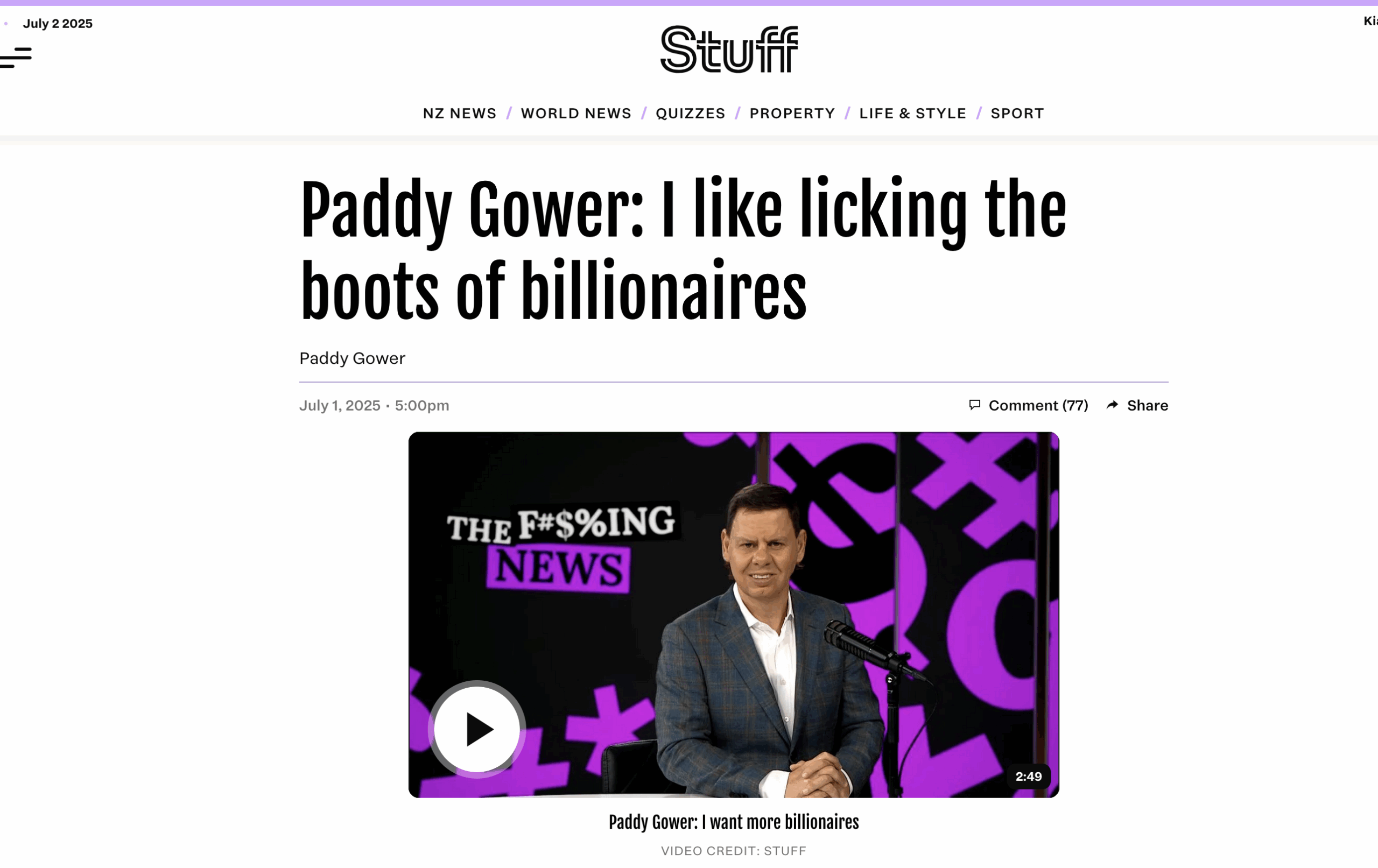
In a recent piece for Stuff, veteran journalist Paddy Gower expressed his delight at Jeff Bezos’s multimillion-dollar wedding and dismissed criticism of a proposed billionaire helipad in Williams-Mowbray. His closing line, “I just want more billionaires” was not satire. It was offered in earnest, a confession of desire for more wealth, more luxury, more power, imported into Aotearoa under the guise of economic development.
There’s something deeply revealing in this. Gower, promoted as a hard-hitting political reporter, is using his platform to openly cheer for the ultra-rich. But he’s not alone. His article is symptomatic of a broader media culture in Aotearoa that increasingly embraces wealth as spectacle, celebrates elite consumption, and dismisses grassroots resistance to capitalist encroachment as trivial or naive.
As anarcho-communists, we reject this narrative entirely. We don’t want more billionaires. We want none. We want a world without exploitation, without elite land grabs, without jetsetters carving up our whenua for their private pleasure. Gower’s article isn’t just tone-deaf, it’s an ideological endorsement of everything we’re fighting to dismantle.
The Wedding as Spectacle
Gower begins with a flourish, “I loved the Bezos wedding.” He confesses a guilty pleasure in watching the absurdly extravagant nuptials unfold. But this kind of “guilty pleasure” is far from harmless. When the ultra-rich throw grandiose, hyper-consumptive events, they aren’t just celebrating, they are asserting a global social order. The message is clear – the world exists to serve their fantasies, no matter the cost to climate, labour, or community.
This is not an apolitical spectacle. It’s a performance of domination.
Billionaires like Bezos do not simply accumulate wealth; they reshape cities, supply chains, and entire planetary ecosystems in their image. Their weddings, yachts, and rockets are not just excess, they are material expressions of a system that demands the dispossession of the many for the pleasure of the few.
When Gower celebrates such events as entertainment, he normalises that dispossession. He teaches us not to question it. He trains our attention on the dazzling surface, away from the violence that sustains it.
The Helipad Debate: A Case of Local Resistance
Later in the article, Gower waves away concerns about the proposed helipad development on Wellington’s green belt, part of the Williams-Mowbray estate. The development would allow billionaires to bypass the city and land directly in their luxury enclave, quietly circumventing public processes, environmental concerns, and community input.
To Gower, this is unimportant, a “non-issue.” But that’s easy to say from the comfort of media celebrity, far removed from the daily grind of renters, workers, and tangata whenua defending their right to access and care for the land.
The helipad controversy is not about envy or tall poppy syndrome, as Gower claims. It is about power, the power of the wealthy to reconfigure public space for private convenience, and the creeping erosion of collective control over our shared environment. It is about the widening chasm between those who move through the world by helicopter, and those who catch three buses and still can’t afford the rent.
To dismiss this as a side show is to side with enclosure. It is to say, implicitly, that the rich should be free to do what they like, and the rest of us should shut up and watch.
“I Just Want More Billionaires”: The Ideology Behind the Statement
At the heart of Gower’s piece is this astonishing admission, “I just want more billionaires.” He offers this not as critique or irony, but as aspiration. In his view, billionaires bring glamour, jobs, capital. They are, somehow, the answer to what ails Aotearoa.
Let’s unpack this fantasy.
What does it mean to want more billionaires? It means welcoming further concentration of wealth and power into the hands of a tiny elite. It means embracing a system where the fortunes of a few come at the expense of the many. It means approving the logic of private jets, mega-mansions, and speculative capital while ordinary people live in cars, shelters, or overcrowded flats.
To want more billionaires is to want more inequality.
It is also to want less democracy. Billionaires don’t just consume, they dominate. They fund political parties, shape media narratives, and lobby against taxation, regulation, and workers’ rights. They hollow out the commons while selling us their philanthropy as salvation.
And in Aotearoa, they bring with them a colonial logic – that the land is there to be bought, fenced off, and enjoyed by the rich. That whenua is just real estate, to be accessed by helicopter if needed. That local voices, including Māori ones, are to be tolerated only when convenient.
Gower’s desire for more billionaires is not a neutral preference. It is an invitation to intensify capitalist enclosure, environmental destruction, and social hierarchy.
Against the Spectacle: What We Really Need
We don’t need more billionaires. We need fewer landlords. We need more public housing. We need universal access to healthcare and education. We need food sovereignty, community-owned energy, and the return of stolen land. We need an economic system that values people over profit, life over luxury.
In short, we need a rupture with the capitalist order Gower celebrates.
This isn’t about jealousy or moralism. It’s about survival. We are living through climate collapse, a housing crisis, and spiralling mental health epidemics, all driven in large part by the economic system that produces billionaires. Their accumulation is not incidental to our suffering. It is its cause.
Billionaires are not just rich individuals. They are structural expressions of capitalism’s failure to meet human and ecological needs. Their very existence is incompatible with a just society.
To challenge them is not to indulge envy – it is to defend our lives.
Media and the Manufacture of Consent
That a prominent journalist would so brazenly advocate for billionaire expansion is revealing. It tells us something about the role of mainstream media in contemporary Aotearoa – not as a check on power, but as its marketing wing.
Rather than scrutinising wealth, much of the media now celebrates it. Rather than platforming the voices of workers, renters, or tangata whenua, it obsesses over real estate portfolios, luxury developments, and the movements of tech oligarchs.
This is not accidental. Media outlets are increasingly owned, influenced, or funded by capital. Their revenue models depend on advertising and corporate access. And their cultural sensibility is shaped by the worldviews of the comfortable, not the struggling.
What Gower offers, then, is not a rogue opinion, it is a distilled version of a dominant ideology. One that says progress comes from above, from the rich, from overseas. One that sees democracy as obstruction, and community concerns as noise.
As anarcho-communists, we reject this utterly. We believe in bottom-up media, rooted in community, accountable to the people, committed to truth and liberation. We need stories that lift up resistance, not consumption; that challenge wealth, not flatter it.
The Path Forward: Build Collective Power
What, then, is to be done?
We must organise. At the community level, we can fight billionaire encroachment, be it helipads, luxury developments, or speculative land grabs. We can demand participatory planning processes, environmental protections, and respect for Māori sovereignty.
At the economic level, we must build alternatives: housing co-operatives, workers’ collectives, mutual aid networks, and public commons that operate outside of profit logics. We must push for wealth taxes, land reform, and the decommodification of essential services.
And at the cultural level, we must reject the spectacle. We must unlearn the worship of wealth and embrace a politics of solidarity. The Bezos wedding is not a dream, it is a distraction from everything that matters.
We can no longer afford to be dazzled.
Aotearoa Beyond Billionaires
Paddy Gower’s article is not just a one-off opinion, it is a symptom of a deeper sickness in our culture. A sickness that equates wealth with worth, privilege with progress, domination with development.
But another Aotearoa is possible. One where land is held in common. One where resources are shared. One where power flows from the people, not from capital. One where community, not consumption, is the measure of success.
We don’t want more billionaires. We want liberation from the system that creates them.
And that liberation begins not in media boardrooms or luxury wedding venues, but in the streets, the unions, the collectives, and the whenua, where people still fight, still organise, still believe in a world without billionaires at all.