blog

The Wealth Pyramid and the Illusion of Progress – Global Capitalist Inequality

The latest figures from the 2025 UBS Global Wealth Report confirm a fact that many of us live every day but are rarely encouraged to fully name: the world is not merely unequal; it is grotesquely and systemically so. Just 1.6% of the world’s adult population now controls 48.1% of all personal wealth. That amounts to about 60 million individuals holding $226 trillion in net worth, while the bottom half of the global population – nearly four billion people – share less than 1% of all personal wealth. This is not a failure of the system. It is the system.

In capitalist mythology, wealth is presumed to be the natural outcome of hard work, innovation, or risk-taking. But the sheer scale of this concentration defies any such moral logic. We are not talking about millionaires flourishing due to their talent or thrift. We are dealing with a global oligarchy, a structure of domination so entrenched that it renders the daily struggles of most of the world’s population invisible or irrelevant in the eyes of power. To make sense of this arrangement, we must strip away the illusions of meritocracy, reform, and nationalist development, and instead see capitalism for what it is – a machinery for the extraction and concentration of wealth, backed by state violence, debt coercion, and ideological mystification.

This article is based on the findings presented in Michael Roberts’ summary of the Global Wealth Report . We argue that wealth inequality is not a by-product of mismanagement or corruption, but the predictable and necessary outcome of capitalist property relations. Any attempt to “redistribute” wealth within the bounds of existing state and market frameworks is doomed to fail, not because redistribution is impossible, but because capitalism requires inequality as its central organising principle.

Capitalist Accumulation and the Architecture of Inequality

The UBS report maps what it calls the “global wealth pyramid”, an illustration of class war from above. According to the data, 82% of the world’s adults, 3.1 billion people own just 12.7% of global wealth, placing them in the “middle and lower strata” of the pyramid. At the same time, the top 18.2% (680 million people) control a staggering 87.3% of all personal assets. This means that the vast majority of human labour, time, care, creativity, and sacrifice is ultimately converted into value that benefits an elite minority.

In Roberts’ summary, he rightly highlights the role of financial assets, stocks, bonds, derivatives, in driving inequality. This reflects a deeper shift in capitalism since the 1970s – a movement from industrial capital to financial capital, from the factory floor to the stock exchange, from exploitation through production to exploitation through speculation. In 2024 alone, global financial wealth grew by 6.2%, while real property wealth grew by only 1.7%. In other words, the rich got richer simply by owning the instruments of capital, while the rest of us slogged through stagnant wages, debt burdens, rising rents, and environmental collapse.

This is not wealth as most people understand it, homes, savings, or personal security. It is wealth as control, over markets, states, livelihoods, and futures. It is wealth as a weapon.

The Geography of Exploitation

The global wealth distribution also exposes the regional dimensions of capitalist inequality. North America and Eastern Europe saw the largest increases in wealth last year, while Latin America, Oceania, and Western Europe experienced declines. On average, a North American adult holds almost six times more wealth than a Chinese adult, twelve times more than someone in Eastern Europe, and nearly twenty times more than a Latin American adult.

But regional averages obscure class dynamics. The top 1.6% of wealthy individuals are scattered globally. They may reside in different countries, but they inhabit the same class – a transnational bourgeoisie whose loyalty is to capital, not community, and whose interests are preserved through military alliances, trade agreements, and international financial institutions. Whether they are oligarchs in Moscow, bankers in Zurich, tech moguls in San Francisco, or real estate tycoons in Auckland, they benefit from the same underlying system of dispossession.

This is why appeals to “national development” or “economic patriotism” ring hollow. No nation, however rhetorically independent, can insulate itself from the logic of accumulation without fundamentally breaking with capitalism itself. The wealth gap is not merely between the Global North and South, but between owners and non-owners, between capital and life.
Debt, Discipline, and the Myth of Opportunity

Roberts’ figures focus on net worth – assets minus liabilities – but the centrality of debt to the global wealth system deserves sharper attention. For the majority of the global population, debt is not a tool of investment, but a mechanism of control. People borrow to survive, to pay rent, buy food, access healthcare, get an education. Meanwhile, the wealthy use debt as leverage, a way to multiply their capital, avoid taxes, and speculate with other people’s futures.

Debt enforces discipline. It ensures compliance, obedience, and docility. A person in debt cannot strike. A person in debt cannot relocate, protest, or say no to exploitation. Debt is the modern chain, and it binds workers as surely as any physical shackle.

Moreover, the capitalist system sells the myth that upward mobility is possible for anyone who works hard enough. But the wealth data makes clear that mobility is the exception, not the rule. Capital begets capital. The rich have access to compound interest, diversified portfolios, and tax havens. The poor have payday loans, rising rents, and wage theft.

This isn’t just about inequality. It’s about entrapment.

State and Capital: Partners in Plunder

It would be naïve to assume that this wealth concentration occurred in a vacuum, or in spite of governments. In reality, states are key partners in the preservation and expansion of capitalist inequality. Through tax cuts for the rich, bank bailouts, privatisation, austerity, and militarised policing, governments in both liberal democracies and authoritarian regimes ensure that the rules remain stacked in favour of capital.

Even where progressive reforms are introduced,welfare programs, wealth taxes, public housing, they are often eroded over time, captured by elites, or restricted by legal frameworks designed to protect private property above all else.

This is not accidental. The capitalist state does not exist to serve “the people.” It exists to guarantee the conditions necessary for capital accumulation, and to suppress any serious threats to that accumulation. Courts, police, prisons, and parliaments are not neutral institutions, they are class instruments. Their primary role is to maintain the legitimacy and smooth functioning of capitalist rule, even when dressed in democratic robes.

Beyond Redistribution: The Case for Abolition

Faced with such staggering inequality, liberal reformers often call for redistribution through wealth taxes, basic income, progressive taxation, or stakeholder capitalism. While some of these policies might alleviate immediate suffering, they ultimately leave the core structure of exploitation intact.

Redistribution assumes that the problem is one of outcomes, not origins. But the problem is ownership itself, the private ownership of the means of life. As long as housing, health, education, energy, land, and information are privately owned and controlled, then wealth will continue to flow upward, no matter how clever the tax code.

What we need is not redistribution, but abolition. We must dismantle the structures, legal, financial, and ideological, that make it possible for one person to own the labour and life of another. This means expropriating landlords, cancelling debt, eliminating inheritance, and building new systems based on cooperation, mutual aid, and horizontal decision-making.

It also means rejecting the illusion that states can deliver liberation. History shows us that even leftist governments, when operating within the capitalist framework, become tools of compromise and co-optation. True emancipation must come from below through direct action, popular assemblies, federated communes, and mass refusal.

Imagining the World to Come

The figures from the UBS report are chilling, but they also reveal the cracks in the system. If a tiny elite can hoard nearly half the planet’s wealth, then that wealth is not invincible. It is vulnerable. It is located. It can be seized, reappropriated, and transformed.

The path forward is not easy. It requires organisation, courage, and solidarity across borders and identities. It requires rebuilding the social fabric shredded by decades of neoliberal atomisation. But it is possible.

Imagine a world where housing is a right, not an asset. Where energy is produced by cooperatives for need, not profit. Where no one is in debt for being sick, educated, or alive. Where care is collective, decisions are democratic, and wealth is measured not in dollars but in joy, security, and shared abundance.

Such a world cannot coexist with the wealth pyramid. It must be levelled — not just through policy, but through revolution.

Michael Roberts’ analysis of global wealth inequality confirms what anarcho-communists have long known: capitalism is not broken; it is working exactly as intended. It creates wealth for the few by extracting value from the many. It relies on debt, exploitation, and state violence to preserve this order. And it is incapable of delivering justice, equality, or freedom.

The only way forward is to dismantle the architecture of accumulation and replace it with systems rooted in solidarity, not scarcity; cooperation, not competition; freedom, not coercion.

The time has come to abolish the pyramid.

Against Billionaire Worship: A Response to Paddy Gower’s Celebration of Capitalist Excess

In a recent piece for Stuff, veteran journalist Paddy Gower expressed his delight at Jeff Bezos’s multimillion-dollar wedding and dismissed criticism of a proposed billionaire helipad in Williams-Mowbray. His closing line, “I just want more billionaires” was not satire. It was offered in earnest, a confession of desire for more wealth, more luxury, more power, imported into Aotearoa under the guise of economic development.

There’s something deeply revealing in this. Gower, promoted as a hard-hitting political reporter, is using his platform to openly cheer for the ultra-rich. But he’s not alone. His article is symptomatic of a broader media culture in Aotearoa that increasingly embraces wealth as spectacle, celebrates elite consumption, and dismisses grassroots resistance to capitalist encroachment as trivial or naive.

As anarcho-communists, we reject this narrative entirely. We don’t want more billionaires. We want none. We want a world without exploitation, without elite land grabs, without jetsetters carving up our whenua for their private pleasure. Gower’s article isn’t just tone-deaf, it’s an ideological endorsement of everything we’re fighting to dismantle.

The Wedding as Spectacle

Gower begins with a flourish, “I loved the Bezos wedding.” He confesses a guilty pleasure in watching the absurdly extravagant nuptials unfold. But this kind of “guilty pleasure” is far from harmless. When the ultra-rich throw grandiose, hyper-consumptive events, they aren’t just celebrating, they are asserting a global social order. The message is clear – the world exists to serve their fantasies, no matter the cost to climate, labour, or community.

This is not an apolitical spectacle. It’s a performance of domination.

Billionaires like Bezos do not simply accumulate wealth; they reshape cities, supply chains, and entire planetary ecosystems in their image. Their weddings, yachts, and rockets are not just excess, they are material expressions of a system that demands the dispossession of the many for the pleasure of the few.

When Gower celebrates such events as entertainment, he normalises that dispossession. He teaches us not to question it. He trains our attention on the dazzling surface, away from the violence that sustains it.

The Helipad Debate: A Case of Local Resistance

Later in the article, Gower waves away concerns about the proposed helipad development on Wellington’s green belt, part of the Williams-Mowbray estate. The development would allow billionaires to bypass the city and land directly in their luxury enclave, quietly circumventing public processes, environmental concerns, and community input.

To Gower, this is unimportant, a “non-issue.” But that’s easy to say from the comfort of media celebrity, far removed from the daily grind of renters, workers, and tangata whenua defending their right to access and care for the land.

The helipad controversy is not about envy or tall poppy syndrome, as Gower claims. It is about power, the power of the wealthy to reconfigure public space for private convenience, and the creeping erosion of collective control over our shared environment. It is about the widening chasm between those who move through the world by helicopter, and those who catch three buses and still can’t afford the rent.

To dismiss this as a side show is to side with enclosure. It is to say, implicitly, that the rich should be free to do what they like, and the rest of us should shut up and watch.

“I Just Want More Billionaires”: The Ideology Behind the Statement

At the heart of Gower’s piece is this astonishing admission, “I just want more billionaires.” He offers this not as critique or irony, but as aspiration. In his view, billionaires bring glamour, jobs, capital. They are, somehow, the answer to what ails Aotearoa.

Let’s unpack this fantasy.

What does it mean to want more billionaires? It means welcoming further concentration of wealth and power into the hands of a tiny elite. It means embracing a system where the fortunes of a few come at the expense of the many. It means approving the logic of private jets, mega-mansions, and speculative capital while ordinary people live in cars, shelters, or overcrowded flats.

To want more billionaires is to want more inequality.

It is also to want less democracy. Billionaires don’t just consume, they dominate. They fund political parties, shape media narratives, and lobby against taxation, regulation, and workers’ rights. They hollow out the commons while selling us their philanthropy as salvation.

And in Aotearoa, they bring with them a colonial logic – that the land is there to be bought, fenced off, and enjoyed by the rich. That whenua is just real estate, to be accessed by helicopter if needed. That local voices, including Māori ones, are to be tolerated only when convenient.

Gower’s desire for more billionaires is not a neutral preference. It is an invitation to intensify capitalist enclosure, environmental destruction, and social hierarchy.

Against the Spectacle: What We Really Need

We don’t need more billionaires. We need fewer landlords. We need more public housing. We need universal access to healthcare and education. We need food sovereignty, community-owned energy, and the return of stolen land. We need an economic system that values people over profit, life over luxury.

In short, we need a rupture with the capitalist order Gower celebrates.

This isn’t about jealousy or moralism. It’s about survival. We are living through climate collapse, a housing crisis, and spiralling mental health epidemics, all driven in large part by the economic system that produces billionaires. Their accumulation is not incidental to our suffering. It is its cause.

Billionaires are not just rich individuals. They are structural expressions of capitalism’s failure to meet human and ecological needs. Their very existence is incompatible with a just society.

To challenge them is not to indulge envy – it is to defend our lives.

Media and the Manufacture of Consent

That a prominent journalist would so brazenly advocate for billionaire expansion is revealing. It tells us something about the role of mainstream media in contemporary Aotearoa – not as a check on power, but as its marketing wing.

Rather than scrutinising wealth, much of the media now celebrates it. Rather than platforming the voices of workers, renters, or tangata whenua, it obsesses over real estate portfolios, luxury developments, and the movements of tech oligarchs.

This is not accidental. Media outlets are increasingly owned, influenced, or funded by capital. Their revenue models depend on advertising and corporate access. And their cultural sensibility is shaped by the worldviews of the comfortable, not the struggling.

What Gower offers, then, is not a rogue opinion, it is a distilled version of a dominant ideology. One that says progress comes from above, from the rich, from overseas. One that sees democracy as obstruction, and community concerns as noise.

As anarcho-communists, we reject this utterly. We believe in bottom-up media, rooted in community, accountable to the people, committed to truth and liberation. We need stories that lift up resistance, not consumption; that challenge wealth, not flatter it.

The Path Forward: Build Collective Power

What, then, is to be done?

We must organise. At the community level, we can fight billionaire encroachment, be it helipads, luxury developments, or speculative land grabs. We can demand participatory planning processes, environmental protections, and respect for Māori sovereignty.

At the economic level, we must build alternatives: housing co-operatives, workers’ collectives, mutual aid networks, and public commons that operate outside of profit logics. We must push for wealth taxes, land reform, and the decommodification of essential services.

And at the cultural level, we must reject the spectacle. We must unlearn the worship of wealth and embrace a politics of solidarity. The Bezos wedding is not a dream, it is a distraction from everything that matters.

We can no longer afford to be dazzled.

Aotearoa Beyond Billionaires

Paddy Gower’s article is not just a one-off opinion, it is a symptom of a deeper sickness in our culture. A sickness that equates wealth with worth, privilege with progress, domination with development.

But another Aotearoa is possible. One where land is held in common. One where resources are shared. One where power flows from the people, not from capital. One where community, not consumption, is the measure of success.

We don’t want more billionaires. We want liberation from the system that creates them.

And that liberation begins not in media boardrooms or luxury wedding venues, but in the streets, the unions, the collectives, and the whenua, where people still fight, still organise, still believe in a world without billionaires at all.

Fight the Power: Aotearoa’s Struggle Against Authority, Capital, and Colonialism

Fight the power” is more than a slogan. It’s a lifeline. A declaration. A refusal. It’s the rallying cry of the dispossessed and defiant. In Aotearoa, it means confronting every institution built on theft, control, and exploitation—from the colonial state to the capitalist system, to the social hierarchies that divide us.

The Power We’re Fighting

To fight the power is to understand it. The power we oppose in Aotearoa didn’t arrive by accident or evolve peacefully, it was forged through violence, cemented by colonisation, and polished into “respectability” through the institutions of state, law, education, and media.

In Aotearoa, power wears a number of faces: the Crown, the police, Parliament, capital, the landlord class, the boss. But its structure is always the same – some rule, most obey. It is enforced from above and justified with myths: that it’s inevitable, that it’s for our own good, that it’s democratic, even benevolent.

But power in this system means the right to hoard land stolen from tangata whenua. It means landlords profiting off a housing crisis while whānau sleep in cars. It means police shooting young Māori men and then being “investigated” by their mates. It means an economy designed not to meet human need but to produce endless growth for the few while the many go hungry, cold, and overworked.

It means people are told they’re failures when they can’t survive a system designed to fail them.

To fight the power is to unmask this system and burn away the illusion of neutrality.

Colonisation Was the Original Power Grab

The colonial state didn’t arrive with democracy. It arrived with rifles, missionaries, and contracts written in bad faith. Te Tiriti o Waitangi was supposed to establish a partnership. Instead, it became the legal smokescreen for land theft, militarised invasion, and economic domination.

In the 1800s, Māori land was stolen under the guise of “civilising” missions. But the real mission was profit. Māori were forced off their whenua so settlers could plant sheep and wheat for the Empire. When iwi resisted, the Crown sent in troops. Resistance was met with massacres. Mana motuhake was criminalised. Indigenous authority was replaced by British law. Tino rangatiratanga was ignored.

Colonisation isn’t just a historic event—it’s a present-tense system. It lives on in state structures that still deny Māori sovereignty. In prisons disproportionately filled with Māori. In urban planning that displaces Māori communities. In the exploitation of Māori labour and the suppression of tikanga in schools and workplaces.

Anarcho-communism in Aotearoa must begin with decolonisation. Not as a metaphor, but as a practical, ongoing process of dismantling Pākehā authority and returning land and power to Māori.

Fighting the power in this context means refusing to play the role of the “good settler” and instead standing in solidarity with indigenous resistance movements. It means recognising that our liberation is bound up with theirs, and that without land back, there is no justice.

The Police Protect Power, Not People

Let’s be clear: the police are not neutral. They were created to protect property and enforce colonial control, not to keep people safe. In fact, the first New Zealand police forces were established to suppress Māori resistance in the mid-1800s. Their mission hasn’t changed.

Every time the cops evict a family from a Kāinga Ora home, arrest a protester, or shoot a young Māori man, they are enforcing capitalist and colonial order. Every time they patrol poor neighbourhoods instead of investigating corporate tax fraud, they remind us who they really serve.

Police violence is not an aberration. It’s the system working as intended.

Calls to “reform” the police misunderstand their purpose. You can’t reform a colonial militia. You abolish it. You defund it. You dismantle the carceral state and replace it with community-led approaches to harm, justice, and safety.

Real safety comes from solidarity, not surveillance. It comes from housing, health care, kai sovereignty, and connection—not from tasers and tear gas.

Capitalism Is the Daily Power Drain

Capitalism is the great battery of power. It drains us of our time, our health, our energy to charge the bank accounts of the rich.

Every week in Aotearoa, thousands of people wake up exhausted, anxious, and dreading work they hate. Not because they’re lazy. Because the economy demands they trade their lives away for survival. Rent, debt, food, bills, these aren’t just costs. They’re chains.

The average wage doesn’t cover the cost of living, and benefits are kept below the poverty line by design. Meanwhile, the 1% accumulate wealth at a rate that would make even colonial governors blush.

Capitalism turns need into profit. You need housing? Here’s a landlord who’ll drain half your income. You need food? Here’s a supermarket cartel price-gouging your weekly shop. You need work? Here’s a boss who’ll surveil your bathroom breaks and fire you for being late.

There is no ethical capitalism. There’s no just version of wage labour. Capitalism is structured around coercion. You work or you starve. You rent or you freeze.

Fighting the power means fighting capitalism. Not by appealing to Labour governments or “kind capitalism” or ESG investing. But by building dual power: co-ops, mutual aid networks, food forests, tenant unions, worker solidarity networks. Every moment we reclaim from profit is a moment of real freedom.

The Power of Patriarchy and White Supremacy

Domination doesn’t only come from above; it’s also reinforced laterally between us. Patriarchy and white supremacy are systems of control that fracture our class, our resistance, and our capacity to build collective futures.

White supremacy in Aotearoa is not just in slurs and swastikas. It’s in who gets the job. Who gets listened to. Who gets stopped by police. Who has access to intergenerational wealth and who has trauma from generations of dispossession and violence.

Likewise, patriarchy is in the power imbalance in relationships, the undervaluing of care work, the expectation that women and gender-diverse people must manage emotion, keep the peace, and clean up the mess created by men trained to dominate.

To fight the power means confronting these systems not just in society, but in ourselves. It means decolonising our relationships. Unlearning dominance. Learning to listen, to be accountable, to be soft where we were taught to be hard.

Anarcho-communism is a relational politics. Our goal is not just to destroy hierarchy but to build new, liberated ways of being that are non-hierarchical, feminist, anti-racist, queer-affirming, interdependent.

Parliament Is a Power Trap

Every election cycle, the system dusts itself off and asks for your trust. Parties pitch their platforms. Billboards go up. Promises are made. And then nothing really changes.

Housing gets worse. Benefits stagnate. Prisons expand. Police budgets grow. The climate burns. The left tells you to vote harder. But Parliament is not where power lives. It’s where resistance goes to die.

Even the most well-meaning MPs are caught in the machinery of a settler-capitalist state. The job of Parliament is to manage capitalism and maintain order. The job of radicals is to smash that order and build something better.

That doesn’t mean doing nothing. It means building outside the ballot box. Strikes. Occupations. Direct action. Autonomous spaces. Land back. It means organising in ways that can’t be bought off, silenced, or co-opted.

The state will never give us liberation. We take it, together, from below.

The Power of Solidarity

Fighting the power is not a solo mission. It’s collective. Power isolates. Solidarity unites.

We build power not through hierarchy, but through horizontal organising. Not through charismatic leaders, but through shared responsibility. Not through control, but through consent.

In every tenancy union that forces a landlord to back down, every picket line that wins higher pay, every decolonial hui that reclaims tikanga from colonial erasure, we see it. Real power lies with the people. When we move together, we can’t be stopped.

Mutual aid, too, is a revolutionary act. Not because it’s charity—but because it decentralises care, redistributes resources, and reminds us of our collective strength. Every community fridge, every radical childcare collective, every zine distro, every seed bank – these are the seeds of the world we want.

The revolution won’t look like a Hollywood explosion. It will look like a thousand hands sowing liberation together.

The Power of Refusal

Sometimes, the most radical thing you can do is say no.

No to the boss who wants you to work unpaid overtime.
No to the cop who asks where you’re going.
No to the landlord who raises your rent.
No to the state that wants to register, track, and control you.
No to the inner voice that says you’re alone, powerless, or crazy for dreaming of something better.

Refusal is a muscle. The more we practice it, the stronger we become.

We refuse to be cogs in their machines.
We refuse to be soldiers for their wars.
We refuse to be obedient voters in their rigged games.

We refuse to live lives defined by their violence.

The Power We Build

To fight the power is to build another one in its place. Not a copy. Not a new party or ideology. But a whole new logic – one based on autonomy, mutual aid, direct democracy, and care.

It’s a slow, messy, beautiful process.

We build worker co-ops where profit doesn’t dominate.
We build community housing on stolen land returned.
We build free clinics where care isn’t rationed.
We build schools where curiosity thrives, not compliance.

We build with the understanding that liberation is not a future destination—it’s a way of moving now.

Final Words

“Fight the power” is not just a slogan to chant. It’s a lens. A practice. A politics of refusal and creation.

In Aotearoa, it means fighting the colonial state, the capitalist economy, the gendered and racialised violence that props it all up—and building something else from the ground up – a society without prisons, without landlords, without bosses, without borders.

We fight not because we believe we will win overnight.

We fight because we cannot unsee what this world does to the people we love.

We fight because we believe, deeply, in each other.

We fight the power—because the power has never fought for us.

Start-Ups Can’t Save Us: An Anarcho-Communist Response to the Cult of Entrepreneurship

Be your own boss.
Disrupt the system.
Chase your passion.
Monetise your dream.

These are the slogans of a society desperately trying to convince itself that freedom can be found inside a cage—as long as you decorate the bars with your own logo.

In today’s capitalist dystopia, entrepreneurship is sold as a way out. Out of poverty, out of dead-end jobs, out of oppression. If you hustle hard enough, brand yourself well enough, and get on the right side of an algorithm, you too can escape the grind. You can be “free.” You can win.

But anarcho-communists know better. Entrepreneurship is not a challenge to capitalism, it is one of its most seductive lies. It promises empowerment while deepening alienation. It markets autonomy while reinforcing exploitation. It encourages people to internalise the system’s logic, calling it creativity.

This critique of entrepreneurship culture is not because we don’t believe in creativity, initiative, or self-determination, but because we want those things freed from the profit motive, private property, and market discipline. We don’t want to be our own bosses. We want no bosses.

The Entrepreneur as Myth: From Barbed Wire to Business School

Capitalism has always needed myths to justify itself. The entrepreneur is one of its most powerful.

The idea is simple: a self-made individual with vision, hustle, and courage builds something from nothing. It’s the rags-to riches story rebooted for the age of TikTok and TED Talks. The entrepreneur doesn’t exploit, they innovate. They don’t dominate, they inspire.

But this is a lie.

Historically, many of the first “entrepreneurs” were slave owners, colonisers, and war profiteers. The modern myth of entrepreneurship hides the violence at capitalism’s roots: enclosure, genocide, forced labour. The original start-up capital was often stolen land and stolen people.

Even today, entrepreneurship relies heavily on inherited wealth, racial and gender privilege, and global labour exploitation. Venture capital funds “visionary” founders while migrant workers clean their offices and build their gadgets. Behind every tech platform is a factory, a warehouse, a mine.

There is no such thing as a self-made billionaire. There is only structural theft, laundered through branding.

Entrepreneurship Is Capitalism Rebranded

The entrepreneur is marketed as an outsider—a rebel disrupting the system. But in reality, entrepreneurship is capitalism distilled to its purest form.

It celebrates private ownership, competition, and profit accumulation. It rewards individualism, scarcity thinking, and hyper-productivity. It demands we treat every moment of our lives as an opportunity to optimise and monetise.

Entrepreneurs are taught to treat people as markets, needs as niches, and care as a service you can charge for. The business model becomes the lens through which all human activity is filtered.

Start a podcast, not a union.
Sell herbal tea blends, not mutual aid.
Build an app for loneliness, don’t challenge the atomisation that causes it.

The system doesn’t want you to question why the world is broken. It wants you to build a product that pretends to fix it.

Hustle Culture Is the New Discipline

Under industrial capitalism, discipline came from the clock, the manager, the factory bell. Today, we wear our bosses in our pockets. The discipline is internalised.

Entrepreneurship culture is hustle culture: wake up at 5am, sacrifice your weekends, work 80 hours now to “live like a boss” later. It’s the Protestant work ethic with an Instagram filter. Burnout is a badge of honour. Exhaustion is reframed as passion.

This culture weaponises autonomy. It says: if you’re still poor, you didn’t hustle hard enough. If your mental health is crumbling, you didn’t meditate hard enough. If your product failed, it’s your fault—not the economy, not systemic inequality, not the parasitic rentier class.

Hustle culture turns systemic failure into personal shame.

In place of solidarity, it gives you self-help. In place of community, it gives you branding. In place of revolution, it gives you marketing funnels.

Entrepreneurship Reinforces Inequality

Start-ups don’t democratise wealth—they concentrate it. The tech industry is a prime example. A handful of founders reap unimaginable profits while workers are casualised, underpaid, and overworked. Gig economy “entrepreneurship” turns taxi drivers and delivery workers into algorithmically managed serfs.

In the Global South, micro-entrepreneurship is pushed as “development” while structural adjustment and debt traps keep countries impoverished. Selling second-hand clothes or SIM cards on the street isn’t empowerment—it’s survival in the wreckage of neoliberalism.

Even when entrepreneurship is presented as a tool for marginalised people—like Indigenous, Black, queer, or disabled entrepreneurs—it often ends up co-opting resistance into the marketplace. Cultural traditions, identities, and struggles are commodified for profit. Authenticity becomes a marketing asset.

Representation is not liberation. One oppressed person with a brand is not a threat to capitalism. It’s often a way for capitalism to absorb, sanitise, and repackage dissent.

The Logic of Entrepreneurship Is Anti-Communal

Entrepreneurship teaches people to see other people as competitors. If someone starts a community garden, you start a branded organic food business. If someone gives things away, you figure out how to monetise that service.

Scarcity becomes a business opportunity. Generosity becomes a threat.

This undermines social solidarity. Instead of sharing knowledge, we “protect our intellectual property.” Instead of organising collectively, we look for “market edge.” Even in social justice spaces, the logic of competition creeps in: who gets the grant, who gets the platform, who gets the followers.

This is no accident. Entrepreneurship atomises us. It trains us to hustle individually rather than act collectively. It replaces collective power with personal branding.

Under capitalism, even care work is being pulled into the market. Coaching, wellness, therapy—all increasingly commodified, all increasingly reserved for those who can pay. But healing is not a service. Community is not a business.

We need care that’s mutual, not monetised.

We Don’t Need More Bosses—We Need No Bosses

Entrepreneurship is often sold as an alternative to wage labour. “Don’t work for a boss—be your own boss.” But this just shifts the exploitation.

Entrepreneurs become their own tyrants, internalising capitalist discipline. And when they succeed, they hire others—becoming bosses themselves. They reproduce the same hierarchies they supposedly escaped.

We don’t need new bosses. We need no bosses. We don’t need more CEOs. We need co-operatives. We need collective ownership of land, resources, and labour. We need structures where no one accumulates power or profit at the expense of others.

Anarcho-communism offers a different model: worker self-management, federated decision-making, community control, solidarity economics. Not everyone clawing their way to the top of a pyramid—but dismantling the pyramid entirely.

Creativity Without Capitalism

Let’s be clear: we are not against creativity. We are not against initiative, invention, or passion. We want people to bake, build, brew, design, craft, plant, paint, and experiment. But we want that freed from the crushing pressures of profit and market survival.

Creativity under capitalism is distorted. Instead of asking “what does the world need?” we’re forced to ask “what can I sell?”

Art becomes content. Innovation becomes disruption. Culture becomes brand identity.

We want a world where creativity is shared, not sold. Where everyone has time, space, and resources to create—not just those who can monetise their talent. Where skills are passed on freely, not hidden behind paywalls. Where no one has to starve to be an artist.

In short: we want to socialise the means of expression, not just the means of production.

Alternatives: Mutual Aid, Co-operatives, Commons

So what does an anarcho-communist response look like in practice?

We reject the capitalist path of entrepreneurship and instead build systems rooted in mutual aid and solidarity. Examples include:

Worker co-operatives run democratically, without bosses, where surplus is shared.
Land trusts and food commons that provide for community need rather than market demand.
Mutual aid networks where people meet each other’s needs without conditions or profit.

Skillshares, hackerspaces, fablabs, and open-source communities where innovation is decentralised and shared.
Community currencies and resource libraries that challenge private ownership and enable non-monetary exchange.

These alternatives don’t replicate the logic of the market. They replace it. They are not about making the system more humane—they are about making it obsolete.

Entrepreneurship Is Not Liberation—It’s Adaptation

Capitalism survives by adapting. It doesn’t fear criticism—it absorbs it. That’s how we ended up with “feminist” venture capitalists, “green” start-ups, “ethical” banks, and “woke” billionaires.

Entrepreneurship is part of this co-option. It offers the illusion of autonomy while leaving the core structure of capitalism intact. It tells the poor and oppressed that their liberation lies in building a brand, not tearing down the system that exploits them.

Liberation cannot be bought. It cannot be pitched. It cannot be monetised.

We will not find freedom by branding ourselves better within capitalism. We will find freedom by destroying the conditions that force us to brand ourselves in the first place.

From Individual Escape to Collective Liberation

Entrepreneurship tells you to “bet on yourself.” We say: “bet on each other.”

Don’t climb the ladder. Kick it down.
Don’t build a brand. Build a commune.
Don’t pitch an idea to investors. Share it with your comrades.
Don’t dream of unicorns. Dream of revolution.

The path out of exploitation is not paved with business plans. It’s built through struggle, solidarity, and shared power. We don’t need more start-ups. We need shutdowns—of the rentier class, the corporate state, and the myth of meritocracy.

We reject the false freedom of the marketplace. We fight for the real freedom of the commons.

In a world where everything is commodified, to create without profit is rebellion. To organise without hierarchy is revolution.

We don’t want to be the next Jeff Bezos or Elon Musk. We want to abolish the conditions that make such people possible.

Safe Homes, Not Boot Camps: Why Real Justice Begins With Housing

In Aotearoa New Zealand, youth justice policy is often dominated by sensational headlines, alarmist rhetoric, and calls for punitive crackdowns. Yet a recent study from Otago University cuts through the noise and offers a radically simple insight: when young people have access to safe, stable housing, they are far less likely to come into contact with the criminal justice system. This finding, though unsurprising to anyone who understands the roots of social harm, exposes the deep contradictions at the heart of government approaches to both crime and housing.

The study analysed national-level data across multiple housing interventions and justice outcomes. It found that youth living in emergency housing, such as motels or shelters, saw no significant reduction in offending. But those placed in public housing—secure, long-term homes—were significantly less likely to be charged with offences over time. Three years after entering public housing, youth offending dropped by 11.7%, and court charges by 10.9%. Similarly, those receiving the Accommodation Supplement saw an 8.6% reduction in charges and a 13% drop in alleged offending.

In short: if you want to stop crime, give people homes. If you want to build a safer society, invest in community wellbeing, not punishment.

Housing Deprivation Is Structural Violence

What the state likes to call “youth offending” is often nothing more than the logical result of poverty, dislocation, and systemic neglect. It is not a coincidence that Māori and Pasifika youth, those most systematically excluded from stable housing, are overrepresented in our youth justice system. It is not a coincidence that areas with underfunded public infrastructure, precarious employment, and unaffordable housing are also the areas with higher rates of criminalisation.

The dominant narrative, however, frames these young people as the problem – unruly, disrespectful, in need of discipline. From this position, the solution can only be control: boot camps, ankle bracelets, curfews, youth prisons. But this narrative is not only wrong, it is actively harmful. It diverts attention away from the social and economic structures that create conditions of desperation in the first place.

Dr Chang Yu, lead author of the study, put it bluntly: “Cutting public housing supply threatens to reverse the progress achieved.” And yet this is precisely what the current government is doing. While touting a tough-on-crime stance, it is simultaneously slashing funding to Kāinga Ora, gutting public housing development, and restricting access to emergency accommodation. The contradiction is glaring – the same politicians who say they want to stop youth crime are dismantling the very social systems that keep young people out of the courts.

Crime Is a Failure of Capitalism, Not Morality

From an anarcho-communist perspective, this contradiction is no accident, it is a feature of the system. Capitalism produces inequality, and then punishes the poor for the conditions it has created. Housing, under capitalism, is not treated as a human right, but as a commodity to be bought, sold, speculated on, and hoarded for profit. Landlords profit from scarcity; property developers are incentivised to keep housing expensive; banks encourage debt servitude in the form of thirty-year mortgages.

In this environment, public housing becomes a threat. It challenges the idea that homes must be earned through market competition. It represents a form of collectivised provision, however flawed or bureaucratic, that sits uneasily alongside neoliberal dogma. That is why public housing is constantly under attack: not because it is ineffective, but because it works. Because it represents a crack in the logic of capitalist accumulation.

If we follow the logic of the Otago study to its conclusion, we are left with a radical proposition – crime prevention doesn’t begin with more police, more prisons, or more punishment. It begins with material conditions. It begins with food, housing, education, and care. In other words, it begins with communism, not in the abstract, but in the everyday sense of shared resources, mutual support, and collective flourishing.

The Punitive State Is a Dead End

Despite the clear evidence, the state doubles down on carceral logic. In the past year alone, the government has reintroduced the “Three Strikes” legislation, launched a Ram Raid Bill targeting youth with harsher sentences, and announced plans for military-style youth academies – boot camps in all but name.

These moves are not only ineffective; they are actively counterproductive. Boot camps do not reduce reoffending. What they do is isolate, traumatise, and entrench state power over the most marginalised. What they do is funnel youth into a pipeline of surveillance, punishment, and lifelong exclusion. All under the pretence of “restoring discipline.”

But discipline is not what young people need. They need stability. They need to know where they’re sleeping next week. They need food in the fridge, books in their bag, parents who aren’t being evicted or working three jobs just to cover the rent. They need a system that sees them as people, not problems to be fixed, or threats to be neutralised.

Imagining Housing as a Commons

If we are serious about building a future free from cycles of harm, we must go far beyond tinkering at the edges of state policy. We must decommodify housing entirely. Homes should not be sources of profit—they should be embedded in community control, operated through co-operatives, trusts, and iwi-led organisations accountable to those who live there.

This is not utopian. Across the world, examples exist – tenant-run housing collectives, land trusts that resist gentrification, squats transformed into thriving community centres. In Aotearoa, these ideas are not new, they align with traditions of papakāinga, of whānau-based living, of collectivised land use long suppressed by colonial and capitalist interests.

Imagine a housing system where land was not sold to developers but returned to hapū and iwi. Where tenants had real decision-making power over their homes and neighbourhoods. Where housing was integrated with education, health, gardens, and community care. Where “crime prevention” meant supporting people before the crisis hits, not punishing them after the fact.

This is the foundation of a non-carceral, post-capitalist society. A society rooted in tino rangatiratanga and class solidarity. A society that puts relationships before profit, and justice before punishment.

Organising for Real Change

To reach this future, we must organise. Tenants must unionise. Public housing residents must demand accountability and democratic governance. Land occupations, squats, and mutual aid projects must be supported, defended, and multiplied. We must call out the government’s lies when they slash housing budgets while claiming to protect the public.

We must push for a politics that links housing with prison abolition, colonial reparations, and ecological justice. Because these struggles are not separate, they are part of the same terrain.

We are told that justice looks like punishment. But justice, real justice, looks like housing. It looks like the absence of handcuffs, and the presence of home-cooked meals. It looks like young people painting murals, not waiting for court dates. It looks like warm, dry bedrooms, not boot camps. And if we want that world, we will have to build it together.

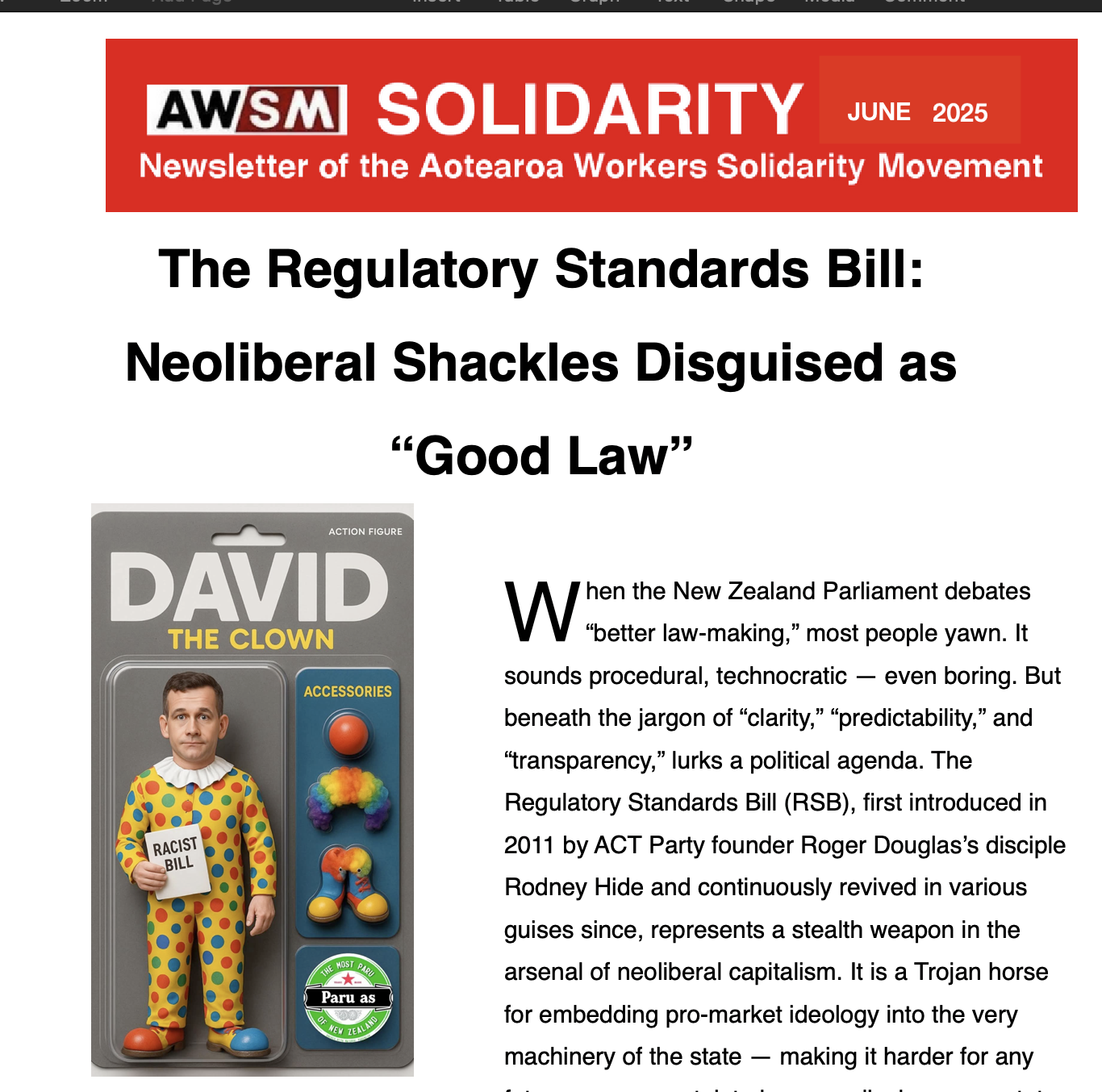
June 2025 Issue of Solidarity -Newsletter of Aotearoa Workers Solidarity Movement

Contents


The Regulatory Standards Bill: Neoliberal Shackles Disguised as “Good Law”
Rebuke and Resistance: Te Pāti Māori’s Protest, Abstentionism, and the Path to Indigenous Sovereignty

Pay Equity Protest

Greenwashed Capitalism: The Limits of the Green Party’s 2025 Budget

Available from: https://awsm4u.noblogs.org/post/2025/06/01/july-2025-issue-of-solidarity-newsletter-of-aotearoa-workers-solidarity-movement/

The Employment Relations Amendment Bill: A State-Sanctioned Assault on the Working Class

The National-ACT-New Zealand First coalition government’s Employment Relations Amendment Bill (ERAB), will see a sweeping series of legislative changes that reshape the legal terrain of labour in Aotearoa. These changes, billed by the government as necessary for “labour market flexibility” and “economic growth,” represent a radical rollback of worker protections. Cloaked in technocratic language and presented as pragmatic reform, the bill in fact amounts to a systemic attack on organised labour, unionism, and the basic rights of working people.

ERAB does not signal the failure of the state to protect workers, it reveals the true nature of the state itself. The bill should be understood not as a policy misstep, but as a calculated act of class warfare by a government acting as the political arm of capital.

What the Bill Contains

At the heart of the Employment Relations Amendment Bill lies a multi-pronged effort to deregulate labour protections and entrench power in the hands of employers. There are four major pillars to this legislative shift:

  1. The Introduction of a “Contractor Gateway Test”
  2. The Limitation of Personal Grievance Remedies
  3. The Repeal of the 30-Day Rule for New Employees
  4. The Restoration of Employer Powers to Deduct Wages During Partial Strikes

Each of these measures contributes to the erosion of worker autonomy and legal protections, and together they mark a sharp rightward shift in employment law—one that prioritises capital accumulation over dignity, security, or fairness.

Institutionalising Insecurity: The Contractor Gateway Test

Perhaps the most structurally damaging reform is the introduction of a “contractor gateway test.” This test is intended to establish a legal presumption that certain workers are not employees, but independent contractors—thereby removing them from the protections afforded under the Employment Relations Act. If a worker meets a checklist of conditions (such as having a written contract stating they are a contractor, having the theoretical ability to work for others, and not being penalised for declining work), they can be categorised as contractors regardless of the actual nature of the work.

This change is designed to exploit the legal fiction of contractor “freedom.” In practice, it will increase precarity for thousands of workers who are functionally dependent on a single employer. Gig economy workers, cleaners, hospitality staff, care workers, and migrant labourers will be among the hardest hit – those least able to negotiate or contest exploitative arrangements.

By facilitating this mass misclassification, the state legitimises a race to the bottom. Sick leave, minimum wages, overtime, and holiday pay become luxuries rather than rights. Workers will be rendered atomised economic agents, responsible for their own exploitation.

Making Workers the Problem: Personal Grievance Restrictions

The bill also proposes restricting workers’ ability to raise personal grievances, especially in cases of dismissal. Under ERAB, employers may avoid paying compensation if the dismissed worker is deemed to have contributed to their dismissal through “serious misconduct.” In other words, the government is offering employers legal leeway to terminate employment while avoiding financial consequences.

The bill also excludes workers earning more than $180,000 from being able to raise personal grievances, creating a two-tier system in which legal recourse is determined not by the justice of one’s case, but by the size of one’s paycheque.

These provisions are punitive and ideological. They send a clear message: if a worker is sacked, it is probably their own fault. This is not an attempt to resolve disputes fairly – it is a mechanism of discipline. A demoralised, fearful workforce is a compliant one.

Attacking Unionism: Repealing the 30-Day Rule

Another key component of ERAB is the repeal of the 30-day rule. Previously, when a worker started a job in a workplace with a collective agreement, they would automatically receive the terms of that agreement for their first 30 days. This protected workers from being picked off and offered worse contracts before they had a chance to join a union or understand their rights.

Its repeal will allow employers to immediately undercut collective agreements by offering inferior individual contracts. The aim is not to promote fairness—it is to weaken union density, divide workers, and remove the incentive for employers to negotiate with unions at all. It is a classic tactic of divide and rule.

Recriminalising Solidarity: Deductions for Partial Strikes

Finally, the bill reintroduces employers’ ability to deduct pay for “partial strike” actions—where workers might refuse specific duties while continuing to perform others. Partial strikes are a form of limited industrial action that allow workers to escalate disputes strategically and carefully. Punishing them with pay cuts is intended to suppress this tactic and reassert managerial authority.

This reform is aimed squarely at reasserting capital’s power to punish resistance. It also represents a symbolic victory for employers: a return to the draconian provisions of the Employment Contracts Act era.

A Longer History of Repression

While these reforms are severe, they are not novel. Rather, they follow a decades-long trajectory of neoliberal labour market restructuring in Aotearoa. The 1991 Employment Contracts Act, spearheaded by National’s Ruth Richardson, abolished compulsory unionism and national awards, deregulating industrial relations and shifting power dramatically towards employers. This was complemented by the broader economic reforms of the Fourth Labour Government, which introduced market logic into almost every facet of public life, including education, health, and welfare.

Since then, no government has meaningfully reversed this trend. The Clark government (1999–2008) offered some mild reversals, and the Sixth Labour Government (2017–2023) introduced the Fair Pay Agreements (since repealed). But the fundamental structure of employer dominance has remained untouched.

In this light, ERAB is not a betrayal of some progressive consensus. It is a continuation of the neoliberal project with renewed aggression. Its goal is to further erode the legal terrain on which workers might mount a defence.

The State as the Manager of Capital

Anarcho-communists have long argued that the state does not function as a neutral arbiter in labour relations. It is the executive committee of the ruling class, managing the conditions under which capital can reproduce itself. It may, at times, offer workers concessions such as welfare payments, labour protections, or health and safety laws, but these are always tactical, not moral. They can be revoked as easily as they are granted, and they are most often granted in the wake of unrest or threat.

ERAB illustrates this logic perfectly. Rather than responding to a crisis of productivity or economic necessity, it seeks to pre-emptively disarm the working class in anticipation of future struggle. Its goal is to ensure that capital can extract more surplus value with fewer obstacles. In this sense, the bill is not simply anti-worker—it is anti-democratic, in the truest sense. It aims to suppress the ability of people to determine the conditions of their own labour, and thus their own lives.

Resistance: Beyond Legalism, Beyond the State

Faced with these developments, many liberal commentators and union leaders have called for legal challenges, electoral change, and lobbying. But anarcho-communists recognise that such strategies are insufficient. The state has already shown its allegiances. No matter which party holds office, workers’ rights will be contingent on the approval of capital and its political servants.

Instead, we must build resistance from below. That means rejecting the logic of legalism and instead fostering the conditions for direct action and solidarity. This includes:

-Rebuilding radical, rank-and-file led unions that are accountable to workers, not party officials.
-Organising mutual aid networks to provide material support for striking or sacked workers.
-Occupying and collectivising workplaces under threat, with or without legal recognition.

Conclusion: No Authority but Ourselves

The Employment Relations Amendment Bill is not a detour from democratic principles – it is a confirmation that parliamentary democracy in a capitalist state is a dead end for the working class. It consolidates employer power, undermines unionism, and exposes the state’s role as an instrument of class domination.

But in this dark moment, there is also clarity. The illusions of social partnership, of progressive government, of justice through legislation are burning away. What remains is the possibility of something else: the possibility of worker self-organisation, of mutual aid, of a society based not on hierarchy or profit, but on solidarity and shared need.

We must turn away from begging for better laws and begin building our own power. The road ahead is not easy, but it is ours. And as always, it begins not in Parliament but on the shop floor, in the streets, and in the hearts of those who still believe that another world is possible