Symbolic States, Real Genocide: The Empty Politics of Palestine Recognition

The New Zealand government, like many others across the imperialist West, has refused to recognise a Palestinian state. At first glance, this appears to be a diplomatic slight or a moral failure. In truth, it is far deeper, it is the calculated refusal of a settler-colonial state to recognise the legitimacy of another colonised people’s struggle, precisely because doing so would expose the contradictions at the heart of its own existence. But while the refusal is damning, we must also reckon with a more sobering truth that even when states do offer recognition, it is little more than a symbolic gesture – a hollow act that does nothing to halt the bombs, lift the siege, or stop the machinery of genocide grinding on. Recognition without action is a cruel theatre of humanitarian concern, designed to pacify outrage while ensuring business as usual for empire.

Since 1988, over 140 UN member states have recognised the State of Palestine in some form. In 2012, Palestine was granted “non-member observer state” status at the United Nations, a symbolic victory after decades of lobbying. Yet in 2025, Palestinians remain stateless, occupied, and subject to one of the most violent genocides of the modern era. Recognition has not stopped the killing. Recognition has not ended the blockade of Gaza. Recognition has not secured the right of return for refugees. Recognition has not dismantled Israel’s apartheid laws or halted its expansion of illegal settlements.

Instead, recognition has been reduced to a diplomatic fig leaf. Countries such as Ireland, Spain, and Norway have made headlines by announcing recognition of Palestine, but their governments continue to trade with Israel and the corporations profiting from occupation. The European Union as a whole continues to treat Israel as a key trading partner, granting it access to markets and research funds. Even those states who present themselves as “friends of Palestine” refuse to enact the kinds of measures that could meaningfully challenge Israeli power: arms embargoes, sanctions, cutting of diplomatic and economic ties, or the expulsion of ambassadors.

The futility of recognition is that it leaves intact the very structures of global capitalism and imperialism that uphold Israeli apartheid. By recognising Palestine, Western states can signal virtue without challenging their military alliances, their corporations’ profits, or their own complicity in settler-colonial violence. It is not solidarity, it is performance.

New Zealand has consistently followed the lead of larger imperial powers in matters of international recognition. It has recognised Kosovo, South Sudan, and even Ukraine’s sovereignty claims, yet it refuses to recognise Palestine. The reason is not a mystery, recognition of Palestine is not just about international diplomacy, it is about admitting that colonised people have a right to resist and reclaim stolen land.

New Zealand, itself a settler-colonial project built on the dispossession of Māori, has no interest in affirming this principle. To do so would invite uncomfortable parallels with its own history of land theft, broken treaties, and ongoing colonial violence. A government that relies on the fiction of legitimacy over stolen land cannot afford to legitimise Palestinian claims to sovereignty. Recognition would shine too bright a light on the contradictions of Aotearoa’s own foundations.

Successive governments, Labour and National alike, have hidden behind the rhetoric of “supporting a two-state solution,” while refusing to take the step of recognising Palestine as a state. This duplicity serves two purposes. First, it allows New Zealand to maintain its loyalty to the United States, its primary imperial ally. Second, it avoids alienating the business and military interests tied to Israel and its Western backers. New Zealand’s military companies profit from involvement in weapons development; its intelligence networks are linked into the Five Eyes alliance that shields Israeli crimes. Recognition would be a symbolic rebuke to these interests, and so it is avoided.

The refusal of recognition is obscene, but there is a further obscenity – the idea that recognition, even if granted, could matter in the midst of genocide. Since October 2023, Israel has unleashed unrelenting mass killing in Gaza, bombing homes, schools, hospitals, and refugee camps. The death toll has risen into the hundreds of thousands. Famine, displacement, and disease are the daily reality for survivors. International law has been shredded, and yet no state has intervened to stop the massacre.

What would recognition mean in this context? Would a proclamation from New Zealand or any other government bring back the dead, rebuild the rubble, or open the borders for aid? Clearly not. Recognition during genocide is not liberation, rather it is a sickly moral gesture that allows governments to pretend they have done “something” while the killing continues unchecked.

If recognition had any weight, the dozens of states that have recognised Palestine since 1988 would have already transformed the material conditions of occupation. Instead, recognition has been powerless precisely because it was never intended to be power. It is designed to look like solidarity while ensuring nothing fundamental changes.

Recognition without action is worse than nothing, because it obscures the machinery of complicity. States that recognise Palestine while continuing to fund, arm, and trade with Israel are enablers of genocide. The United States sends billions in military aid every year. Germany exports weapons that are used to bomb Palestinian civilians. Britain provides diplomatic cover at the UN. Australia trains alongside Israeli forces. New Zealand, though smaller, is tied into this web through its alliances and intelligence networks.

Every state that claims to support a “peace process” while maintaining ties to Israel is complicit. Every state that recognises Palestine without imposing sanctions or embargoes is complicit. Recognition is not solidarity; solidarity would mean dismantling the political and economic systems that enable occupation. Recognition is not resistance; resistance would mean arming boycott movements, cutting trade, and isolating Israel as a pariah state. Recognition is not liberation; liberation can only come from below, from the struggles of Palestinians themselves, supported by international movements of workers, students, and communities.

The question of recognition cannot be separated from the realities of Aotearoa. This country was built on the dispossession of Māori land, the imposition of foreign law, and the suppression of Indigenous resistance. To this day, Māori face structural violence in housing, health, education, and the justice system. The state that refuses to recognise Palestine is the same state that refuses to honour Te Tiriti o Waitangi in substance.

Solidarity with Palestine in Aotearoa cannot be limited to calls for governmental recognition. It must mean confronting the settler-colonial structures here at home. It must mean standing with Māori struggles for tino rangatiratanga, land back, and sovereignty. The refusal to recognise Palestine is not an aberration, it is consistent with a settler state that denies Indigenous rights everywhere.

If recognition is futile, what then is the path forward? For anarcho-communists, the answer is clear: liberation will not come from the recognition of states but from the destruction of states, empires, and the capitalist system they defend. Palestine will not be free because Ireland or Spain or New Zealand declares it so. Palestine will be free when the people of Palestine, supported by global solidarity movements, dismantle the systems of occupation and apartheid that oppress them.

This requires building movements of boycott, divestment, and sanctions from below. It requires disrupting the flow of weapons, money, and political legitimacy to Israel. It requires solidarity strikes by dock workers refusing to load arms, by students occupying campuses to demand divestment, by communities blockading military shipments. It requires connecting the struggle in Palestine to all struggles against colonialism, racism, and exploitation.

Recognition is empty; direct action is power. Recognition is symbolic; material solidarity is transformative. Recognition keeps faith in governments; liberation requires their overthrow.

The New Zealand government’s refusal to recognise Palestine is a mark of cowardice and complicity. Yet even if it were to grant recognition tomorrow, the futility of such a gesture would remain. Recognition does not stop bombs, lift sieges, or return land. It is a hollow act, designed to placate outrage while preserving empire.

The path to Palestinian liberation does not run through parliaments or ministries. It runs through the streets, the workplaces, the universities, and the fields where ordinary people confront the machinery of imperialism. It runs through the linking of struggles – Māori sovereignty in Aotearoa, Black liberation in the United States, Indigenous resistance in Latin America, and anti-imperialist movements worldwide.

Palestine will not be free when governments say it is a state. Palestine will be free when the people overthrow apartheid, and when the global system that sustains it is brought down. Recognition is not liberation. Liberation is struggle. And it is only through that struggle, everywhere, that the chains of empire can be broken.


Numbered and Owned: Resisting Digital Control in Aotearoa

RNZ recently published an article Digital IDs Are Coming, the discussion centres on the increasing adoption of digital identification systems worldwide, including in New Zealand. The piece highlights the so-called efficiency and convenience digital IDs offer, such as seamless airport check-ins and streamlined access to services. However, it does acknowledge the privacy and security concerns associated with storing personal data electronically, especially regarding potential cyberattacks and identity theft. Experts like Paul Spain and Joe Edwards emphasize the importance of voluntary participation and the need for individuals to have control over their information.

While the article atttempts to present a balanced view, it inadvertently contributes to the normalisation of digital identification by focusing more on its benefits and downplaying the potential risks. By framing digital IDs as an inevitable progression towards efficiency and convenience, it subtly encourages acceptance without critically examining the broader implications. The emphasis on voluntary adoption and individual control, though important, may not fully address concerns about systemic surveillance, data privacy, and the potential for exclusion of those without access to digital technologies.

In essence, the article serves more as an introduction to digital IDs rather than a critical analysis, potentially paving the way for their widespread acceptance without sufficient public scrutiny about digital IDs being part of a global push to make everyday life more legible to bureaucracies, corporations, and security agencies. The government, banks, and technology firms promise that digital identity systems will make life easier with fewer passwords, less paperwork, faster services, and smoother travel. Yet behind this glossy language of “convenience” lies the oldest trick of capitalist modernity – reducing human beings to data points, codifying them into categories that can be monitored, traded, and controlled.

The RNZ feature lays out the official framing that this is the next step in the inevitable march of technological progress. The message that Aotearoa must modernise or be left behind is clear. Yet what is dressed up as progress is in fact enclosure through a new round of fencing off human freedom, carving it into databases and algorithms that benefit the ruling class. To understand why digital ID matters, and why anarcho-communists in Aotearoa must resist it, we need to place it in its wider political and historical context.

Identification has always been political. From the Domesday Book in Norman England, cataloguing land and subjects for taxation, to the colonial pass laws that restricted the movement of Indigenous peoples, the state has always sought to “see” its subjects. Identification systems allow power to flow one way – authorities gather information about us, but we rarely have any say in how it is used.

In Aotearoa, this began with the imposition of written land titles, replacing Māori collective custodianship with a Pākehā system of property deeds that could be bought and sold. Identification was not just about recognising who someone was, but about displacing entire ways of life in favour of capitalist legality. The Treaty rolls, the Native Land Court, the census were all mechanisms of identification tied to dispossession.

Fast-forward to the 20th century: and we have driver licences, passports, IRD numbers, and WINZ client IDs. Each new identifier promised efficiency but also deepened surveillance. Digital ID is not new, rather it is simply the next step in this centuries-long process of codification, but now accelerated by algorithms, biometrics, and global databases.

The RNZ piece notes that banks, government services, and private companies are keen on digital ID because it cuts costs. Yet what is cost-cutting for them is dependency for us. If every transaction, from paying rent to getting a doctor’s appointment, requires a digital ID, then not having one becomes a form of exclusion.

The rhetoric of “choice” is hollow. Just as with My Vaccine Pass during the pandemic, the infrastructure of compulsion hides behind the mask of voluntarism. Once institutions align around a digital ID, participation becomes mandatory in practice, if not by law. To “opt out” will mean opting out of society.

Here we see the neoliberal logic at work: outsource identification to private tech firms, integrate it into banking and e-commerce, and frame it as a service rather than a state mandate. In reality, it binds us more tightly to both state bureaucracy and capitalist platforms.

Aotearoa’s rollout is not happening in isolation. From the UK to Samoa, all across the world, digital identity projects are being pursued. The World Bank promotes digital IDs through its ID4D initiative, and corporations like Microsoft and Mastercard are eager to integrate them into financial systems.

This is not a coincidence. Capitalism thrives on universality – to extract value, it must make everything comparable, exchangeable, measurable. Just as the enclosure of common lands allowed for capitalist farming, the enclosure of identity into digital form allows for new markets in data, new efficiencies in labour control, new frontiers for surveillance.

The danger is not simply “Big Brother watching you.” It is a deeper restructuring of social life so that every interaction, economic, social, or political, flows through systems owned and operated by ruling elites.

Let us strip away the PR and call digital ID what it is – infrastructure for capitalist surveillance. Imagine a society where every payment, every movement, every healthcare visit, every online interaction is tied to a single ID. The state will say it fights fraud and crime; banks will say it prevents money laundering. Yet the real outcome is that ordinary people become transparent while the powerful remain opaque.

Consider the possibilities:

  • Employers use digital IDs to track workers’ compliance.
  • Landlords demand them for tenancy, excluding those deemed “high-risk.”
  • WINZ links benefits directly to ID, tightening conditionality.
    Police access ID databases in the name of “safety”.
    Corporations mine ID-linked data for targeted advertising and behavioural manipulation.

In short, digital ID is less about proving who we are, and more about disciplining us into who they want us to be.

Proponents often frame digital ID as a tool for inclusion and giving access to services for those who lack traditional forms of identification. Yet history shows that identification schemes rarely empower the marginalised; they entrench their marginalisation.

For Māori, digital ID risks becoming another layer of colonial imposition. Whose definitions of identity are encoded? Whose whakapapa is legible to the system? How will iwi or hapū sovereignty be respected when the state assumes the authority to digitally define who is who? For migrants, refugees, and the poor, digital ID becomes a gatekeeping tool: “Show us your papers, or your app, or your biometric scan.” The promise of access often hides the reality of exclusion.

What, then, is to be done? For anarcho-communists, digital ID cannot be treated as a neutral technology to be tweaked or regulated. It is part of the machinery of capitalist control, and resisting it requires a broader struggle against the system that produces it.

That means rejecting the narrative of inevitability. Technology is not destiny. Just as workers once smashed the machines of the factory system, not out of technophobia but out of class struggle, we too must see digital ID as a terrain of conflict.

Direct action, mutual aid, and solidarity are our tools. We can build alternative forms of verification based on trust, community, and reciprocity, not state databases. We can refuse to normalise ID checks in everyday life. We can support those most likely to be excluded by these systems, ensuring that solidarity, not surveillance, defines our communities.

The fight against digital ID is not about defending some romanticised “old way” of identification. It is about resisting the creeping normalisation of control. The state tells us that security requires surveillance; corporations tell us that convenience requires surrender. Both are lies.

True security comes from community, not databases. True convenience comes from freedom, not dependency on apps. Our liberation will never be found in QR codes or biometric scans. It lies in dismantling the systems that make identification a tool of domination in the first place.

Anarcho-communism insists on a different horizon: a world where people are not reduced to numbers in a system but recognised as full human beings in their collective relations. That is the opposite of what digital ID offers.

Digital IDs are coming, the state tells us. But inevitability is a political weapon, not a fact. Capitalism has always tried to convince us that its enclosures are “progress.” The enclosure of identity into digital form is no different. It will not bring freedom or empowerment. It will bring tighter oppression, disguised as convenience.

As anarchists in Aotearoa, our task is clear: refuse to be numbered, refuse to be reduced, refuse to let our lives be coded into systems of domination. The struggle against digital ID is the struggle against capitalist surveillance, against colonial imposition, against the machinery of control. It is part of the broader struggle for a world beyond state and capital.

When they tell us “Digital IDs are coming,” we must answer “so is resistance.”

Digital ID – The New Chains of Capitalist Surveillance

The world is entering an era where identity is no longer a matter of personal relationships, lived experience, or even paperwork. Increasingly, it is reduced to biometric scans, algorithmic verification, and digital tokens. Across the globe, governments and corporations are rolling out digital identification systems, facial recognition passports, biometric driver’s licences, app-based vaccine passes, QR-coded welfare access, and unified digital wallets. The language that accompanies these projects is familiar – efficiency, convenience, modernisation, inclusion. We are told that digital ID will make life easier, reduce fraud, and open new opportunities.

The reality, however, is far more sinister. Identification has never been neutral, it has always been a weapon of power, wielded by states and capitalists to monitor, control, and discipline populations. From passports to colonial passbooks, from welfare cards to border regimes, the apparatus of identification has always been tied to domination. Digital ID is simply the latest iteration of this long history, but with a scale and sophistication that makes its dangers even more profound. Far from liberating us, it is forging new chains and binding us more tightly to systems of surveillance, exclusion, and exploitation.

Identification as Domination

To grasp what digital ID represents, we must situate it within the longer history of identification as a tool of authority. The passport, now normalised as a necessary object of travel, was originally a way for states to restrict movement. In medieval Europe, peasants and serfs required written permission to leave their estates. Colonial regimes across Africa, Asia, and the Pacific perfected these systems of control, forcing indigenous people to carry passes while settlers roamed unhindered. In apartheid South Africa, the “pass laws” criminalised Black South Africans for existing outside their assigned zones, reducing life itself to a bureaucratic calculation of permission.

Identification has never been about protecting the individual; it has been about protecting property relations. States have needed to know who people are in order to tax them, conscript them, and deny them rights. Employers demanded papers to guarantee that workers were legally exploitable. Landlords used identification to screen tenants, banks to gate-keep credit, police to track dissenters. The notion of “identity” under capitalism has always been bound up with surveillance and discipline.

Digital ID does not break from this tradition but it intensifies it. What once required a physical stamp or signature now demands a biometric scan or QR code. Where once a police officer demanded to see your papers, now an algorithm silently determines your access. The shift is not from control to freedom, but from analogue domination to digital domination.

The Logic of Digital ID

Behind the rhetoric of convenience lies the hard logic of capital and the state. Digital ID is not being built for us, it is being built to extend the power of those who already govern our lives.

At its core, digital ID represents the enclosure of access. Increasingly, the essentials of life, healthcare, housing, employment, welfare, travel, are gated behind digital checkpoints. Without the correct identification, people are excluded. This transforms existence itself into a series of permissions, each mediated by algorithmic verification. Access to food, shelter, or work becomes conditional on whether a machine recognises your fingerprint or face.

It also expands surveillance capitalism. Every scan, swipe, or login generates data. This data is stored, tracked, and monetised. Digital ID reduces human beings to data streams, feeding the profits of corporations like Microsoft, Mastercard, and Accenture, companies deeply embedded in global ID initiatives. Far from empowering individuals, digital ID empowers corporations by turning our lives into commodities to be sold.

Digital ID also disciplines labour. By tying welfare payments, work permits, or banking access to digital identity, states and corporations acquire powerful new tools to coerce populations. In India, the Aadhaar biometric system has left millions excluded from rations and pensions when fingerprints failed to scan, producing not efficiency but hunger. Migrant workers across the world are increasingly monitored through digital verification, making precarious labour even more vulnerable.

Perhaps most insidiously, digital ID normalises surveillance itself. By embedding digital checkpoints into daily life, whether entering a building, logging into a service, or accessing healthcare, surveillance becomes routine. What once might have provoked outrage becomes ordinary. Control does not need to be imposed violently when it is integrated seamlessly into the everyday functions of existence.

The consequences of digital ID are not abstract. Around the world, its implementation reveals the sharp edges of exclusion and control.

As already mentioned India’s Aadhaar project, the largest biometric ID system in history, covers over a billion people. It was presented as a means of reducing corruption and expanding access to welfare. In reality, it has excluded millions of poor and rural people from food rations and pensions because their fingerprints did not register. Reports have documented starvation deaths when families were denied grain for lack of proper authentication. For the poor, the system is not convenience, it is a death sentence.

In Europe, digital ID takes a different but equally insidious form. The EU is developing a unified “digital identity wallet” for banking, healthcare, and travel, promoted as freedom for citizens. At the same time, the Eurodac database stores the fingerprints of asylum seekers to enforce deportations and prevent secondary movement. Digital ID here is double-edged, advertised as seamless mobility for the privileged, but functioning as chains for migrants.

Across Africa, the World Bank and multinational corporations are funding digital ID projects under the guise of “financial inclusion.” Tied to mobile money systems, these IDs are less about inclusion than about expanding debt markets and integrating populations into circuits of extraction. They replicate colonial practices where identification was a prerequisite for resource exploitation and labour discipline.

In settler-colonial states like New Zealand and Australia, digital driver’s licences and facial recognition technologies are being trialled under the language of security and convenience. But both countries maintain extensive databases of their populations, and both have long histories of surveillance and repression against indigenous peoples and political activists. Digital ID here strengthens existing patterns of racialised and political control, embedding them in everyday transactions.

The Role of the State

For anarchists, it is no surprise that the state is at the centre of these developments. The state has never been a neutral provider of services. It is a machinery of class rule, designed to enforce property relations and maintain hierarchy. Digital ID offers the state new levels of efficiency in population management. Welfare can be rationed through digital checkpoints, ensuring that only the “deserving” poor receive aid. Policing is strengthened through biometric databases, making dissent and protest more dangerous. Borders become omnipresent, extending into every workplace, clinic, and street corner. Even the ritual of voting is increasingly tied to digital verification, further legitimising the state’s hold.

But the state does not act alone. The infrastructure of digital ID is outsourced to corporations, tech giants and consultancy firms whose profits depend on extracting and selling data. ID2020, the flagship global digital ID initiative, is a partnership between Microsoft, Accenture, Gavi, and Mastercard. This fusion of state power and corporate capital creates a techno-bureaucratic regime that is incredibly difficult to resist at the level of the individual. It is not simply your government demanding your data, it is a web of global corporations embedding control into the infrastructure of daily life.

Resistance and Its Possibilities

And yet, systems of domination are never total. The chains of digital ID can be resisted, but the struggle requires collective defiance. Individuals cannot simply opt out when access to food, housing, or healthcare is increasingly contingent on digital verification. Resistance must be social, coordinated, and rooted in solidarity.

It begins with exposing the lie of convenience. The marketing of digital ID depends on people believing it is in their interests. By revealing its function as surveillance, exclusion, and profit-making, we can puncture the narrative that it is a neutral technological advance. Convenience is the sugar that coats the poison pill.

Resistance also means standing with those most affected by exclusion. When people are denied access to food or healthcare because a machine rejects them, solidarity demands that communities step in. Mutual aid networks, food distribution, and grassroots healthcare can undermine the state’s monopoly on survival. By caring for each other without demanding documents, communities demonstrate the possibility of life beyond identification.

Direct action has its place as well. Surveillance infrastructure can be disrupted, whether through physical sabotage, digital hacktivism, or leaks that expose the collusion of states and corporations. Every act that slows the expansion of digital ID chips away at its inevitability.

Perhaps most crucially, resistance means refusing to internalise the normalisation of surveillance. We must continue to feel anger each time a new checkpoint is introduced, each time a new biometric system is trialled, each time a new database is constructed. The greatest victory of power is not when it controls us, but when it convinces us that control is natural.

Digital ID is not a neutral innovation. It is the frontier of capitalist surveillance and state control. It deepens exploitation, excludes the vulnerable, and integrates every aspect of life into the machinery of profit and domination. Identification has always been a tool of authority, from medieval passes to apartheid laws, and digital ID is the most sophisticated form yet.

The ruling class wants us to believe digital ID is inevitable. But inevitability is the language of power. Systems of domination can be resisted, sabotaged, dismantled. The struggle against digital ID is not about nostalgia for the days of paper documents; it is about defending the very possibility of living without being constantly monitored, verified, and reduced to data.

What is at stake is not simply privacy, but freedom itself.

Palestine: The No State Solution

For decades, the world has been captivated by proposed solutions to the Israeli-Palestinian conflict, ranging from the two-state solution to the one-state solution. These ideas, while superficially promising, fundamentally fail because they cling to the notion that state structures,whether Israeli or Palestinian, can bring liberation. Anarchism offers a crucial critique of this reliance on states and borders, envisioning a world where people, not institutions, dictate their destinies. In this context, the No-State Solution emerges as the only path toward real justice and freedom.


Mainstream conversations often revolve around the two-state solution, which, despite being heavily promoted internationally, remains deeply flawed. Even if implemented, it would still perpetuate the colonial and capitalist frameworks that created the problem. The creation of two separate states entrenches nationalism and hierarchies of power, rather than dismantling them. Similarly, the one-state solution, which imagines a unified state where Palestinians and Israelis coexist with equal rights, still operates within the framework of a capitalist, hierarchical system. Anarchists recognise that true freedom cannot be found within the confines of any state structure.


The No-State Solution is not an abstract fantasy. It draws from historical precedents and the lived experience of Palestinians themselves. Despite decades of colonisation and displacement, Palestinians have maintained resilient communities through systems of mutual aid and solidarity. In refugee camps across Lebanon, Jordan, and Syria, informal systems of governance emerged without the presence of a state. Property rights, social traditions, and even revolutionary movements were organised autonomously.


These camps, often neglected or subjected to external control, have become hubs for autonomous organisation where Palestinians manage their own affairs. Despite the lack of official recognition or state enforcement, Palestinian refugees have created functioning communities based on mutual aid, solidarity, and traditional practices, demonstrating the potential for anarchist principles to flourish in the most adverse conditions.

In Lebanon, for example, the Shatila and Ein el-Hilweh camps have developed their own internal governance structures. These camps operate with localised councils that manage everything from dispute resolution to infrastructure maintenance. Property rights, though unofficial, are respected within the community through oral agreements and mutual recognition. No central authority dictates who owns what; instead, land and housing distribution relies on informal negotiations based on trust and communal decision-making. This decentralisation of power is an inherently anarchistic approach to governance, where the community collectively handles its own needs without state interference.
Similarly, in Jordan’s Baqa’a camp, which houses tens of thousands of Palestinian refugees, traditional social structures have been repurposed to address contemporary challenges. Families and extended kinship networks play a significant role in maintaining order and supporting those in need. This reliance on social traditions, such as collective child-rearing and communal sharing of resources, reflects the principles of mutual aid and cooperation. These informal systems ensure that, despite the state’s neglect, basic needs are met, and social cohesion is maintained.


In Syria, the Yarmouk refugee camp was once considered a “capital” for Palestinian refugees, where revolutionary movements took root alongside everyday communal life. Before its destruction in the Syrian civil war, Yarmouk was a thriving community where political movements like the Popular Front for the Liberation of Palestine (PFLP) organized resistance against both Israeli occupation and oppressive state forces in the region. This revolutionary spirit coexisted with a strong tradition of self-help and mutual support. Even without formal political recognition, Yarmouk’s residents managed healthcare, education, and social welfare through grassroots efforts, often in direct defiance of both Syrian state control and external political pressures.


These examples of self-organisation in Palestinian camps show the anarchist potential that exists within the Palestinian society. In the absence of a functioning state, Palestinians have demonstrated that they can organise effectively, build social structures, and foster solidarity. This self-reliance, born out of necessity, embodies anarchist ideals of rejecting top-down authority and building power from the grassroots. It proves that communities can thrive through mutual aid, cooperation, and the rejection of hierarchical control.

The No-State Solution builds on these lived experiences, showing that the Palestinian people have already laid the groundwork for a future without state domination. By scaling up these examples of autonomous governance and mutual aid, Palestinians could forge a path to liberation that transcends the traditional state-based models of control. These refugee camps provide a living blueprint for how a stateless society can function, even in the face of immense external pressure. The challenge now is to expand these principles beyond the camps and into the broader struggle for Palestinian liberation, rejecting both Israeli colonialism and the authoritarian tendencies of nationalist governance.


These examples of self-organisation highlight the anarchist potential that already exists within Palestinian society. The idea of a No-State Solution isn’t about rejecting organisation but about rejecting authoritarianism. It’s about moving towards a future where communities govern themselves, free from the oppression of state power.


At the heart of this solution is the rejection of nationalism as a liberating force. While the Palestinian resistance has historically embraced nationalism as a response to Israeli occupation, anarchists understand that nationalism inherently divides people. It reinforces borders, exclusion, and hierarchy—the very structures anarchism seeks to dismantle. Instead, we should focus on decolonizing social relations, removing not just the physical borders but also the mental ones that divide Palestinians and Israelis. The future must be built on solidarity, where people see each other not as enemies defined by national identity, but as fellow human beings in a shared struggle for freedom.


In practice, the No-State Solution offers the opportunity for true autonomy. It’s a vision where communities manage their own resources, resolve conflicts through dialogue rather than military force, and live without the domination of a ruling class. The solution to the Israeli-Palestinian conflict, therefore, lies not in creating another state but in erasing the structures that necessitate one. This means dismantling capitalism, patriarchy, and colonialism, not just in Palestine, but globally.
Anarchists across the world have a role to play in this struggle. Solidarity with the Palestinian cause cannot be limited to calls for statehood but must support the broader fight against all forms of domination. Boycotts, divestments, and sanctions (BDS) are valuable tools in applying pressure on Israel’s apartheid regime, but they must be paired with direct action and international solidarity efforts. Anarchists must amplify the voices within Palestine that challenge both Israeli colonialism and the oppressive aspects of Palestinian governance under the Palestinian Authority. It is not enough to simply oppose Israel’s occupation, we must oppose the structures of power that maintain it.


We can see a powerful parallel to the No-State Solution in the revolutionary example of the Zapatistas in Chiapas, Mexico. For decades, the Zapatistas have created autonomous zones governed by the principles of direct democracy, rejecting both the Mexican state and capitalist forces. Their movement, born from the resistance of Indigenous people to state violence, has built a functioning society based on horizontal structures, mutual aid, and communal decision-making. The Zapatistas provide a living example of how communities can self-govern without relying on a state, and how they can thrive through cooperative networks rooted in autonomy. Like the Zapatistas, Palestinians can resist both colonialism and the authoritarianism that often arises within their own ranks, building systems of mutual aid and self-determination that do not rely on the violent apparatus of the state.


The Zapatistas’ struggle reminds us that autonomy and statelessness are not abstract concepts but achievable realities. Their success has shown that when communities come together to resist both external oppression and internal hierarchies, they can create new worlds outside of state control. The Zapatistas’ emphasis on decentralisation and the rejection of top-down governance echoes the potential for Palestinians to organise outside of the state paradigm, forging a future based on self-management, communal solidarity, and true liberation.


The model for a No-State Solution can also be seen in revolutionary experiments like Rojava in Northern Syria. Rojava’s decentralised, multi-ethnic federation provides a glimpse of what a stateless society could look like in practice, where communities govern themselves based on principles of direct democracy, gender equality, and ecological sustainability. Just as the people of Rojava have rejected the nation-state, so too must Palestinians and Israelis reject the false promise of statehood as the path to liberation.


This isn’t just about tearing down borders or toppling governments. It’s about building a world where power flows horizontally, not vertically. Where decisions are made collectively, resources shared equitably, and no one group dominates another. For Palestinians, this means rejecting the notion that their liberation can come through the creation of a new state, and instead embracing a future of genuine autonomy, free from the yoke of Israeli colonialism and the authoritarianism of any Palestinian ruling class.

Anarchists, in Palestine, Israel and globally, must stand firm in our rejection of the state as a liberating force. We must advocate for a world beyond borders, beyond nations, and beyond oppression. The No-State Solution is not a utopian dream, but a necessary step toward real freedom, a freedom that can only be realised when we dismantle the power structures that keep us divided and oppressed.

Republished from: https://awsm4u.noblogs.org/post/2024/10/20/palestine-the-no-state-solution/

Trump’s Promise to Crack Down on the “Radical Left” Post–Charlie Kirk Shooting

On 10 September 2025, the political landscape of the United States was shaken when conservative activist Charlie Kirk was fatally shot during an event at Utah Valley University. The public reaction was swift and intense. President Donald Trump delivered a formal statement, decrying the violence as a “dark moment for America,” blaming what he termed the “radical left” for fostering an environment of incendiary rhetoric, and pledging measures to crack down on those he holds responsible. Trump’s words and actions in the wake of the tragedy have raised alarm bells among many, especially on the left. Trump’s promise is not merely about bringing a shooter to justice, it represents a broader shift towards authoritarian suppression of dissent, a red-baiting of progressive movements, and a tightening of state power that anarchists have long warned against.

Trump’s immediate reaction followed a familiar script of public grief, heroic framing, and blame. He said he was “filled with grief and anger,” that Kirk was a “tremendous person,” and called his killing “heinous” and “dark.” But while mourning publicly, he also issued pointed blame. The “radical left,” according to Trump, had created an atmosphere in which violence is normalised towards those on the right. In his words, “radical left” actors were comparing “wonderful Americans like Charlie to Nazis and the world’s worst mass murderers and criminals,” which he suggested contributed to political violence.

Beyond rhetoric, Trump did not stop at words. He has restated his intention to build on earlier measures designed to suppress what his administration calls subversive ideologies. Already in 2025, early in his second term, Trump signed Executive Order 14190, titled Ending Radical Indoctrination in K-12 Schooling, which bans educational material deemed “anti-American or subversive,” especially teachings related to critical race theory and “gender ideology.” In August 2025, he declared a crime emergency in Washington, D.C., federalising law enforcement there and deploying National Guard units, actions which the administration justified as an attempt to restore “safety” amid rising violent crime. The pieces were already in place. The Kirk tragedy has simply become the catalyst for promises of even more sweeping crackdowns.

To anarcho-communists, who advocate a society free from hierarchical, authoritarian structures, and in which people govern themselves democratically, a Trump crackdown against the “radical left” is deeply ominous. What might it look like?

1. Criminalisation of Dissent

   The history of modern American politics is replete with precedents. Black activists, anarchists, anti-war protestors, and labour organisers have been surveilled, infiltrated, and prosecuted, not for violence, but for dissent. Under such a crackdown, legal, and even extra-legal, tools could be used to define certain ideas, protests or organisations as “subversive.” Speech could be policed, universities censored, organisers arrested. The Executive Order on indoctrination already signals that schools and teachers may face legal consequences for teaching certain ideas.

2.Surveillance State Expansion

   In order to suppress what is labelled as “radical left,” the state must monitor it through social media monitoring, intelligence gathering, data mining of activist networks, infiltrating groups suspected of “extremist” leanings. Already, debates over what constitutes domestic extremism have created broad tools that can encompass many progressive or leftist actions.

3. Policing and Militarisation

   Deploying federal agents and the National Guard for political ends, often under the guise of crime control, can result in the militarisation of civil life. Police raids, mass arrests, checkpoint-style law enforcement, and heavier penalties for protest actions could become normalised. The conversion of political conflict into policing conflict is a set piece in the authoritarian playbook.

4. Targeted Suppression

   Not all “radical left” actors are the same – anarcho-communists, ecological activists, labour radicals, anti-imperialists. Trump’s framing tends to lump together all left-wing dissent in a way that makes specificity irrelevant. But practically, suppression might target groups that are militant, overtly revolutionary, or highly visible. Media outlets, collectives, unions, mutual aid networks, any visible organisation that does not conform, could come under official suspicion.

5. Chilling Political Culture

   Even without outright laws or arrests, the promise of repression chills speech. Teachers may self-censor, protestors may avoid engaging, organisers may be more cautious. Solidarity becomes risky. Activists might face social or legal ostracisation just for being affiliated with controversial causes.

From an anarcho-communist perspective, which seeks the abolition of hierarchy, capitalism, and coercive state power, Trump’s crackdown is not just another instance of political repression; it is a legitimation of deeper systemic violence.

  Anarcho-communism holds that the state is a tool of class power. Laws, police, and courts function to defend property rights and capital accumulation, not equitable justice. Under a crackdown, these tools disproportionately harm the working class, marginalised communities, and political dissidents. Trump’s promise furthers this inherent authoritarian impulse by expanding repressive apparatuses, legal, police, ideological, in the name of “law and order.”

  Trump blames left-wing rhetoric for violence after Kirk’s death, yet has previously supported rhetoric that demonises political opponents as existential enemies, dehumanising rhetoric that can serve as moral groundwork for repression. Trump’s blaming of alleged leftist rhetoric for violence, and simultaneous political mobilisation against the left, equates dissent with danger. This slippery slope often leads to punishment without proof. Who defines “radical left” anyway? Already Trump’s definitions, indoctrination, anti-American, subversive, are dangerously broad. Ideological labels are wielded to erase nuance and dissent. What begins as targeting “extremists” can rapidly expand to cover civil libertarians, anti-capitalists, radical ecologists, or anyone questioning the status quo.

  Anarcho-communism depends on horizontal structures: mutual aid, communal self-organisation, autonomous spaces independent of state or capitalist control. All these are vulnerable in a crackdown. Organisations rooted in community care, radical ecology, or direct action may be labelled extremist or subversive, and suppressed via legal harassment, funding cut-offs, or policing.

If the promises intensify into policy, as often happens, the ramifications are profound. Executive Orders like Ending Radical Indoctrination are already  in place and could be used as precedents to broaden definitions of subversion. Legal doctrines around “dangerous speech,” “national security,” or “public order” can be stretched.

  Once suppressive measures are introduced, they tend to outlast their initial pretext. Laws enacted under crisis often survive by bureaucratic inertia. Then surveillance, ideological policing, and militarised enforcement become normalised features of everyday life.

Trump’s promise to crack down on the “radical left” in response to the shooting of Charlie Kirk is more than a conventional political manoeuvre. It amplifies a discourse that conflates dissent with threat, ideology with violence, and invites state power to suppress voices it fears. For anarcho-communists, invested in a vision of society free from coercion and hierarchy, this moment should not merely be one of analysis, but of fierce mobilisation.

Why We Should Care Here

Some will say: “That’s America’s problem. It won’t happen here.” But we know better. Global capitalism is networked. Authoritarianism spreads. And our ruling class is always eager to import tools of repression from abroad. Anti-terror laws, protest bans, surveillance systems, they circulate between the US, the UK, Australia, and Aotearoa like products on the same supply chain.

Already, New Zealand politicians echo Trumpian rhetoric. They attack “radical activists,” “extremist protestors.” They frame anyone who questions capitalism or colonisation as a threat to “social order.” If Trump normalises a new Red Scare in the US, rest assured it will wash up on our shores.

The nightmare scenario is not inevitable. Resistance can push back, not only through protest, but by building alternative social relations, demystifying the language of repression, and refusing to internalise the frame that the state defines what is radical. When the ruling class centralises power under the guise of security, it is up to social movements to decentralise power, reaffirm autonomy, and confirm that dissent is not violence, but democracy refusing its chains.

Digital Licences and the New Panopticon: The Move to Smartphone IDs in Aotearoa

On 23 August 2025, the New Zealand Government announced that it would legislate to allow driver’s licences, Warrants of Fitness (WoFs), and certificates of fitness to be carried digitally on smartphones. For the first time, drivers will no longer be legally bound to keep a physical licence on them when driving. Prime Minister Christopher Luxon lauded the change as “a common sense thing,” while Transport Minister Chris Bishop celebrated New Zealand’s status as a global pioneer, boasting that this country would be among the first in the world to embrace fully digital licensing.

At face value, this appears to be a harmless modernisation – a reform designed to make people’s lives easier by reducing dependence on plastic cards and paper certificates. It is framed as an update that reflects the ubiquity of smartphones, the rise of digital wallets, and the growing impatience of a society accustomed to instant services. Yet as with many reforms dressed up in the language of efficiency and convenience, there is far more at stake. The digitisation of licences and WoFs is not a neutral step forward but a calculated extension of surveillance, exclusion, and state control under the guise of modernisation.

Digital licences are part of a broader project of normalising surveillance, deepening inequality, and further embedding capitalist and statist domination in everyday life. Apparent “progress” in the realm of digital governance must be treated with suspicion.

The Convenience Rhetoric – Efficiency Masking Control

The state’s central justification for introducing digital licences rests on convenience. Ministers speak of making life “easier,” aligning New Zealand with other technologically advanced countries, and saving citizens from the supposed hassle of carrying physical cards. Yet convenience has long been a rhetorical cloak for policies that in fact increase state oversight.

Carrying a plastic card may be mildly inconvenient, but it grants a measure of independence. A physical licence exists in your wallet, outside the control of any network, app, or database. It is vulnerable to being lost or stolen, but it is also tangible and self-contained. A digital licence, however, is never entirely yours. It resides in an app designed by the state in collaboration with private contractors, linked to databases beyond your control. Every time it is accessed or presented, a record can be generated, stored, and potentially cross-referenced with other information about you.

We need to be suspicious of reforms that increase the visibility of individuals to the state. As Michel Foucault’s analysis of the panopticon reminds us, surveillance does not need to be continuous to be effective. The knowledge that one could be watched at any time is enough to regulate behaviour. By moving licences and WoFs into digital systems, the state extends its capacity to watch, to record, and ultimately to discipline.

Surveillance in the Digital Age

The dangers of digital identity systems are not speculative. Across the world, we see how centralised databases and digital credentials become tools of authoritarianism. In India, the Aadhaar biometric ID system has been used to deny welfare to those who fail fingerprint scans, while in China, digital IDs integrate seamlessly into the wider “social credit” apparatus that punishes dissent and rewards conformity.

New Zealand is not immune from these dynamics. Once the infrastructure for digital licences is built, it becomes relatively simple to integrate it with other state systems – benefit records, voting enrolments, even health data. What begins as a “driver’s licence on your phone” can evolve into a full-spectrum digital ID. This is the logic of scope creep, in which technologies introduced for limited purposes expand into wider domains of control.

Supporters argue that digital systems increase security, but security for whom? For the state, digital records create more reliable trails of evidence, more opportunities to cross-check compliance, and more ways to punish non-conformity. For citizens, however, they mean less privacy, less autonomy, and a deepening sense that one’s movements and activities are permanently recorded.

The Digital Divide and Structural Exclusion

Another aspect neglected in the Government’s triumphant rhetoric is the question of access. Digital licences presume that every citizen owns and can operate a smartphone capable of running government apps. Yet this is far from true.

Low-income families, elderly people, rural Māori and Pasifika communities, and those who simply cannot afford constant device upgrades risk being excluded. While the Government insists that digital licences will be an option, the reality of social expectation and bureaucratic inertia is that physical licences will soon be sidelined. Once police officers, rental agencies, or even nightclubs grow used to checking digital credentials, those without them will find themselves marginalised, regarded as backward, or even treated as suspicious.

From an anarcho-communist perspective, this reveals the class nature of digital reforms. Technologies presented as universally beneficial often reinforce existing inequalities. The wealthy, connected, and tech-savvy gain additional convenience, while the marginalised are forced into new layers of exclusion. This reflects the logic of capitalism itself – reforms that appear progressive on the surface conceal their real function of stratifying society and entrenching hierarchies.

Corporate Capture and the Commodification of Identity

No digital system operates in isolation from capitalism. Developing and maintaining the infrastructure for smartphone licences will inevitably involve private contractors, cloud providers, and app designers. The state presents the rollout as a neutral act of governance, but in reality it is another transfer of public dependence to private capital.

Corporations benefit in two ways. First, through direct contracts to design and maintain the systems. Second, and more insidiously, through the monetisation of data. Once people’s identities are digitised, the temptation to link them with consumer behaviour, financial transactions, and social media activity becomes immense. Even if New Zealand’s government swears to protect data, we know from countless international examples that privatisation by stealth soon follows.

The commodification of identity, where our very capacity to move, drive, or prove who we are becomes a profit centre, is utterly at odds with anarcho-communist principles. Identity should be a common resource, held in trust by communities, not a product managed by states and exploited by corporations.

Fragility and Dependence

Proponents of digital licences often argue that they are “more secure” than physical cards. Yet this overlooks the fragility of digital systems. Smartphones run out of battery, apps crash, servers go offline, and systems can be hacked. A plastic card does not depend on Wi-Fi, 4G coverage, or the latest OS update.

Digital dependence is not resilience, it is vulnerability. By tying essential credentials to devices and networks, the state makes citizens more dependent on fragile infrastructures that can and do fail. This fragility is often downplayed in the rush to appear modern, yet it will be the public who bear the cost when outages or cyber-attacks occur.

Resilience lies in decentralisation, not in brittle centralised systems. A physical licence, however imperfect, embodies a kind of autonomy that digital systems cannot replicate.

The Myth of Technological Leadership

Minister Bishop boasted that New Zealand would be among the first in the world to implement such a system. This pride in being an early adopter is revealing. The state frames technological acceleration as inherently virtuous, as though being first confers moral superiority. Yet being first to adopt a flawed or authoritarian technology is not a triumph but a danger.

Technological hubris leads governments to adopt systems before their risks are fully understood. By the time negative consequences emerge, the system is already embedded, and reversal becomes politically and technically difficult. This is the path dependency of digital governance, once society is locked into an infrastructure, it becomes almost impossible to opt out.

Rather than rushing to be first, a genuinely emancipatory politics would ask whether such systems are needed at all, and whether they truly enhance human freedom.

Towards Alternatives: Community-Centred Identity

If society requires systems of identity and accountability, they must be built from the ground up in ways that protect autonomy rather than erode it. Community-issued credentials, overseen by local collectives rather than centralised states, offer one possibility. Such systems could be physical or digital but must remain open-source, transparent, and non-commodified. Instead of being managed by corporations, identity could be treated as a commons, owned and governed collectively.

Equally, communities could experiment with non-identitarian methods of accountability. Rather than proving identity through documents, individuals could be recognised through relationships of trust, mutual responsibility, and local accountability. These may appear impractical in the context of modern nation-states, but they remind us that bureaucratic identity systems are not natural or eternal. They are historical constructs that can be resisted, dismantled, or replaced.

Resistance and Praxis

How, then, should anarcho-communists respond to the rollout of digital licences? Resistance must operate on multiple levels.

First, there is the work of education and agitation by exposing the real dangers of digital IDs and challenging the narrative of convenience. This means writing, speaking, and organising within communities to ensure people see beyond the government’s glossy rhetoric.

Second, there is the demand for genuine choice – that physical licences remain permanently available, with no penalty or stigma for using them. Any attempt to phase out physical options must be resisted as coercion.

Finally, we must connect this issue to the wider struggle against surveillance capitalism and state power. Digital licences are not an isolated reform but part of a continuum of control that includes facial recognition, biometric passports, and algorithmic policing. Only by linking these struggles together can we mount an effective resistance.

The Government’s proposal to allow driver’s licences and WoFs to be stored on smartphones has been heralded as a pragmatic modernisation, a step toward convenience in a digital world. Yet beneath this rhetoric lies a far more troubling reality. Digital licences deepen surveillance, reinforce inequality, transfer public functions to private capital, and render citizens dependent on fragile technologies.

These developments are not neutral. They are extensions of a broader system in which the state and capital collaborate to regulate and commodify everyday life. The convenience narrative obscures the erosion of autonomy, the deepening of exclusion, and the entrenchment of hierarchical power.

We must therefore reject the framing of digital licences as a “common sense” reform. Instead, we should see them as another frontier in the struggle between liberation and control. Our task is not merely to criticise but to resist, to imagine alternatives, and to build systems rooted in community, autonomy, and mutual aid.

The state wants us to believe that progress lies in carrying our identities in our pockets, ready to be displayed at the tap of a screen. We must insist that true progress lies elsewhere – in dismantling the apparatus of surveillance and building a society in which identity is not a weapon of control but a shared resource of freedom.

Breathing Together in a System That Is Choking Us: An Anarcho-Communist Critique of Chlöe Swarbrick’s 2025 AGM Speech

Chlöe Swarbrick’s 2025 Green Party AGM speech opens with a calm, almost meditative invitation: “I want everyone to take a deep breath… In. Out.” It is a disarming way to begin a political address, especially one delivered in the midst of deepening inequality, climate breakdown, and an increasingly authoritarian political atmosphere in Aotearoa. The breath is meant to unite the audience in a shared physical act, to steady the nerves before talk of political struggle. Yet there is something telling in this opening. In a time when people are not just tired but actively crushed by capitalism’s pressures, to lead with a collective deep breath risks quieting the urgency rather than sharpening it. Breathing together is fine, but only if that inhalation is the prelude to a shout, a rallying cry, and not just a sigh.

The speech proceeds to identify the fundamental problem: our infinite human potential being commodified and constrained by the “market logics” of neoliberal capitalism. Swarbrick is right to call this out. For decades, Aotearoa has been reshaped into a playground for property speculators, agribusiness, and foreign capital, while ordinary people are told to measure their worth by their productivity and their ability to pay rent on land their ancestors may have lived on for generations. She correctly links these conditions to a politics of betrayal, noting how the state has retreated from providing for its people, replacing social care with market-based solutions that treat citizens as customers. But even here, the analysis feels limited. The speech diagnoses the commodification of life but shies away from identifying the root cause – the very existence of hierarchical power and private property. The state and capitalism are not malfunctioning; they are functioning exactly as designed. They exist to centralise control and extract value from the many for the benefit of the few. Naming “market logics” is a start—but the speech stops short of advocating the abolition of those logics.

When Swarbrick speaks about anger, she walks a careful line. “We have a lot to be angry about,” she concedes, but she insists that anger must be channelled into “organised action” to be effective. This is unobjectionable on the surface, but in context, “organised action” here is clearly parliamentary action – votes, campaigns, policy proposals. For anarcho-communists, the channeling of anger into such avenues is precisely how anger is neutralised. Our anger should not be tamed into legislative processes that ultimately serve to protect the system. It should be nurtured into direct action, workplace organising, rent strikes, community self-defence, reclamation of land and resources, forms of collective struggle that do not wait for permission from Parliament or for a better-intentioned politician to hold office. The history of Aotearoa is rich with such action, from Ngāti Whātua’s occupations at Bastion Point to the militant unionism of the early 20th century. Those are the channels that truly transform anger into power.

One of the most striking choices in the speech is the decision to avoid a politics of blame. Swarbrick says that people “don’t want to hear another argument about whose fault it all is.” This sounds conciliatory, even mature. Yet there is a danger here. When we avoid talking about fault, we risk obscuring the reality of class domination. It is not enough to say that “politicians, CEOs, landlords, monopolies” have failed us. They have not failed, they have succeeded in enriching themselves and maintaining control. It is the system, hierarchical power itself, that perpetuates exploitation. By refusing to engage in explicit class analysis, the speech risks collapsing systemic oppression into a story of bad actors who could be replaced, rather than a structure that must be dismantled.

This avoidance is most evident when we consider the solutions Swarbrick proposes. Like much of Green Party policy, they are reforms – wealth taxes, free public services, climate mitigation through government regulation. These are, without question, preferable to the punitive austerity and privatisation pushed by the political right. But they are still bound by the same framework of centralised authority, wage labour, and market dependence. There is no space here for community control of production, for workers seizing their workplaces, for hapū and iwi reclaiming their land in perpetuity. Instead, the proposed changes would keep the capitalist economy intact while redistributing some of its spoils more equitably. This is “green growth” rather than ecosocialism; a better-managed capitalism rather than its abolition.

The environmental elements of the speech are equally limited by this framework. Swarbrick’s climate politics are far stronger than those of Labour or National, she is willing to name fossil fuel companies, agribusiness, and extractive industries as culprits. Yet the solutions remain locked within the logic of state-managed capitalism. There is talk of renewable energy investment and public transport expansion, but no acknowledgement that true climate justice requires dismantling industrial capitalism’s core, the endless extraction of resources for profit. Anarcho-communists argue for degrowth – planned, democratic, and voluntary reduction of production to meet human needs within ecological limits, not for more efficient ways to keep the growth machine running.

Hope runs as a constant refrain in the speech. Swarbrick insists that we can and must restore it. This is an appealing message in dark times. But hope, when tied to the electoral cycle, becomes a commodity too: something that parties sell in exchange for votes. The hope we need is not hope in politicians, no matter how principled, but hope in our own collective capacity to live differently. This is where anarcho-communism diverges most sharply from the Green vision. We do not want better managers of the system; we want to abolish the system that requires management in the first place.

Perhaps the most glaring omission in the speech is solidarity with movements outside Parliament. Nowhere does she mention striking workers, tenants’ unions, anti-colonial land occupations, or the mutual aid networks that kept communities alive during the pandemic. These struggles are where the seeds of a liberated society are sown, outside the glare of the Beehive, in the daily acts of resistance and cooperation that build real autonomy. By centring Parliament as the locus of change, the speech inadvertently sidelines these grassroots movements, reducing them to potential allies in a legislative campaign rather than the primary agents of transformation.

And yet, the speech is not without its strengths. Swarbrick speaks with an authenticity rare in parliamentary politics, openly acknowledging burnout, despair, and the manipulation of fear by those in power. Her critique of neoliberalism is sharper than anything heard from Labour in the last decade, and her willingness to challenge the myths of trickle-down economics is refreshing. But for anarcho-communists, sincerity and courage in the halls of power are not enough. The problem is not simply who holds office, but the fact that such offices exist at all.

In the end, Swarbrick’s AGM speech embodies the contradictions of the Green Party itself. It speaks to a deep disillusionment with the status quo and gestures toward systemic change, but it remains committed to the parliamentary path. It seeks to unite people across divides, but in doing so, it blunts the revolutionary edge needed to confront capital and the state. It recognises the urgency of our crises but proposes solutions that leave the underlying structures intact.

For anarcho-communists, the task is not to dismiss such speeches outright, but to read them critically and to see both the openings they create and the limitations they impose. When Swarbrick names the commodification of life, we can seize that moment to push the conversation toward collective ownership. When she calls for organised action, we can remind people that the most powerful organising happens outside parliamentary walls. When she speaks of hope, we can insist that it must be rooted in self-management and mutual aid, not in electoral victories.

We should not expect the Green Party, or any party, to deliver the revolution. That is our work. It is the work of tenants refusing rent increases, of workers taking control of their workplaces, of communities rewilding stolen land, of neighbours feeding each other without waiting for the supermarket delivery truck. It is messy, decentralised, and without guarantees, but it is the only path to a freedom that cannot be legislated away.

So yes, breathe in. Fill your lungs with the air that capitalism has not yet stolen. But as you exhale, let it be a roar, not a sigh. Let it carry across picket lines and protest marches, into community gardens and union meetings, into every place where people are refusing to be managed and are instead taking control of their own lives. The future we fight for will not be delivered from a podium at an AGM, it will be built by all of us, together, in the streets, on the land, and in the countless acts of defiance that make another world possible.

Food insecurity in Aotearoa: rising demand in a broken system

According to RNZ (2.8.25), roughly 30 percent of people seeking food aid through the New Zealand Food Network (NZFN) were doing so for the first time. This alarming proportion reveals that hardship is extending into households that have never before needed emergency food support. According to NZFN CEO Gavin Findlay, even dual‑income families, people who would previously have been considered economically secure, are now struggling to feed their whānau. Many have exhausted all private fallback options, such as savings or family assistance, before reluctantly turning to external support.

The scale of the need is staggering. NZFN now supports approximately 500,000 people per month, and the organisation estimates it only meets about 65 percent of demand. With household costs rising 6.2 percent in the past year, many are pushed into precarity despite working, saving, or tapping family networks.

This spike in demand cannot be separated from policy failures and the broader capitalist economic system. The 2024–25 period saw dramatic increases in living costs, energy, rent, transport, groceries, without commensurate real wage growth or meaningful expansion of social welfare. The result is rising poverty.

Consumer NZ surveys and governmental Grocery Market studies highlight ongoing uncompetitive markets, that undermine affordability. Meanwhile, targeted responses, such as the Commerce Commission’s prosecution of Woolworths and Pak’n Save for misleading pricing—are slow-moving and lack teeth given weak enforcement tied to the Fair Trading Act.

In this environment, many working families cross the line into food insecurity, not thanks to laziness or mismanagement, but because market logics actively shape a system where profit takes priority over feeding people.

Food insecurity is not a failure of individuals, but a structural symptom of capitalist distribution. The collapse of reliable access for working households reveals how safety nets are brittle and inadequate. Public systems, MSD, housing, health, are stretched and underfunded. Charitable responses step in, but are also under‑resourced and increasingly unable to scale.

In effect, we see a privatised patchwork response. Food banks, rescue networks and community hubs address immediate needs but cannot resolve the underlying causes of wage stagnation, insecure housing, exploitative labour, and neoliberal market structures in food distribution.

The figure that 30 percent of seekers are first‑time users is politically potent. It shows major sectors of the population pushed to the wall, and unwillingly aware of their vulnerability. This is fertile ground for organising and people figuring out collectively that what affects one household may soon affect others.

NZFN: solidarity in action, but limited capacity

Founded in July 2020 during the initial COVID response, the New Zealand Food Network rapidly built a distributed system, collecting surplus and donated food from producers, retailers, and businesses and redistributing it to 64 partner “Food Hubs” across the country; and supporting food banks, social supermarkets, community services, schools, and emergency relief providers. Over five years, NZFN has redistributed some 35 million kilograms, enough for 79 million meals, while preventing millions of kilograms of food waste and greenhouse emissions.

These achievements are remarkable, organised mostly by volunteer labour, donations, and corporate surplus. On NZFN’s fifth anniversary, they launched a “5th Birthday Wishlist” to solicit protein, dairy, produce, hygiene supplies, and household staples, and received a five-tonne beef donation from ANZCO Foods, equivalent to 40,000 meals.

Yet NZFN remains chronically under‑funded, with its distributed hubs only meeting around 65 percent of observed need. Many hubs, such as Fair Food in Auckland, report record volumes of rescued kai, 2.3 tonnes daily, 680 tonnes annually, but also report rising marginalisation of elderly and first-time seekers. Other grassroots efforts, such as BBM Foodshare in South Auckland, continue to struggle with budget cuts and uncertainty over sustainable funding.

Grassroots networks as bases for resistance

What does this say for anarcho‑communist praxis in Aotearoa? Organisations like NZFN, Fair Food, Food Rescue groups, BBM, social supermarkets, and community kitchens embody the mutual aid ethic, redistributing resources horizontally, empowering recipients, and resisting commodification. These are crucial prefigurative spaces, not only alleviating suffering, but demonstrating what solidarity looks like.

However, when demand rises beyond capacity, and especially when newcomers enter the struggle, networks can become overwhelmed. Without expanded support from government, or pressure to redistribute wealth more equitably, volunteer-run circuits can only absorb so much.

The key, then, is to bridge the mutual aid infrastructure with wider political struggle – pressing for living wages, rent control, robust welfare, decommodified health and housing, and democratic control over food systems. Pressure could take the form of coordinated mass advocacy, alliances with sympathetic unions, city councils, Māori collectives, and environmental organisations.

The story that 30 percent of food‑aid seekers are first‑timers is a wake-up call. Aotearoa’s precarious middle is crossing the line, and it reflects systemic injustice, not inadequate character.

Charities like NZFN, Fair Food, and BBM do critical solidarity work, but they are under‑resourced and facing escalating need. As anarcho‑communists, we must support mutual aid while refusing to normalise this as the solution. Instead we demand—and organise for systemic transformation – reclaiming food production and distribution for communities, not profits; empowering collective survival; highlighting the political nature of hunger; and fighting for a society where no one is forced to ask for food.

Let this 30 percent statistic be the spark that ignites broader resistance. Let us amplify the voices of first‑time seekers, honour the labour of mutual aid networks, and build toward a future where food is a shared resource and a social right.

Empire in the Antipodes: Why the FBI’s Wellington Office Is a Threat to Aotearoa

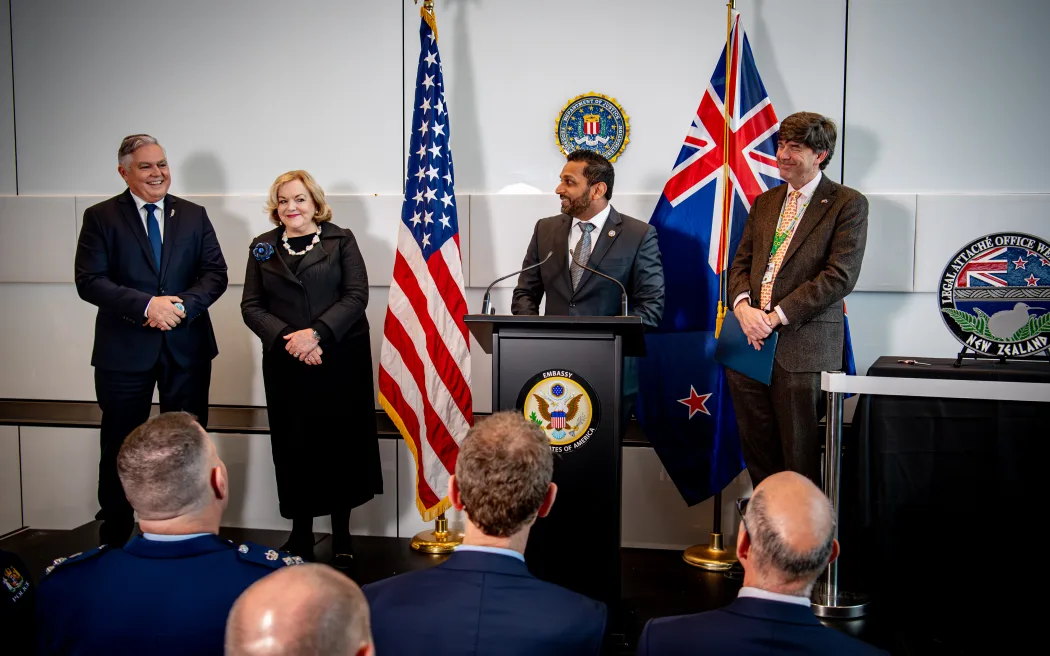
On 31 July 2025, the FBI officially opened its first standalone office in Aotearoa New Zealand, based in Wellington’s U.S. Embassy. For most of the mainstream media, this development was reported with a mixture of bureaucratic neutrality and mild curiosity. For politicians, it was framed as a logical step in enhancing cooperation on “transnational crime.” But for those of us grounded in anti-authoritarian, anti-imperialist traditions of resistance, the meaning is far clearer – this is a dangerous expansion of American imperial policing into the Pacific, an alarming deepening of New Zealand’s entanglement with the global surveillance state, and a stark reminder that in the eyes of empire, no land is truly sovereign.

This move is not about safety or justice but about extending the reach of capital and control through surveillance and soft occupation. The narratives of “cybercrime” and “child exploitation” are being used to justify foreign policing on Indigenous land, while drawing historical and contemporary connections to colonialism, Five Eyes hegemony, and capitalist control.

Policing Beyond Borders

The Federal Bureau of Investigation is, by legal definition, a domestic agency. It exists to enforce U.S. federal law on U.S. soil. Yet the FBI now operates over 60 Legal Attaché offices around the world, and the new Wellington branch has been upgraded to become one of them, tasked with responsibility not only for Aotearoa but also for Niue, Samoa, the Cook Islands, Tonga, and even Antarctica. This is a global policing project masquerading as international cooperation.

The FBI has been present in New Zealand since 2017, managed through its Canberra office. What has changed is that now, the FBI is no longer a guest, it is a tenant with its own office, its own staff, and its own extraterritorial power. FBI Director Kash Patel’s visit to New Zealand was not just administrative, it was ideological. At a press conference, he made clear that the new office was about “countering the influence of the Chinese Communist Party in the Indo-Pacific.” While New Zealand ministers such as Winston Peters and Judith Collins quickly distanced themselves from this overt geopolitical framing, the cat was already out of the bag. The FBI is not just here to stop online paedophiles or drug traffickers. It is here to enforce the strategic goals of the American empire.

The backlash was immediate. Beijing condemned the comments as provocative and destabilising. Thousands of Kiwis expressed their anger online. Some posted furious responses on social media. This is not a fringe reaction. It is the instinct of people who know, whether consciously or intuitively, that what is being done in their name is not for their protection but for their submission.

Five Eyes, Many Lies

To understand the danger of this moment, one must understand the Five Eyes. Formed as a post-war intelligence alliance between the United States, the United Kingdom, Canada, Australia, and New Zealand, the Five Eyes has become a sprawling surveillance machine. It is a central pillar of what Edward Snowden exposed as the modern panopticon, a world where the internet is weaponised to track, manipulate, and suppress populations in the name of “national security.”

In this context, the FBI’s expansion is not a bureaucratic upgrade, it is an insertion of another gear in the machine. It deepens the convergence of policing, intelligence, and military strategy across the Anglosphere. It makes Aotearoa even more complicit in the surveillance of its own people and of Pacific nations long exploited by Western colonial powers.

It also deepens our vulnerability. New Zealand has tried to maintain a strategic balance in its foreign relations – reliant on China as its biggest trading partner, aligned with the U.S. and UK through Five Eyes. This tightrope walk has always been fraught, but the FBI’s presence risks turning it into a fall. Patel’s anti-China statements not only escalated diplomatic tension, they forced New Zealand to pick a side in the increasingly dangerous theatre of U.S.- China competition.

And that choice is being made without democratic consent. The FBI was not invited by the people of Aotearoa. It was welcomed in by a political class eager to please its imperial friends while hiding behind the language of public safety.

The Carceral Smokescreen

The official justification for the FBI’s expansion rests on the pillars of “transnational crime” – cyber intrusions, child exploitation, organised crime, and drug trafficking. These are serious issues. But serious problems do not justify authoritarian solutions. What we are witnessing is the use of moral panic to expand surveillance infrastructure and carceral logic.

The FBI has a long and brutal history, not just of policing crime, but of repressing dissent. From the COINTELPRO operations that targeted civil rights leaders, Black radicals, and Indigenous activists, to the post-9/11 entrenchment of racial profiling and entrapment, the FBI has always served the preservation of white supremacist, capitalist, and imperial power.

Its arrival in Aotearoa is not neutral. It is not humanitarian. It is not apolitical. It is the expansion of a violent institution that answers to a violent empire.

Moreover, the notion that transnational crime is best tackled through foreign intelligence agencies ignores the real roots of harm. Why is organised crime flourishing? Because economic systems create desperation, exclusion, and inequality. Why are children exploited? Because patriarchal capitalism commodifies bodies and thrives on secrecy and silence. Why is cybercrime rampant? Because capitalism digitised the economy without care for consent, justice, or digital sovereignty.

To address these harms, we do not need more spies. We need more justice, real, transformative, community-rooted justice. The FBI is not the answer. It is part of the problem.

Pacific Subjugation, Again

That the FBI’s jurisdiction includes Niue, Tonga, Samoa, and the Cook Islands is not a coincidence, it is a strategy. The Pacific is being recolonised under the guise of security. With China increasing its presence in the region through economic partnerships and infrastructure projects, the U.S. is rushing to reassert dominance, not through aid or diplomacy, but through militarisation and surveillance.

The FBI in Wellington will act as a regional hub, not just for information gathering, but for soft coercion. These nations, many still grappling with the legacies of colonisation and neo-colonial governance, are now being brought into the orbit of American law enforcement without meaningful consent or reciprocal benefit.

This is not security. This is soft occupation. And it must be opposed.

The People Say No

One of the few hopeful elements in this bleak development has been the public response. Aotearoa is not asleep. Many see this for what it is, imperial overreach dressed in bureaucratic clothing. The protests, online and offline, speak to a population that still values sovereignty, autonomy, and transparency.

As anarcho-communists, we believe in people power. We believe that real security comes not from surveillance but from solidarity. We believe that no foreign agency should operate on these lands without the consent of the people who live here, and that even then, true justice is built from the ground up, not imposed from above.

The anger is growing, and it is righteous. But we must go beyond protest. We must organise.

A Call to Resistance

This moment is a call to action. The FBI’s presence is only the most visible layer of a deeper system that treats Aotearoa and the Pacific as pawns in a geopolitical chess game. To resist this system, we must connect the dots.

We must link the FBI to the NZ Police, to the SIS, to the Five Eyes, to the prison-industrial complex, to colonial land theft, to capitalism’s extraction and surveillance economies. We must say not just “No FBI”, but also “No prisons. No cops. No empires. No bosses.”

We must demand an end to foreign policing and a beginning to something else, something rooted in mana motuhake, tino rangatiratanga, and collective liberation.

The opening of an FBI office in Wellington is not an isolated event. It is a sign of a system expanding, a machine tightening its grip. But every expansion carries the seeds of its own opposition.

The future we want will not be built by diplomats or directors. It will be built by us, together, from below, in defiance of the states and empires that seek to divide and dominate us.

Let this be our line in the sand. We were not born to be watched. We were born to be free.

The Nerd Reich: Tech Billionaires and Authoritarianism

In the current stage of late capitalism, the figure of the tech billionaire has taken on an almost theological dimension. They are portrayed as visionaries, geniuses, men (almost always men) whose innovations will rescue us from ecological collapse, social fragmentation, and the limits of human biology itself. They promise immortality through AI, peace through crypto, and utopia through deregulated digital governance. But behind the thin veneer of progress and innovation lies a disturbing reality: these men are not building a better world, they are preparing to rule over its ruins.

In a recent episode of Decoder, journalist Gil Duran lays bare what he terms “The Nerd Reich” – a loosely connected but ideologically coherent group of tech billionaires and venture capitalists who are quietly waging war on democratic institutions, collective decision-making, and the very idea of egalitarianism. The interview, rich in insight and dripping with alarm, deserves to be read not merely as a critique of individual arrogance but as a glimpse into the structural death drive of capital. A system that, in its desperation to preserve elite control, is birthing a new form of digital feudalism.

For those of us who stand within the anarcho-communist tradition, this emerging constellation of authoritarian tech-libertarianism is neither surprising nor novel. It is the logical conclusion of a society where wealth is treated as wisdom, ownership as virtue, and control over digital infrastructure as a divine right. What Duran calls “The Nerd Reich,” we might more precisely name techno-neofascism, a ruling class project to resurrect hierarchical domination in sleek black turtlenecks and smart contracts.

From Libertarianism to Autocracy – The Dark Enlightenment Arrives

At the intellectual centre of this movement is a web of reactionary thought cloaked in technological jargon. Duran highlights the influence of Curtis Yarvin (also known by his blog pseudonym “Mencius Moldbug”), a former software engineer turned political philosopher of the so-called “Dark Enlightenment”. Yarvin openly advocates for the dismantling of democracy and its replacement with a kind of “CEO monarchy,” in which a single, unaccountable ruler efficiently governs a polity as if it were a startup.

It is difficult to overstate how grotesque this vision is. Yarvin’s contempt for the “unproductive, which often maps onto the disabled, the racialised, the poor, recalls the most violent projects of eugenics and colonial domination. He has casually proposed turning these people into biodiesel or locking them into VR environments to be managed as livestock. This is not satire. It is class war waged as fantasy, and it is no accident that such ideas find resonance among the likes of Peter Thiel, Marc Andreessen, Elon Musk, and Sam Altman.

These men are not merely building apps and platforms. They are attempting to build states, or more accurately, to replace states with corporate governance models. Whether it is Thiel bankrolling far-right political candidates, Musk using Twitter (now X) to shape political discourse, or Andreessen pouring millions into projects that aim to “exit” from democratic society entirely, the trajectory is clear. This is not an eccentric ideological fringe. It is the direction of capitalist power itself in an era where traditional mechanisms of state legitimacy are in crisis.

The Rise of the Network State – Capital’s Final Utopia

One of the most chilling developments in this landscape is the increasing popularity of the “network state” concept—a kind of digital micronation built on blockchain governance, bypassing traditional regulatory frameworks. Popularised by Balaji Srinivasan, the network state is presented as a liberatory alternative to the inefficiencies of the nation-state. In reality, it is the digital equivalent of a walled estate, where capital rules without interference and where citizenship is reduced to a subscription model.

In Honduras, Prospera – a private charter city backed by U.S. tech investors – has already begun implementing this model. In Greenland, a startup called Praxis aims to build a city for “like-minded people” (read rich libertarians) with its own governance, currency, and laws. Closer to home, Duran recounts how a major Silicon Valley firm attempted to declare a “national security emergency” to bypass local environmental laws and construct a private city on an old military base in California.

This is the logical endpoint of a capitalist system that no longer needs mass participation. Having outsourced production, financialised labour, and automated much of its value extraction, capital now seeks to secede from humanity itself. The network state is not a fantasy of freedom. It is a blueprint for a neo-feudal dystopia, in which the population is divided into those who own code and those who are owned by it.

The Alliance with Fascism: MAGA, Musk, and Emergency Powers

In case this seems abstract, Duran draws attention to the very real and immediate political alliances forming between the tech elite and authoritarian political movements. Musk’s open alignment with MAGA discourse, Thiel’s financing of Trumpist candidates, and the broader silence of Silicon Valley in the face of growing far-right movements signal a dangerous convergence.

Duran warns that should Trump or another autocratic figure seize power again in the United States, many tech leaders would not resist. They would likely collaborate, seeing in the rollback of democratic norms an opportunity to fast-track their vision of corporate governance. In this alliance, executive emergency powers become tools not for managing crisis, but for realising dreams of total control.

This is not merely opportunism. It is a marriage of convenience between two factions of the ruling class – the decaying fossil of traditional nationalism, and the sleek, data-driven autocracy of the digital elite. Together, they form a hybrid authoritarianism that is both technologically advanced and ideologically regressive – a kind of cybernetic fascism in which dissent is algorithmically filtered and obedience is gamified.

The Technocratic Death Cult: Why the Billionaires Hate Democracy

Why do these men hate democracy? The answer, as always, is that democracy limits their power. Even in its degraded liberal form, democratic governance imposes taxes, regulations, environmental protections, and, worst of all, popular demands for redistribution. For men who have grown used to absolute control within their companies, the idea that a waitress in Des Moines should have equal say in shaping the future as a venture capitalist in Menlo Park is offensive.

But more fundamentally, they see history not as a collective process but as a canvas for their will. In this, they echo the fascist contempt for mass politics and the belief in a natural hierarchy of men. Their preferred future is not a stateless society, but a society in which they are the state. Where their platforms mediate all relationships, their currencies govern all transactions, and their ideologies shape all narratives.

This is what Duran rightly identifies as the “Nerd Reich.” It is a ruling class fantasy of digital totalitarianism, cloaked in the language of innovation and disruption, but animated by the same lust for domination that fuelled colonialism, fascism, and genocide. It is a future in which your landlord is a DAO, your cop is an AI drone, and your government is a startup. And it must be abolished before it is built.

Anarcho-Communist Counterpower: Beyond Resistance, Toward Reconstruction

For Duran, the answer lies in awareness, media exposure, and restoring faith in democratic institutions. While these are necessary steps, they are not sufficient. The tech elite cannot be shamed into submission. They cannot be voted out or regulated into decency. Their power flows not from popularity but from private ownership of infrastructure, and that power must be seized, dismantled, and replaced.

Anarcho-communism offers not only a critique but a program of reconstruction. Where the Nerd Reich offers techno-feudalism, we propose technological mutual aid – open-source tools, federated platforms, worker-owned co-ops, autonomous zones of care and resistance. Where they build network states to exclude, we want digital commons to include. Where they see in automation a way to manage populations, we see in it the possibility of reducing alienated labour and freeing people to pursue lives of dignity and joy.

But we must act quickly. Every year that passes sees deeper entrenchment of platform monopolies, more widespread deployment of surveillance tools, and more ideological capture of the public imagination. We must not only fight back, but we must build the world we want in the cracks of the one they are trying to control.

No Tech Lords, No Masters

Gil Duran’s analysis is essential, urgent, and courageous. But we must take it further. The Nerd Reich is not simply a threat to democracy. It is a threat to life itself. In its attempt to render society programmable, it reduces human beings to data points, social relations to transaction costs, and the Earth to an input-output system. It is, in short, capital in its purest, most death-driven form.

Anarcho-communists must not only expose this horror. It must offer an escape from it, a refusal, a new direction. We must abolish the Nerd Reich not because it is a failed vision, but because it is a successful nightmare. Against their future of domination, we offer a future of solidarity. Against their hierarchies, we offer horizontal care. Against their algorithmic fascism, we offer collective freedom.

We don’t want better tech billionaires.

We want no billionaires at all.