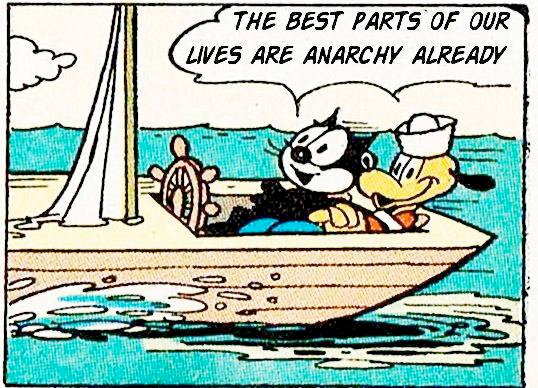
For most people, the word anarchy conjures chaos. Burning cars, smashed windows, shouting crowds, the collapse of all restraint. It is a word carefully trained to frighten. Politicians invoke it as a threat, newspapers as a warning, and police as a justification. Anarchy, we are told, is what happens when order disappears.
But we are making a simpler and more unsettling claim: anarchy is not the absence of order, but the absence of rulers. And far from being rare, it is woven through everyday life in Aotearoa New Zealand.
This is not about anarchism as an ideology, a movement, or a future revolution. We are not arguing that everyone should call themselves an anarchist, nor do we offer a blueprint for how society ought to be reorganised. Instead, we offer something quieter and more subversive. We look closely at how people already live, care, work, raise children, resolve conflict, and survive, often without asking permission, without formal authority, and without the state playing a central role at all. In other words, we argue that anarchism is a lived practice, not a doctrine.
The inspiration for this approach comes from the British writer and thinker Colin Ward, whose work Anarchy in Action refused the dramatic gestures of revolutionary politics and instead turned attention to the mundane. Ward was interested in housing co-operatives, playgrounds, allotment gardens, informal education, and the ways ordinary people organise their lives when institutions fail or intrude too heavily. His argument was disarmingly simple – if you want to understand anarchism, do not look to manifestos or barricades, look at everyday life.
Aotearoa offers a particularly clear view of this everyday anarchism. Not because it is uniquely radical or harmonious, but because the failures and violences of the state are so visible, and because people have had to rely on one another in spite of it. Mutual aid after floods, whānau stepping in where welfare systems fall short, informal housing arrangements that keep people off the streets, cash work and favours that bypass wage discipline, conflict resolved quietly without police or courts, these are not marginal or exceptional activities. They are normal. They are how life continues and yet they are rarely named as political.
One of the most powerful myths of modern society is that order comes from above. We are taught that without rules imposed by the state, without police, bureaucrats, managers, and experts, society would descend into violence and disorder. Cooperation is treated as fragile, conditional, and in need of constant supervision. When people help one another, it is framed as charity or kindness, never as a form of social organisation in its own right.
This myth serves a purpose. It legitimises authority while obscuring the fact that most of what keeps society functioning happens below the level of law and policy. The state depends heavily on unpaid care, informal cooperation, and community resilience, even as it claims credit for stability and threatens punishment for deviation. It is quick to intervene when people step outside permitted channels, but slow, or absent, when real support is needed.
Nowhere is this contradiction clearer than in moments of crisis. After earthquakes, floods, and fires in Aotearoa, it is neighbours, whānau, and community groups who act first. Food is shared, shelter organised, children looked after, elders checked on. These responses are not centrally planned. They emerge from relationships, trust, and local knowledge. The state arrives later, often to regulate, document, or withdraw support once the immediate danger has passed.
This is not an argument that the state does nothing, or that it is always irrelevant. It is an argument that social life is not produced by authority, even when authority claims ownership over it. The order we rely on most is informal, relational, and largely invisible to official accounts.
In Aotearoa, these dynamics are inseparable from colonisation. The settler state did not arrive to create order from chaos. It arrived to impose its own forms of order on societies that were already organised, often in ways that conflicted with European notions of property, hierarchy, and law. Māori social organisation, grounded in whānau, hapū, tikanga, and collective responsibility, represented a profound challenge to the authority of the colonial state. Land tenure without individual ownership, justice without prisons, governance without a sovereign rule, these were not abstract alternatives, but lived realities.
Colonisation sought to dismantle these systems, replacing them with wage labour, private property, policing, and bureaucratic control. Yet despite generations of violence, dispossession, and assimilation, non-state forms of social organisation persist. They persist not as relics of a pre-colonial past, but as adaptive, living practices shaped by ongoing resistance and survival.
It is important to be clear here. We are not claiming that Māori society is “anarchist” in any simple or ideological sense. Such a claim would be both inaccurate and disrespectful. What it does argue is that Māori social life exposes the limits and contradictions of the state by demonstrating that authority is not the only way to organise society, and that relational, non-statist forms of order are not only possible but enduring.
These practices are not confined to Māori communities. Working-class life across Aotearoa is full of informal systems that make survival possible in the face of rising rents, precarious work, and shrinking public services. People share childcare, tools, transport, and knowledge. They look after one another’s kids, cover shifts, lend money without contracts, and find ways around rules that would otherwise leave them stuck. Much of this activity exists in a legal grey area, tolerated when it is convenient and criminalised when it becomes too visible.
What links these practices is not ideology, but necessity. People do not organise this way because they have read anarchist theory. They do it because they have to, and because cooperation works better than competition when resources are scarce and institutions are hostile.
Anarchism, in this sense, is not a destination but a description. It describes what happens when people take responsibility for their own lives and for one another, rather than deferring to distant authorities. It describes social order that emerges from below, shaped by context, relationships, and mutual obligation. It is messy, imperfect, and often fragile, but so is life itself.
This perspective challenges both defenders and critics of the state. Against those who insist that authority is the source of all order, it offers abundant evidence to the contrary. Against those who imagine anarchism only as a future rupture or total collapse, it insists that much of what they desire already exists, quietly, in the present.
We are not trying to romanticise these practices. Informal systems can reproduce inequality, exclusion, and harm. They can fail, break down, or be overwhelmed. Nor do we deny the reality of violence, abuse, or exploitation within communities. What we do though is refuse the assumption that the state is the natural or necessary solution to these problems.
Instead, we ask a different set of questions. How do people actually manage harm when they do not call the police? How do families and communities regulate behaviour without formal authority? What happens when responsibility is collective rather than delegated upward? And why are these forms of organisation so often ignored, dismissed, or actively undermined?
These questions matter now more than ever. As faith in political institutions erodes, as economic inequality deepens, and as crises multiply, the gap between official systems and lived reality grows wider. Governments promise security while delivering precarity. Bureaucracies expand even as their capacity to care diminishes. In this context, the everyday anarchism of mutual aid and informal cooperation is not a fringe phenomenon, it is a lifeline.
We invite you to look differently at your own life and the lives around you. To notice the ways order is created without orders being given. To recognise that much of what feels natural or inevitable is in fact the result of collective effort without command. And to consider what might change if we took these practices seriously, not as temporary stopgaps, but as the foundations of social life.
We are not demanding agreement, but we do ask for attention. Because once you start to see anarchism in action, it becomes difficult to unsee it.
image c/o theslowburningfuse.wordpress.com
One thought on “Anarchy Is Not What You Think It Is”